According to the Ministry of Education and Training, localities have recently conducted comprehensive reviews of their school networks, prioritizing the consolidation of satellite school sites alongside small-scale, fragmented, or substandard facilities.
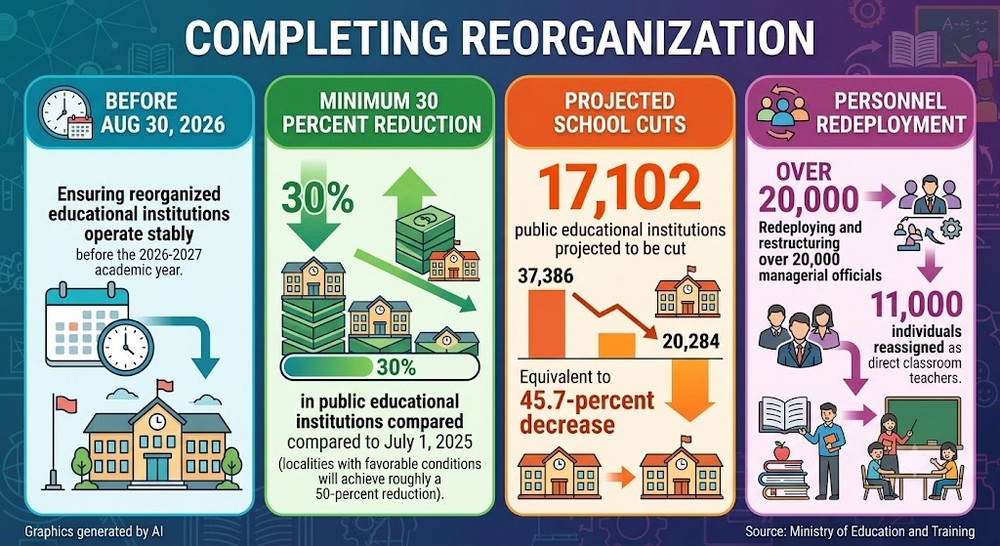
By the end of 2025, authorities in all 34 provinces and cities had approved reorganization plans, thereby eliminating the administrative units of 457 preschools and 914 general education institutions, along with 709 managerial positions nationwide. This consolidation operates on the principle of “reducing to increase”, where cutting administrative heads aims to bolster the frontline teaching workforce.
Right now, localities are racing against the clock to stay on schedule.
For example, in Hanoi, Director Nguyen Van Hien of the municipal Department of Education and Training reported that by August 10, 2026, the capital expects to complete the reorganization of all general education institutions, aiming to slash school administrative units by roughly 50 percent. Notably, 124 public high schools will remain unchanged; instead of merging them, the city will focus on upgrading physical infrastructure to expand enrollment capacity.
Meanwhile, as informed by the Thanh Hoa Province Department of Education and Training, the province aims to reduce public school administrative heads by at least 30 percent, while localities with favorable conditions are striving for a 50 percent cut. Once completed, the province expects to eliminate the administrative heads of 742 schools and continuing education institutions.
This rollout must go hand-in-hand with thorough preparations for the 2026-2027 academic year. For Thanh Hoa Provincial Party Secretary Le Duc Thai, the deadline is non-negotiable. He stated that the restructuring must conclude before the new school year begins, ensuring it doesn’t disrupt teaching and learning or infringe upon the legitimate rights of teachers and students.
In Bac Ninh Province, out of 1,140 educational institutions, the post-reorganization network will retain approximately 584 schools, a reduction of 556 administrative heads, or 48.77 percent. Similarly, Dien Bien Province plans to cut the administrative heads of 176 public schools, dropping from 466 to 290 units, which represents a 37.8-percent decrease.
On August 6, the Dong Nai People’s Committee issued a directive governing personnel placement following public school restructuring. Accordingly, authorities mandated that consolidation must trim administrative units while reinforcing frontline teaching personnel. Each school will retain one principal and several vice principals, with one deputy managing each campus branch.
Following this sweeping shake-up, Dong Nai expects to slash the administrative heads of its public educational institutions from 1,017 to 587, achieving a remarkable 42.28 percent reduction.
Meanwhile, Da Nang has also submitted a proposal to reorganize its school system under central directives. Following fundamental approval by the municipal Party Standing Committee, the Department of Education and Training will collaborate with agencies to get the ball rolling once signed off.
For Director Le Thi Bich Thuan, the situation remains fluid. She explained that local reviews are still underway, meaning an official plan can’t be announced yet and authorities can’t evaluate the precise impact on the upcoming school year.
Meanwhile, in Gia Lai Province, Vice Chairman Lam Hai Giang of its People’s Committee reported that authorities have promulgated a sweeping reorganization scheme covering preschools, general education schools, and vocational centers.
Following this merging, the province’s preschool and general education systems will shrink from 1,267 to 699 schools, trimming 568 institutions for a 44.83 percent reduction. Targeted class sizes are set at 36 students per primary class and 48 students per secondary class. The shake-up will eliminate 1,293 classes and 2,066 teaching positions, while assigning one principal and vice principal per consolidated campus. Each former independent school site or branch will have one vice principal in charge.
In Quang Ngai Province, local officials are urgently combining small-scale preschools and joining adjacent primary schools. Each ward or commune will maintain one preschool, primary school, and middle school, while smaller localities establish multi-level institutions across rural districts.
During this ongoing process, authorities can’t overlook travel distances, commuting safety, transportation costs, and boarding capabilities. In the end, priority must be given to safeguarding learning conditions for vulnerable preschoolers, disabled children, and students from impoverished or remote mountainous island areas.
Localities are currently making concerted efforts to reorganize educational institutions, yet the implementation process is still fraught with confusion.
According to Director Nguyen Tien Dung of the Ninh Binh Province Department of Education and Training, the province previously eliminated 152 school administrative heads and is now striving for a reduction exceeding 50 percent. “We urge the Ministry of Education and Training to promptly issue specific guidelines on reassigning managerial personnel after consolidation, as local authorities are facing severe bottlenecks,” the Director remarked.
He pointed out that while a principal could be reassigned to head a satellite campus and vice principals could shift to roles such as professional group leaders or teachers, there’s no formal legal guidance to authorize this. Furthermore, administrative staff such as accountants, cashiers, and archivists are also in significant surplus.
Director Nguyen Van Khoa of the Nghe An Department of Education and Training proposed that the ministry quickly stipulate the allowable number of vice principals for merged schools, given that the August 30 completion deadline is fast approaching.
Touching on another operational hurdle, Deputy Director Do Minh Tam of the Lao Cai Province Department of Education and Training, suggested establishing regulations on the number of satellite school sites, noting that an excessive number of campuses would create management nightmares.
Sharing this perspective, Director Ta Viet Hung of the Bac Ninh Province Department of Education and Training argued that authorities must clearly define what constitutes a satellite site, a standalone branch, and a campus facility.
Therefore, to achieve the objective of cutting school administrative heads, especially regarding personnel matters, the Ministry of Education and Training needs to issue clear, actionable guidance to localities before the new school year arrives.
In a recent directive on school reorganization, Prime Minister Le Minh Hung instructed authorities to develop specific personnel placement schemes and resolve benefit policies for surplus staff following consolidation. Accordingly, officials should consider reassigning them as commune-level education officers, transferring them to teaching positions suited to their competencies and desires, or facilitating early retirement packages.