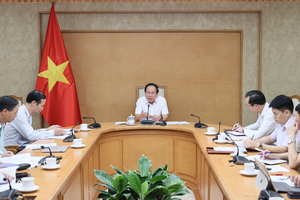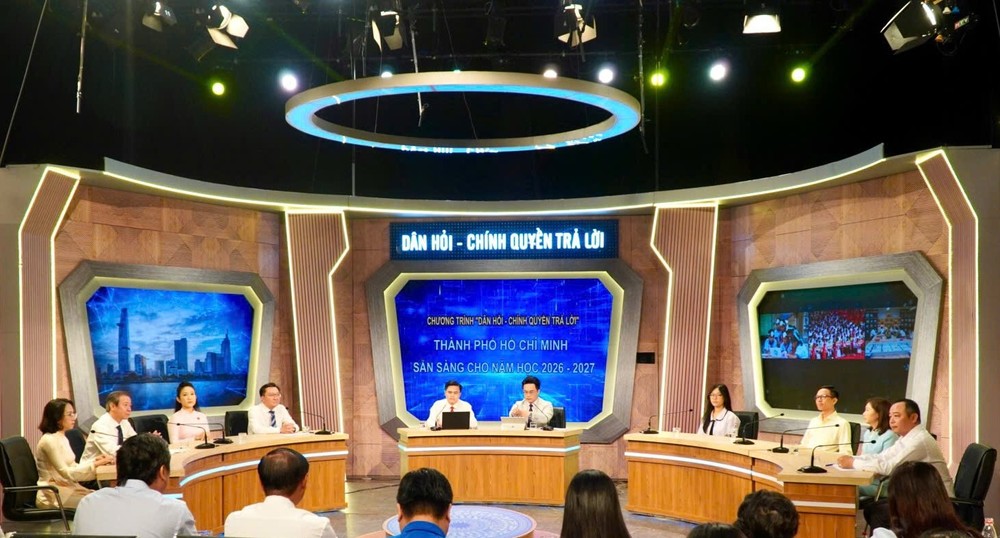
On August 9, the Standing Committee of the Ho Chi Minh City People’s Council, in coordination with Ho Chi Minh City Radio and Television (HTV), organized the August 2026 edition of the “People Ask – Government Answers” program under the theme “Ho Chi Minh City – Ready for the 2026-2027 School Year.”
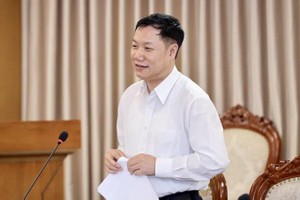
Responding to voters’ concerns, Deputy Director of the Ho Chi Minh City Department of Education and Training, Nguyen Bao Quoc, said the education sector is expected to have more than 2.62 million students, nearly 79,600 classes, and over 126,200 teachers in the 2026-2027 school year.
The city has allocated more than VND274 billion (US$10.5 million) to repair and upgrade facilities, purchase equipment, and improve and supplement operational conditions for newly established schools.
Under the “150-day campaign to complete 1,000 classrooms for the 2026-2027 academic year,” 24 of 53 projects have so far been completed, putting 364 new classrooms into use.
Regarding the organization of two-session-a-day schooling, the city has set a target of implementing the model at all general education institutions from the 2027-2028 school year. The Ho Chi Minh City Department of Education and Training is focusing on a range of solutions and has pledged to ensure that 100 percent of school-age children have access to schooling.
In areas where conditions are not yet sufficient to organize two sessions a day, schools will continue to fully implement the core curriculum while arranging appropriate supplementary educational activities.
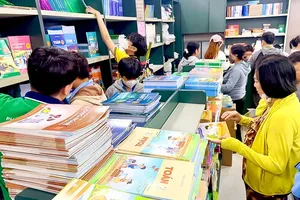
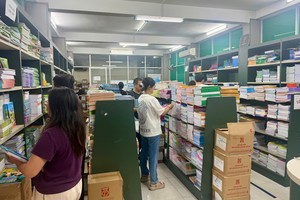
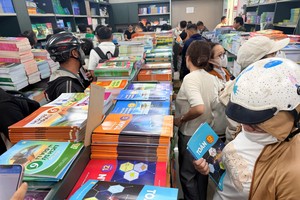
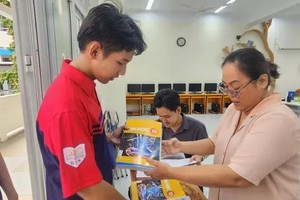
The city will also provide textbooks to 100 percent of disadvantaged students and all students who register for the support program, with a total budget of about VND288 billion (US$11,000).
Regarding student healthcare, Deputy Director of the Ho Chi Minh City Department of Health, Nguyen Van Vinh Chau, said Vietnamese students actually residing in the city, either as permanent or temporary residents, who are verified through VNeID, are eligible for free periodic health check-ups.
The check-ups will cover physical development, nutrition, and mental health, while also screening for risk factors and common medical conditions. The results will be updated on the Community Health Management Platform and integrated with students’ electronic health records.
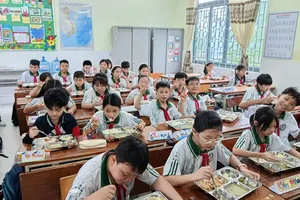
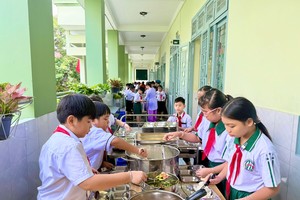
For school-based boarding meals, Assoc. Prof. Dr. Pham Khanh Phong Lan, Director of the Ho Chi Minh City Food Safety Department, said the authority had provided specialized training for more than 4,200 food preparation staff and all principals of educational institutions across the city.
Schools are required to publicly disclose their lists of food suppliers so that parents can participate in monitoring. Catering providers must demonstrate the origin of ingredients, while schools must conduct three-step food inspection procedures and retain food samples daily. The Ho Chi Minh City Food Safety Authority will review and inspect school kitchens, canteens, and catering providers and strictly handle any violations.
Ho Chi Minh City currently has around 14,300 street food establishments, which are managed by local authorities under a decentralized system. The Ho Chi Minh City Food Safety Department will coordinate with local authorities to strengthen regular and surprise inspections, while taking decisive action against unregulated food carts and makeshift food stalls that fail to meet hygiene requirements around schools.
Relevant agencies will also work with schools to educate students about avoiding food sold informally or from unknown sources.
The department maintains rapid-response food safety management teams in different areas and receives direct reports through the hotline at 02839301714. As soon as a report is received from residents or schools, the department will coordinate with local authorities to inspect and verify the case, collect samples, and strictly handle violations in accordance with regulations, Assoc. Prof. Dr. Pham Khanh Phong Lan said.