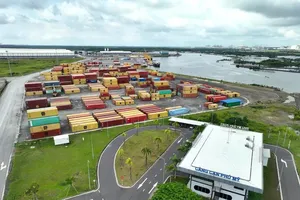
Gemalink Port is expected to reach a total capacity of more than 3 million TEUs per year, with total investment exceeding VND8 trillion (US$304 million). The project is designed to meet the rising demand for import-export cargo and to enhance the capacity to accommodate large container vessels within the Cai Mep–Thi Vai deep-water port complex.
The second phase of the Gemalink project marks a key step in Gemadept’s development strategy for 2026–2030, which focuses on three core pillars, including port operations, an integrated port–logistics ecosystem, and inland waterway and maritime transport.
Once completed, Gemalink Port is expected to achieve a total capacity of more than 3 million TEUs per year, with total investment exceeding VND8 trillion.
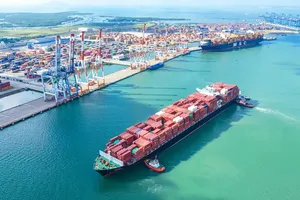
After five years of operation (2021–2025), Gemalink Port has handled 2,018 vessel calls, nearly 70 percent of which were ships with capacities ranging from 160,000 to over 230,000 tons.
Total cargo throughput reached 6.5 million TEUs, with average annual growth maintained at a double-digit rate. The port is among a limited number worldwide capable of accommodating ultra-large container vessels of up to 250,000 tons, equivalent to approximately 24,000 TEUs.
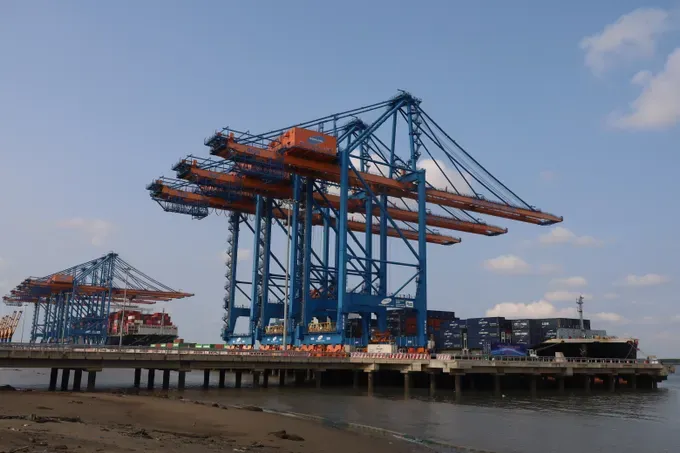
Notably, Phase 2 of Gemalink is being developed under a “Smart and Green Port” model. Core cargo-handling equipment, including electric ship-to-shore (E-STS) and electric rubber-tired gantry (E-RTG) cranes, will be fully powered by electricity and integrated with advanced technologies to optimize operations, reduce emissions, and meet increasingly stringent ESG standards set by global shipping lines.
As a result, the Cai Mep–Thi Vai port cluster, including Gemalink, has maintained its position among the world’s top 10 most efficient container ports, according to assessments by the World Bank.
Phase 2 of Gemalink Port is expected to be completed and become operational in the fourth quarter of 2027.