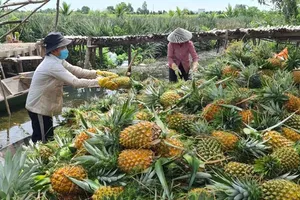
In many suburban communes of Ho Chi Minh City, residents remain closely tied to farming and gardening. However, unlike in the past, the adoption of new techniques and technologies has enabled many households to earn billions of dong annually.
Billion-Vietnamese-dong farming incomes
For farmers, finding agricultural models that are both adaptive and high in value has long been a challenge. Yet the Son Ha orchid garden owned by Luu Cam Hung in Hung Long Commune generates billions of Vietnamese dong in revenue each year. Covering 12,000 square meters, the garden specializes in Dendro orchids, a variety prized in the market for its diverse colors.
Although Dendro orchids are relatively easy to grow, achieving healthy plants with large, long-lasting blooms requires solid technical knowledge. The most critical stage is initial seedling treatment. Newly imported plants must not be planted immediately; instead, they are left for several days to allow wounds to dry. They are then carefully treated with fungicides to prevent soft rot. Proper fertilization is also essential, with balanced use of nutrients and organic fertilizers to produce glossy leaves, large flowers, and thick petals.
The orchid garden owner revealed that the garden currently maintains more than 200,000 orchid plants grown on a well-ventilated, roofed trellis system, generating around VND6 billion (US$227,869) in annual revenue.
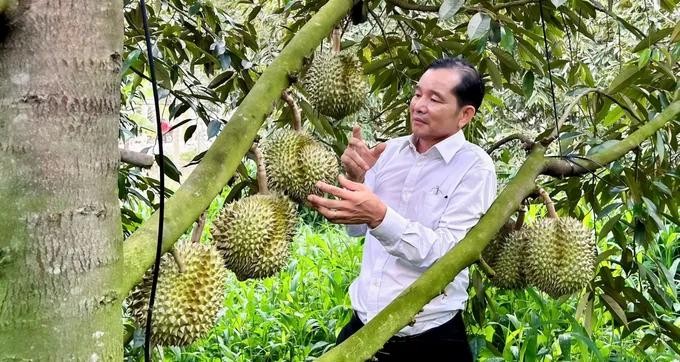
Meanwhile, Dinh Ngoc Khuong began cultivating durian in 2018 using a distinctive approach. One notable feature is the thick layer of green grass covering the ground beneath the trees. Rather than cutting or spraying herbicides, he allows the grass to grow naturally.
By using fish-based fertilizer combined with a well-designed automated irrigation and spraying system, water and nutrients are distributed evenly across the orchard. Pipes are installed above the tree canopy, and with a single command, the entire system operates efficiently, reducing disease risks. The orchard has now entered its harvesting phase, and in favorable years, Khuong earns around VND5 billion.
In nearby Phuoc Thanh Commune, Dang Van Xuan is also a well-known durian grower. Managing a large cultivation area, he has invested in an automated irrigation system to reduce labor and maintain soil moisture. With increasingly unpredictable weather, controlling water supply and irrigation methods has become crucial.
Fertilization is adjusted according to each stage of plant growth, with irrigation systems integrated to deliver precise amounts of water and nutrients to each tree. Many labor-intensive tasks that were once done manually are now supported by machinery, helping to reduce physical strain while improving productivity.
Supporting farmers in adopting technology
Notably, these successful models have been shared widely within the community. Many local farmers visit to learn from Khuong, who provides detailed guidance on composting fish fertilizer, maintaining ground cover, and operating irrigation systems. Chairman Vu Hai Ly of the Phu Giao Commune People’s Committee said such models demonstrate the effectiveness of applying science and technology in agriculture.
Local authorities plan to continue supporting farmers in accessing modern technologies while encouraging the development of organic, safe, and market-linked production models. This is seen as a key pathway to increasing agricultural value and ensuring sustainable development.
Meanwhile, Tran Tuan Anh, an official from the Economic Division of the Phuoc Thanh Commune People’s Committee, described Dang Van Xuan’s farming model as a clear example of knowledge-based agriculture at the local level. “What stands out is not only the economic efficiency but also the motivation it creates for farmers to rethink and innovate. The more techniques farmers apply, the higher the value of their produce,” he said.