Over this period, Vietnam’s national strength, development capacity, international standing, and global credibility have continued to grow steadily.
Held from January 19 to 23, 2026, the 14th National Congress of the Communist Party of Vietnam unanimously adopted the Congress Resolution and elected members to the 14th Party Central Committee meeting rigorous standards of integrity, ethics, credibility, competence, and professional capacity to shoulder major responsibilities before the Party and the people in the new term, guiding the nation toward strength and prosperity in a new era.
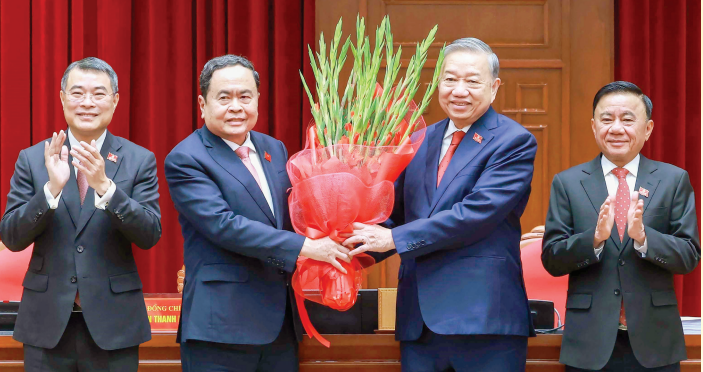
At the Congress, Mr. To Lam was re-elected as General Secretary of the Central Committee of the Communist Party of Vietnam.
The 14th National Congress also set out a series of landmark policy decisions described as a “launching pad” for achieving the country’s two centennial strategic goals: by 2030, to become a developing nation with modern industry and upper-middle-income status; and by 2045, to realize the vision of becoming a developed, high-income country—peaceful, independent, democratic, strong, prosperous, civilized, and happy—steadily advancing toward socialism.
The development goals for the 2026–2030 period and the vision toward 2045 represent a major national aspiration, one that requires every step forward to be firmly grounded and carefully executed.
To realize these goals in reality, the Party has identified 12 major orientations, six key tasks, and three strategic breakthroughs. The action program has been distilled into eight core priorities, guided by the principle: Right choices – Swift implementation – Thorough execution – Results-based measurement.
In his closing address at the 14th National Congress, Party General Secretary To Lam underscored that the spirit of renewal embodies a great aspiration and steady, era-defining steps forward. Without innovation and reform, there can be no breakthroughs, no competitiveness, and no development. He stressed the need to continue renewing thinking, development models, and growth strategies, as well as implementation methods, so that sound policies are translated into tangible outcomes in real life.
The Party General Secretary continues to underscore the guiding principle that “the people are the foundation,” firmly maintaining and strengthening the inseparable bond between the Party and the people, and taking public happiness and satisfaction as the ultimate measure of the effectiveness of Party organizations and the entire political system. In particular, priority must be given to implementing the Resolution of the 14th National Party Congress in an action-oriented manner, ensuring tangible results and decisively overcoming the long-standing weakness in execution. This requires a decisive shift from correct awareness to effective implementation, from high determination to clearly demonstrable outcomes, and from leadership and administration alone to a combined approach that includes inspection, supervision, and accountability. The results of implementing the Resolution must be regarded as the benchmark of the Party’s leadership capacity and its credibility in the eyes of the people.
That resolute spirit of action has already been matched by compelling evidence. As the Party General Secretary emphasized in remarks at an international press conference held immediately after the Congress, the early translation of the Resolution into real-life practice represents a new and notable feature of this Congress. Summarizing the outcomes of the 14th National Party Congress, the General Secretary noted that while many “keywords” could be associated with its results, four verbs stood out in particular: “act,” “implement,” “deploy,” and “execute.” These were consistently paired with adverbs such as “forcefully,” “decisively,” “with breakthroughs,” “effectively,” and “accurately.” Taken together, these keywords converge on a single shared meaning—work in action—capturing the essence of the principle of “less talk, more action.”
According to the Party General Secretary, all documents submitted to the 14th National Party Congress place a strong emphasis on designing concrete action programs, along with mechanisms for inspection, supervision, and performance evaluation. Data, measurable indicators, and public feedback are treated as critical inputs for policy adjustment and for determining accountability.
On January 23, 2026, the 14th-term Politburo issued its first directive on public communication and the implementation of the Congress Resolution. Under this directive, every Party organization, sector, and level of administration is required to formulate specific action plans, clearly assign responsibility for implementation, define timelines and roadmaps, and deliver measurable outcomes. Earlier, speaking on behalf of the 14th-term Party Central Committee, General Secretary To Lam affirmed that the Committee would operate with the highest standard of exemplary leadership, matching words with deeds, following through to completion, and acting swiftly, accurately, and effectively in all work for the people.
He stressed that the effectiveness of public service would serve as the benchmark for the leadership capacity, credibility, and honor of each member of the 14th-term Party Central Committee and reaffirmed the determination to lead the successful implementation of the Resolution of the 14th National Party Congress, steering the country toward strength and prosperity in a new era.
With regard to cadre work, the guiding principle is to “place the right people in the right positions, assign the right tasks, evaluate performance by concrete outputs, and measure effectiveness by public trust.” Priority is given to individuals of integrity and competence, those who dare to act, know how to act, and deliver results, while systematically removing from the system opportunists, those who evade responsibility, and those whose words are not matched by action.
With the successful conclusion of the 14th National Congress of the Party, the real work of implementing the Resolution has truly begun. From the very first days of the new term, the spirit of “say it and do it; do it immediately, do it right, do it decisively, see it through, and deliver results” has been taking root across ministries, sectors, localities, and institutions and among each cadre, civil servant, and citizen.
In his closing address to the Congress, Party General Secretary To Lam underscored this message, calling on every agency, unit, organization, and individual to begin with the most concrete tasks, contributing each day to a more developed country, a more prosperous and happier people, and a stronger Vietnam, standing shoulder to shoulder with the world’s great powers, as President Ho Chi Minh so earnestly envisioned.
Key development goals and targets for the 2026–2030 period
Vietnam aims to achieve an average annual GDP growth rate of 10 percent or higher during the 2026–2030 period. By 2030, GDP per capita is projected to reach approximately US$8,500. The manufacturing and processing sector is expected to account for around 28 percent of GDP, while the digital economy is targeted to contribute roughly 30 percent of GDP.
Labor productivity is projected to grow at an average rate of about 8.5 percent per year. Gross capital formation is expected to reach 35–36 percent of GDP, with total social investment averaging around 40 percent of GDP over the five-year period. The share of the workforce with formal training qualifications or certificates is targeted at 35–40 percent. Vietnam also aspires to rank among the top 40 countries globally on the Happiness Index.