Prof Dr Tran Tho Dat, member of the National Financial and Monetary Policy Advisory Council, stated in an interview by SGGP Newspaper that the informal economic sector constitutes a significant portion of Vietnam’s economy.
Particularly, in 2023, the country had approximately 21 million informal workers, accounting for 55 percent of the non-agricultural labor force. This is a massive and diverse force present in almost all sectors: services, small-scale manufacturing, retail, transport, F&B, e-commerce, and household businesses.
Domestic and international studies estimate that this sector contributes between 13.5-25 percent of GDP. This indicates that the informal sector is a genuine component of the economy, playing a crucial role in consumption, social stability, and job creation for vulnerable groups.
While vast and diverse, the lack of official registration poses difficulties for management, statistics, and support implementation, particularly regarding tax policy. The issue is that for a long time, this informal sector hasn’t been viewed as a component needing development, but have focused primarily on management aspects.
In this context, the change in tax policy has attracted significant attention from the parties concerned. Obviously, it directly impacts millions of household businesses, many of which have reached the taxable threshold despite having low real income. For instance, a household with revenue of VND500 million (US$19,000) per year might only net a few million VND (around $190) in profit per month.
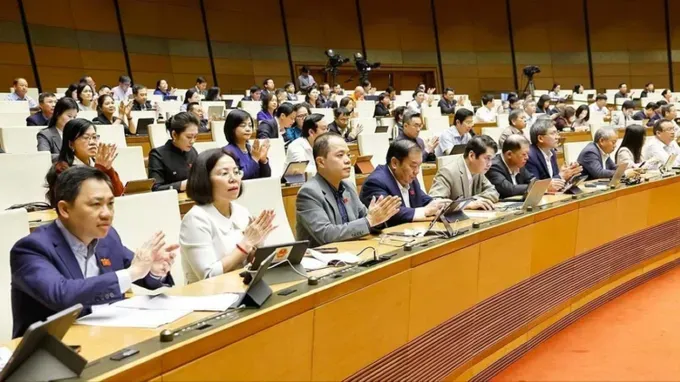
Many National Assembly delegates and experts view this taxable threshold raised to VND500 million as a positive adjustment that is more aligned with the reality of small businesses. It helps distinguish the subsistence group from the commercial business group more clearly. This significantly reduces the anxiety of small-revenue households operating to maintain their livelihoods.
However, there’s a larger issue to address as the tax threshold is merely a parameter. If policy thinking revolves solely around “how much can be collected,” the informal sector cannot develop according to its true nature.
The deeper core issue is a clear definition of the approach to the informal economic sector: seeing them as subjects to be strictly managed or a force to be supported and developed.
For many years, the informal sector seems to have been viewed as a “difficult-to-manage area” or an “untapped tax source.” Such a view reflects only one aspect of the economic picture.
Household businesses do not operate in the informal sector solely to avoid taxes. International research shows that 41 percent of informal business owners say they stay outside the system due to a lack of state support, and 35 percent due to the burden of procedures. These figures suggest they operate informally not to evade obligations, but because informal activity is a consequence of a lack of support for formalization.
International experience shows that successful countries do not view the informal sector as a tax collection target, but as a subject requiring support for development. Governments often deploy three groups of solutions, ranging from reducing compliance costs, simplifying procedures (flexible regulations, easy registration, minimal bookkeeping), to increasing benefits upon formalization.
Alongside these are specific measures such as supporting credit access, insurance, training, digital transformation, and market access. They build a multi-level formalization roadmap, not demanding immediate full formalization but dividing it into tiers of subsistence – small – large, with different tax and support policies for each.
Prof Dr Tran Tho Dat then proposed that it is necessary for Vietnam to devise a long-term vision, not just a modification of tax thresholds, following three major orientations:
- Classify the informal sector into specific target groups. This helps tax policy achieve social consensus and accurately reflect the contribution capacity of each group.
- Design tax policies oriented towards encouragement - support - transparency.
- Develop support infrastructure regarding credit, training, digitization, and insurance. This is considered the root.
The VND500 million threshold is just the starting step to open up a deeper change. The most important message is that it’s time to shift from a mindset of management for taxation to support for development of the informal sector.
If Vietnam can achieve this, the informal sector will no longer be a “gray zone” hindering management, but will become a “bright zone” with a dynamic workforce, contributing more to the economy, and potentially becoming an incubator for hundreds of thousands of small enterprises in the future.