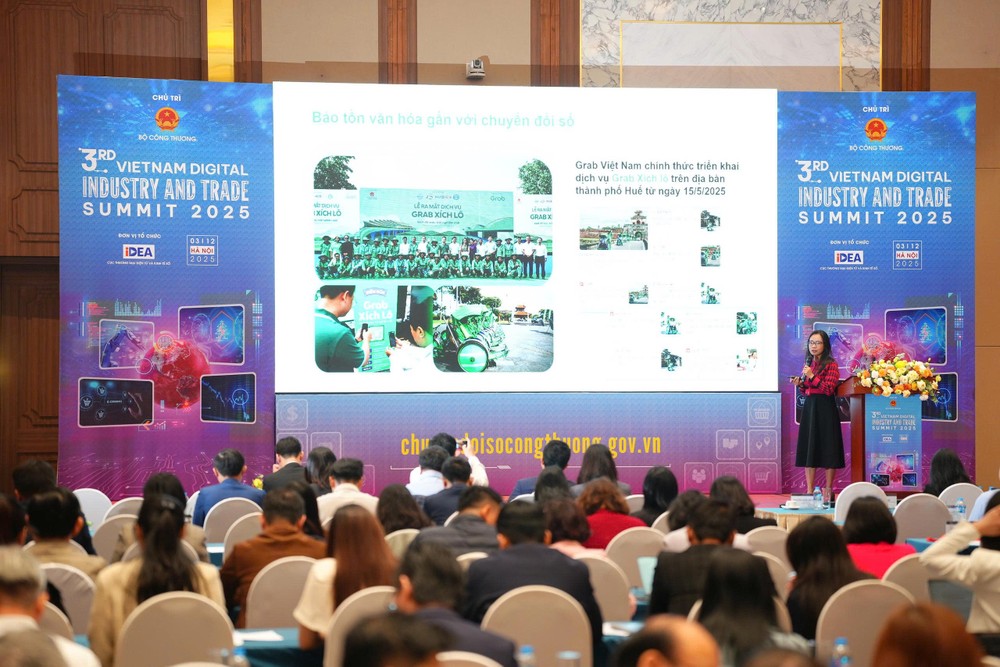
The Ministry of Industry and Trade (MoIT) convened the third Vietnam Digital Industry and Trade Summit 2025 in Hanoi on December 3, spotlighting the theme “Dual Transformation: Digitizing Supply Chains – Greening Growth.” The event underscored Vietnam’s ambition to deploy digital and green transition strategies in tandem as the country moves into a decisive phase of economic restructuring.
In his opening remarks, Deputy Minister Nguyen Sinh Nhat Tan emphasized that Vietnam’s digital economy continues to expand robustly, emerging as a critical pillar for productivity gains, market diversification, and economic resilience. Retail e-commerce alone is projected to surpass US$25 billion, reinforcing its role as a core driver of the country’s internet economy.
The Deputy Minister noted that the Government has designated 2025 as the pivotal year for accelerating Resolution 57 on digital transformation, reaffirming its view of digital transformation as a key force for enhancing national competitiveness and upgrading production capacity. Within the industry and trade sector, he said, the ministry has advanced digitalization across three foundations: digital government, digital economy, and data infrastructure. Yet 2025 will require “more vigorous and comprehensive reforms” to seize the opportunities of the dual transition—digital transformation coupled with green transformation.
To translate these goals into tangible outcomes, Deputy Minister Nguyen Sinh Nhat Tan urged agencies, enterprises, and localities to closely examine emerging technologies—artificial intelligence, the Internet of Things, big data, and cloud computing—and their applicability across digital government, smart manufacturing, smart energy, and e-commerce. He also called for the development of green, sustainable, and secure e-commerce markets; stronger oversight of cross-border e-commerce activities; and deeper regional linkages to support the distribution of local products through digital platforms.
The ministry also emphasized the need for tailored models and solutions to support local digital economy development, particularly for small businesses and household enterprises that form the backbone of provincial economies.
Presenting the report “Orientation for Digital Transformation in Industry and Trade in 2026,” Mr. Hoang Ninh, Deputy Director of the E-Commerce and Digital Economy Agency, reaffirmed that digital transformation remains a strategic mandate, closely tied to the green agenda, sustainable development, and the sector’s comprehensive restructuring through 2030.
According to Mr. Hoang Ninh, the ministry has achieved tangible progress in building digital government: 224 fully online public services are now offered; 95.52 percent of administrative dossiers have been digitized; more than 691,000 dossiers were processed via the ASEAN Single Window in 2024; and over 52,500 enterprises used MoIT’s digital public service systems. The ministry continues to lead the country in citizen satisfaction scores for online public services, securing a perfect 18/18 points—100 percent satisfaction for complaint handling and 97.54 percent for administrative processing. These results, he said, underscore a user-centric approach while laying a vital data foundation for the sector’s next digital-transformation phase.
In the broader digital economy, e-commerce remains the primary growth engine, with the B2C market valued at about $25 billion in 2024, accounting for 10 percent of total retail and consumer-service revenue. Digital transformation in industry and manufacturing is also showing strong momentum: the industrial production index grew 8.4 percent—the highest increase in five years; roughly 90 percent of processing and manufacturing enterprises have adopted some form of digital solution; 35 percent use robots and sensors in production; and 10–12 percent have reached Smart Factory level 3.0.
The energy sector is undergoing an equally profound shift, driven by smart metering, real-time operational data, AI-assisted load forecasting, enterprise energy-management systems (EMS), and the scaling up of renewable-energy models.
Looking ahead to 2025, Vietnam’s digital economy is expected to reach $39 billion, maintaining one of the fastest growth rates in the region. More than 40 AI startups have already attracted $123 million in private investment; 81 percent of Vietnamese users interact with AI daily; and 96 percent express trust in AI-powered agents—a level among the highest in Southeast Asia.
Building on these achievements, Mr. Hoang Ninh said 2026 will mark a “strategic breakthrough period” for the industry and trade sector, with priorities including the standardization of national e-commerce data, the expansion of next-generation smart factories (3.0–4.0), and large-scale rollout of smart metering and energy-management systems nationwide.