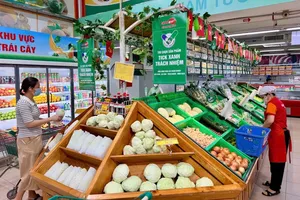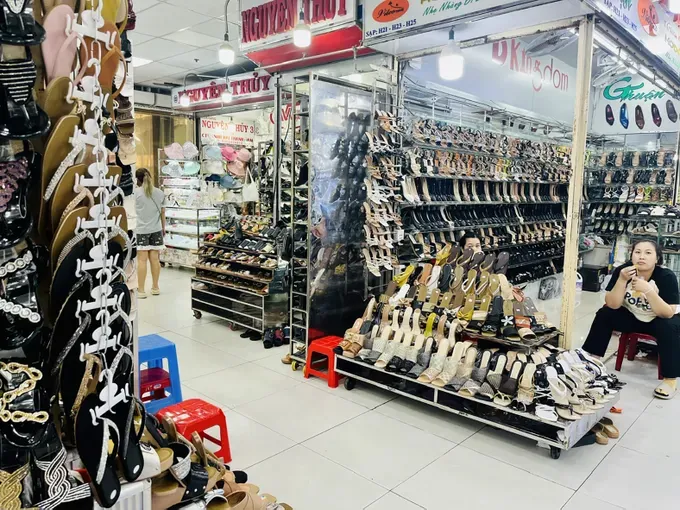
Traditionally, this time of year sees a bustling wholesale atmosphere as the holiday season ramps up. Yet this year, the fashion accessories and jewelry section at An Dong Market (An Dong Ward, HCMC) is notably subdued.
Ms. T., a small trader with over 30 years of experience here, revealed she is currently holding a consignment worth over VND500 million (US$19,600). Despite the high value, she has locked her stall, too afraid to open for business.
“I imported these goods a long time ago,” she lamented. “Now, the new regulations mandate that sold goods must have invoices. If I don’t have input invoices and get inspected, the fines will just add to the hardship.”
Other traders at An Dong Market shared that they had moved their inventory home to avoid inspection, accepting a temporary business suspension even during the year-end peak season. “It’s less than a month until 2026, but we still don’t know how to handle this undocumented inventory,” one trader explained. “If we can’t sell, our capital is buried. If we open, we face the risk of penalties for invalid invoices.”
This sentiment of “losing sleep on a pile of inventory” is pervasive across commercial areas and traditional markets. A construction materials business owner on Nguyen Anh Thu Street (Tan Thoi Hiep Ward, HCMC) stated: “We have a huge amount of stock bought years ago, much of it without invoices. From January 1, 2026, we have to switch to declaration-based tax. What documents should we prepare now? What do we do with all these goods?”
Similarly, a business household in Binh Hung Hoa Ward is worried about a large stockpile purchased from small, scattered sources in the past, which lacked invoices. Now, they cannot sell to organizations or businesses because they cannot issue the necessary output invoices.
Meanwhile, some clothing, backpack, handbag, handicraft traders report they have slashed prices, hoping businesses would buy them as gifts for workers. Yet, even corporate buyers are refusing due to the lack of invoices. “We’re sitting on fire here,” one anxious owner shared. “We’re staring at this pile of goods we have imported, can’t sell it, and don’t know what to do next.”
Addressing the issue of handling inventory before the switch to declaration-based tax, Chairwoman Tran Thi Mai Thao of the Member’s Council at Gia Long Tax Consultant and Services Co. Ltd. noted that during the flat tax period, many goods were purchased without full documentation. She advised that business households should review and statistically catalog all their goods, creating a list to enter as “beginning inventory” to serve as a basis for issuing sales invoices.
However, she cautioned that businesses must ensure goods meet quality standards and legal regulations. Crucially, from January 1, 2026, all purchased and sold goods must have legal invoices and documents, absolute compliance with the law is mandatory.
Deputy Director Nguyen Quang Huy of the HCMC Market Surveillance Division stressed that goods in circulation must have valid invoices and documents to prove their origin. When goods without input documents are detected, functional agencies will inspect, temporarily seize, verify, and handle them according to regulations. This aims to prevent counterfeit and smuggled goods and protect the business environment.
Currently, the HCMC Market Surveillance Division is intensifying propaganda and guidance so business households can proactively review inventory and coordinate with tax agencies to complete documentation or handle it according to regulations. This is to provide maximum support for traders to transition smoothly, but the abuse of transitional regulations to legitimize goods of unknown origin will resolutely not be allowed.
Meanwhile, Head Tran Minh Nha of HCMC Tax Branch 12 shared that the issue of handling inventory before converting to declaration-based tax has been raised in numerous conferences, but specific written guidance is still lacking. Tax Branch 12 has noted this and reported it to the HCMC Tax Department.
According to Head Mai Thi Nghia Le of the Personal Income Tax, Business Household and Other Revenues Division (HCMC Tax Department), regulatory agencies are amending new decrees and circulars, which include content related to determining inventory. Once these regulations are issued, guidance will be provided for business households to implement.
Deputy Director Mai Son of the General Department of Taxation (Ministry of Finance) argued that for high-value items, the paramount requirement is legal origin. He clarified that goods purchased from individuals remain acceptable, provided they are neither counterfeit nor violate intellectual property rights. The tax sector pledges maximum support to help households accurately assess inventory value during the transition.
Concurrently, Chairwoman Nguyen Thi Cuc of the Vietnam Tax Consultants’ Association attributed the documentation gap to the historical reliance on flat tax. To mitigate the gridlock, she proposed a pragmatic solution. For goods not classified as smuggled or counterfeit, tax agencies should consider waiving retrospective input invoice demands. Instead, authorities could allow sellers to fulfill their obligations by paying tax strictly on the sales value, thereby ensuring compliance without crippling business operations.