Across the central coastal provinces, clusters of solar and wind power plants are turning once-barren fields into green corridors. In the Central Highlands, where strong winds prevail, renewable energy projects are rapidly expanding. Meanwhile, in the Mekong Delta and the southernmost province of Ca Mau, new energy hubs are emerging, creating not only power capacity but also jobs, tax revenues, and industrialization opportunities for local communities.
Regions in transition, livelihoods in transformation
From National Highway 1A looking out to sea, the Vinh Tan Power Center in Lam Dong Province’s Vinh Hao Commune rises like a “city of energy” amid the sunshine and winds of the South Central region. Its towering chimneys release thin streams of white smoke that blend with the morning mist—signals of another busy day for hundreds of engineers and operators. With a total capacity of 4,284 MW and an annual output of about 15 billion kWh, the plant contributes trillions of dong to the local budget and provides thousands of jobs.
Lam Dong Province, with the largest land area in Vietnam and a coastline stretching more than 192 kilometers, enjoys a sunny, windy climate that makes it ideal for renewable energy development.
According to Ho Van Muoi, Chairman of the Lam Dong Provincial People’s Committee, green energy from the sun and wind is a strategic priority for the province. Leveraging its highland terrain and coastal exposure, Lam Dong is pursuing an ambitious direction that is offshore wind power development.
The Institute of Energy under the Ministry of Industry and Trade has identified Lam Dong and its adjacent sea areas as among the best sites for offshore wind power in Vietnam, due to their high wind speeds and shallow seabeds. Consequently, Lam Dong is being repositioned as a focal point for offshore wind development.
In recent years, many major domestic and international energy corporations have surveyed the area’s potential. Among them, Pacifico Energy, a leading U.S. renewable energy investor, successfully operates the 40 MW Mui Ne Solar Power Plant, generating 68 million kWh annually and cutting nearly 55,500 tons of CO₂ emissions. Building on that success, Pacifico Energy is now advancing plans for a large-scale offshore wind project off the Lam Dong coast.
Similarly, Denmark’s Copenhagen Infrastructure Partners (CIP) is promoting the La Gan Offshore Wind Project, with a planned capacity of 3.5 GW and a total investment of US$10.5 billion. Once operational, it could supply electricity to more than seven million households per year.
In the Southern region, where electricity demand is surging, liquefied natural gas (LNG) power is seen as a necessary base load source to stabilize the system as the share of renewables increases. Under the revised Power Development Plan VIII, domestic gas-fired power capacity is expected to rise from 7 GW to 16 GW, while imported LNG capacity could jump from 0.8 GW to 22.5 GW by 2030.
Ca Mau Province, with 310 kilometers of coastline and consistent wind speeds of 6.5 meters–7 meters per second, already operates 16 wind power plants (totaling 870 MW) and over 2,800 rooftop solar systems (295 MWp). The province is also included in the national plan to export 12,000–15,000 MW of renewable power via undersea cables.
Green energy is not just transforming regional economies; it is reshaping livelihoods. In coastal communes, young people are shifting from traditional trades to jobs in plant operation and turbine maintenance. New energy tourism services, tours of wind farms and solar plants are emerging, providing additional income streams for local communities.
Challenges ahead
Despite its promise, the green energy transition faces numerous legal and regulatory hurdles. The lack of clear regulations on survey rights, wind measurement, and marine space allocation has complicated project implementation.
Chairman Bui Van Thinh of the Binh Thuan Wind and Solar Energy Association in Lam Dong Province emphasized that while the potential and development plans for offshore wind are clear, regulatory bottlenecks must be resolved particularly the overlap between economic zones and national defense areas. He suggested that pilot projects be launched first to test feasibility and optimize grid connection.
Capital and risk management are also major concerns. Offshore wind, LNG, and nuclear power projects require massive investment and long payback periods. Stable policy environments are crucial for attracting financing; policy uncertainty, by contrast, raises capital costs.
Dang Quoc Bao, Deputy General Director of Trung Nam Group, noted that while enterprises can mobilize resources, pricing mechanisms and planning determine investor confidence. Following the expiration of the FIT (Feed-in Tariff) incentives, many renewable projects have had to renegotiate electricity prices with EVN. Sharp price cuts sometimes up to 40 percent–45 percent have disrupted financial plans, delaying project progress.
Transmission capacity remains another physical bottleneck. Some completed projects lack grid connections. In May 2025, system data showed that wind output was sometimes underutilized due to low wind speeds, while at other times, generation was curtailed for lack of transmission lines and substations.
Energy expert Dao Nhat Dinh warned that without strong gas-based generation and transmission infrastructure, Vietnam’s 2030 renewable targets will be difficult to achieve. Moreover, offshore wind and power export projects still face legal uncertainties regarding security, sovereignty, and cross-border power trade frameworks. This issue demands interagency coordination.
Experts agree that realizing Vietnam’s renewable potential requires synchronized solutions such as stable long-term pricing mechanisms, clear investment frameworks for offshore wind and LNG, and risk-sharing power purchase agreements.
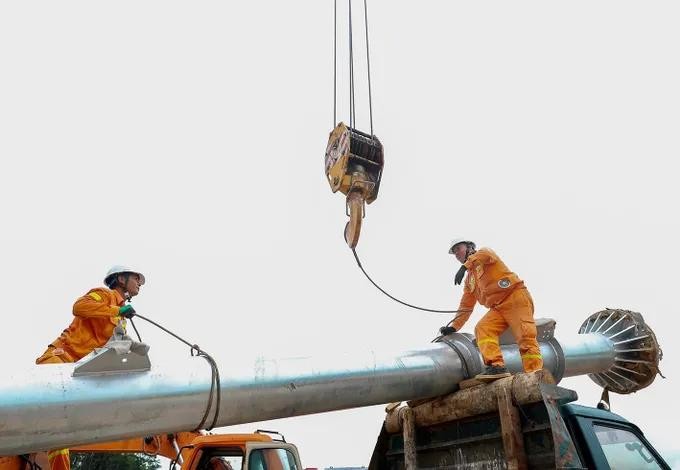
Equally important is accelerating transmission infrastructure investment—opening it to private participation. Transmission planning must precede generation development. Public–private partnership (PPP) models, where investors build transmission lines and substations for later transfer to EVN, could help ease grid congestion and reduce state budget pressure.
Vietnam has the natural resources and human capacity to become a regional green energy leader. Yet this potential will only be fulfilled if policy, planning, and infrastructure constraints are effectively addressed. Only then can green energy ensure national energy security, drive economic growth, create jobs, and place Vietnam firmly within the global clean energy value chain.
The maritime area from Lam Dong province to Ho Chi Minh City experiences an average wind speed of 8-10 m/s at an altitude of 100 meters, with a flat seabed that is conducive to turbine installation. The joint venture PTSC - Sembcorp (Singapore) has been granted permission to survey the maritime region, aiming to export 2.3 GW of electricity to Singapore via undersea cables starting in 2030. PTSC has also successfully manufactured 33 foundations for wind turbine towers for the Greater Changhua 2b&4 project of client Ørsted - a global leader in developing, constructing, and operating offshore wind farms - demonstrating the capability to produce equipment domestically and initially participating in the global supply chain. Offshore wind energy has provided an opportunity for Vietnam to engage in the international value chain.