Taking advantage of its abundant waterways, farmers in An Thoi Dong Commune are developing a range of aquaculture models using new techniques, generating higher incomes. Alongside farmers’ efforts, local authorities are providing technical transfers and facilitating access to capital, creating opportunities to improve productivity and develop sustainable livelihoods.
Profitable farming models
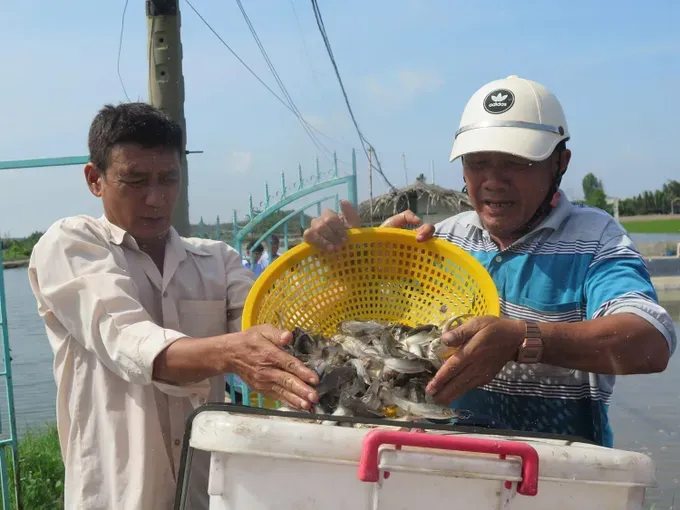
Pham Duy Khanh is one of the well-known snakehead catfish farmers in An Thoi Dong. After nearly ten years in the trade, he now operates six ponds covering about four hectares.
According to him, water treatment before stocking is the most important step in raising snakehead catfish. Although the fish are relatively disease-resistant, they are susceptible to parasitic infections. Each production cycle lasts about one year, with the fish ready for harvest when they reach around 2 kilograms each.
Raising snakehead catfish is less risky than farming other aquatic species. Processing facilities in An Thoi Dong and Binh Khanh communes, Can Gio, buy the fish to make sun-dried products, while traders from Binh Dien Agricultural Wholesale Market also purchase them directly. He sell about 50 tons a year, generating more than VND7 billion (US$266,000) in revenue.
The network of local buyers, together with traders from the wholesale market, has helped establish a supply chain from fish farming to processing and distribution, providing relatively stable outlets for snakehead catfish farmers in An Thoi Dong.
Besides snakehead catfish, farmers in An Thoi Dong have developed brackish-water shrimp and oyster farming models that generate high economic returns. In particular, the locality is supporting high-tech brackish-water shrimp farming, which has proven significantly more effective than traditional methods.
According to Vo Van Phang, Deputy Head of the Economic Division of An Thoi Dong Commune, brackish-water shrimp farming produces about 4,000-5,000 tons annually. Average productivity reaches 40-45 tons per hectare per year, six times higher than traditional farming, while average profit is about VND1.47 billion (US$56,000) per hectare per crop.
An Thoi Dong currently has more than 16,000 hectares of agricultural land, including 1,352 hectares dedicated to brackish-water shrimp farming, about 300 hectares of which use high-tech farming methods. The commune also has nearly 2,000 hectares of water surfaces used for ponds and reservoirs, 548 hectares for oyster farming, and 15 hectares for snakehead catfish farming. The latter produces about 200 tons annually, with average profits of VND1.53 billion (US$58,300) per hectare per crop.
By making better use of available land and water resources, local farmers are expanding suitable farming models, improving productivity and increasing incomes.
Besides aquaculture, An Thoi Dong has a traditional salt-making industry employing more than 500 workers. In recent years, many households have shifted from traditional methods to tarp-based salt production combined with water storage. The approach helps prevent production from being disrupted by increasingly unpredictable weather.
Nguyen Van Viet, a salt farmer in An Thoi Dong, said the new production method helps reduce costs and labor during harvest, particularly when transporting salt from fields to collection points.
To preserve and develop An Thoi Dong’s traditional salt-making industry, the Ho Chi Minh City People's Committee officially recognized the commune’s traditional salt-making craft village in December 2024.
Bringing new techniques to production
The success of aquaculture models in An Thoi Dong has been supported significantly by the transfer of scientific and technical advances, helping farmers gradually change their production methods. Local authorities have coordinated with specialized agencies to provide training, technical guidance and new farming models suited to local land and water conditions.
Tran Hoang Vu, Chairman of the An Thoi Dong Commune People's Committee, said the commune has regularly organized training courses and provided technical guidance while working with agencies under the Ho Chi Minh City Department of Agriculture and Environment to introduce new production models.
Applying advanced techniques has helped farmers increase productivity, reduce risks and improve production efficiency, he said.
This approach has also enabled high-value farming models to gradually expand. From snakehead catfish and high-tech shrimp farming to clam seed nursing and oyster farming using substrates, the transferred models are tailored to local production conditions, giving farmers more options to improve farming practices and increase the value generated from existing production areas.
Access to financial support is also helping farmers invest in production. According to the An Thoi Dong Commune Farmers' Association, since the beginning of 2026, the Ho Chi Minh City Farmers Support Fund has provided more than VND7.3 billion (US$278,000) in loans to nearly 80 farmers in the commune.
The funding has enabled households to invest in farming ponds, expand production, adopt new techniques and improve the efficiency of their farming models.