VN-Index approaches key 1,780-1,800 resistance zone
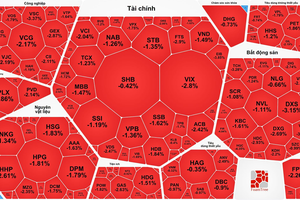
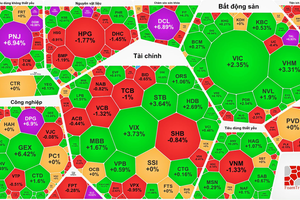
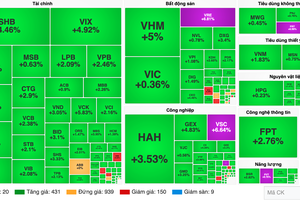
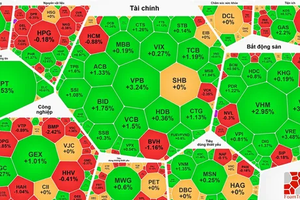
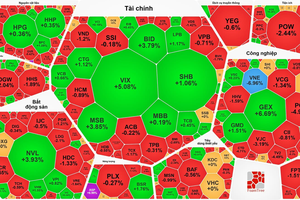
The VN-Index gained 39.04 points, or 2.3 percent, last week, closing near 1,780 points after a sharp rally in the final session. The level represents a key resistance area following the market's recent correction from the 1,800-point region.
SHS Securities said the 1,780-1,800 range remains an important area to watch. The index's short-term trend has been recovering after a period of correction and consolidation, but the 1,800-point level continues to pose a formidable technical barrier. A sustained breakout would require stronger support from both market fundamentals and liquidity, the brokerage said.
Tien Phong Securities (TPS) offered a more cautious assessment, noting that the VN-Index remains below its moving-average system and that its medium-term trend has yet to break decisively out of a bearish structure. The 1,780-1,800 range will therefore be critical in determining whether the market is undergoing a genuine trend reversal or merely a technical rebound.
Improved liquidity, market breadth and the performance of several stock groups in the final trading session of last week indicated that buying demand had become more proactive as the market approached key milestones in Vietnam's market-upgrade story.
However, liquidity has yet to recover broadly across the market. Trading volume on the Ho Chi Minh City Stock Exchange (HOSE) fell 15.3 percent from the previous week, while turnover declined 11.9 percent. On the Hanoi Stock Exchange (HNX), trading volume dropped 13.6 percent, and turnover decreased 16.4 percent.
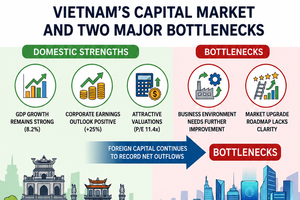
Despite the market's positive recovery, analysts advised investors against chasing rallies and recommended waiting for clearer signals from capital flows and the broader trend, particularly developments surrounding the FTSE GEIS portfolio.
Ta Quoc Dat, an analyst at SSI Securities, said the absence of a clear market trend and a strong leadership group had made large investors reluctant to deploy capital aggressively. Short-term money has largely focused on tactical trading in selected stocks with company-specific catalysts, including potential State divestments.
"Investors holding substantial cash can begin accumulating positions gradually, but should not deploy all their capital at once and should continue monitoring market developments," Ta Quoc Dat said. "Margin borrowing should only be considered once capital flows show a clear and sustained recovery."
FTSE reclassification and State divestments offer fresh catalysts
According to the State Securities Commission of Vietnam, FTSE Russell has officially announced the inclusion of 27 Vietnamese stocks in the FTSE GEIS, three more than the 24 stocks expected under the preliminary assessment in April 2026.
The inclusion will raise Vietnam's estimated weighting in the index to about 0.49 percent, compared with the previously projected 0.328 percent. This could potentially lift foreign capital inflows into the Vietnamese market beyond the earlier estimate of US$1.5 billion.
Securities firms identified two themes that could provide fresh momentum in the coming months: the newly added FTSE GEIS constituents and a potential wave of State divestments. Investors could focus on stocks benefiting from either theme, as well as leading companies that have undergone prolonged accumulation and are beginning to see liquidity improve.
Phan Tan Nhat, Senior Market Strategy Specialist at SHS Securities, said brokerage stocks had come under selling pressure for five to six sessions on thin liquidity before staging a strong recovery at the end of last week.
The rebound suggested that the price trend of securities companies was becoming more positive than the broader market, reflecting expectations surrounding FTSE Russell's newly announced list of Vietnamese stocks in the FTSE GEIS and the country's scheduled official market reclassification at the end of September.
Nguyen The Minh, Director of investment banking at An Binh Securities (ABS), meanwhile, said matched orders on HOSE remained below VND20 trillion, underscoring investors' cautious stance.
Capital flows have also become increasingly selective, with money moving out of some large-cap stocks in banking, real estate and financial services in search of opportunities among mid- and small-cap companies. These include stocks in household goods, travel and entertainment, food and beverages, industrials, telecommunications, and oil and gas.
Nguyen The Minh said investors should look beyond the VN-Index and monitor whether the number of stocks trading above their 50-day, 100-day, and 200-day moving averages continues to increase. The market needs additional catalysts, particularly in the period leading up to September, when further developments on the market upgrade and foreign capital flows could emerge.
An analyst at VPBank Securities shared the view that investors should wait for clearer evidence of a recovery in capital flows. Extremely thin liquidity could, however, provide the foundation for a new rally, the analyst said.
The strong rebound in brokerage stocks following their recent correction also suggested that the VN-Index may have completed a technical adjustment. Several factors could support the market, including FTSE Russell's inclusion of 27 Vietnamese stocks in the FTSE GEIS, marking another milestone in the country's market-upgrade process.
Expectations of a new wave of State divestments could provide another catalyst. Decision No.40/2026 of the Prime Minister, which sets criteria for classifying enterprises for the restructuring of State capital, took effect in August and could accelerate the process.
Still, analysts cautioned that the market needs more than the formal upgrade of Vietnam's stock market, scheduled for September 21, to establish a stronger and more sustainable uptrend.
A broader combination of macroeconomic factors will remain crucial, including easing inflation, lower interest rates, continued economic growth and an improved trade balance, with a return to a trade surplus potentially providing additional support for investor sentiment and capital flows.
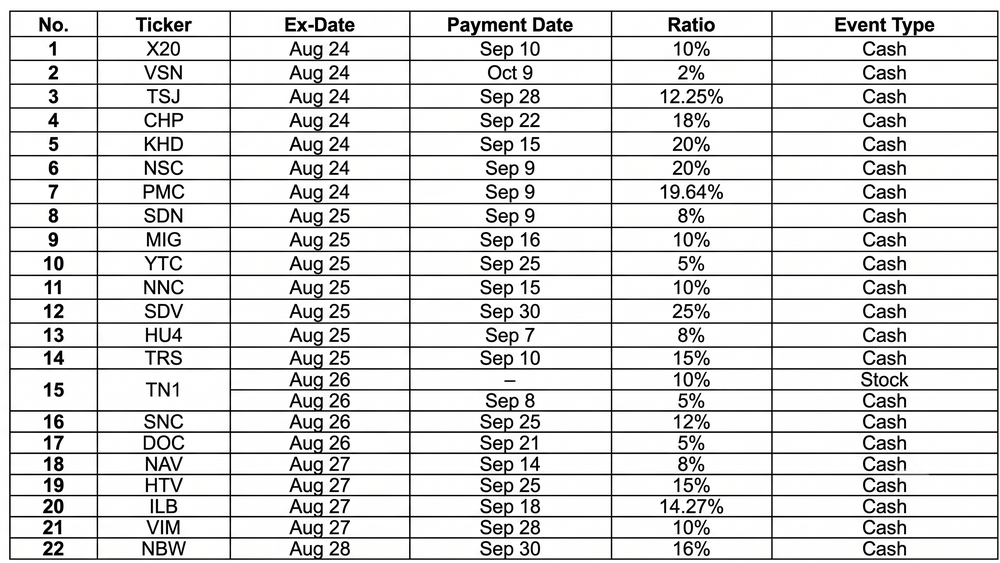
21 of 22 companies to pay cash dividends
Meanwhile, about 22 companies are scheduled to finalize shareholder rights for dividend payments from August 24 to 28. Of these, 21 will pay dividends in cash, with the highest payout reaching 25 percent.