 |
According to Vinasoy, after waiting for objective testing results from a third party, the Fami Calcium soy milk product is proven to meet the standards and be free of Coliform bacteria, ensuring its quality and safety for consumers.
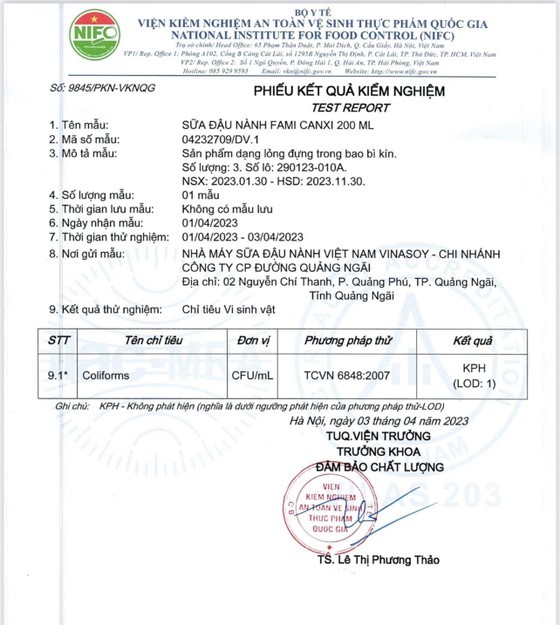 |
The Fami Calcium soy milk product is proven to be free of Coliform bacteria. (Photo: SGGP) |
Earlier, on March 28, NHK News in Japan reported that the Fami Calcium soy milk product imported from Vietnam was contaminated with Coliform bacteria in Japan. Fami Calcium is a product of Vinasoy. Coliform is a bacterium that causes intestinal diseases, with an incubation period of three to four days, and digestive disorder symptoms, such as abdominal pain and diarrhea.
The batch of Fami Calcium soy milk was suspected of being contaminated with Coliform bacteria and was imported by Chiba-based Next Trading Company from Vietnam. The batch consisted of 15 boxes of 200-milliliter milk bags and ten boxes of one-liter milk cartons. After receiving the information, the Japanese importer recalled the entire batch of soy milk and sent samples to a third-party unit in Japan for testing.
According to Vinasoy, Coliform bacteria are widely present in nature and can be found in water, soil, and plant surfaces. Coliform bacteria can easily be destroyed at 75 degrees Celsius. Hence, they cannot survive during the enzyme deactivation process (which involves a temperature of 120 degrees Celsius for 80 seconds) and UHT sterilization (which involves a temperature of 137-140 degrees Celsius for 4-10 seconds) used in the production process of Vinasoy's soy milk.
In addition, Coliforms can ferment sugars to produce acid and gas at 35-37 degrees Celsius within 24-48 hours. If soy milk products packaged in paper containers are contaminated with Coliforms, they will be easily recognizable by signs of swelling, sedimentation, and sour taste. Therefore, the case of Fami Canxi soy milk contamination in Japan only occurs sporadically due to recontamination during transportation and circulation.