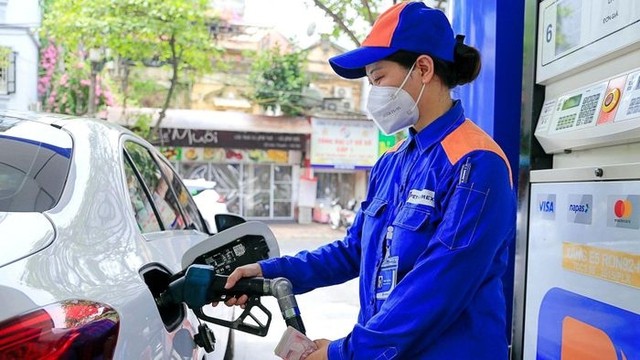
At a working session held in Hanoi on December 26, the Military Petroleum Corporation and the Ministry of Industry and Trade (MoIT) provided an update on domestic fuel production, reserves, and supply conditions. Ms. Nguyen Thuy Hien, Deputy Director of the Domestic Market Management and Development Department under the MoIT, said that in 2025, the country’s two refineries—Dung Quat and Nghi Son—are projected to produce more than 15 million tons of petroleum products, up 6.5 percent year on year. Domestic sales are estimated at about 14.8 million tons, an increase of 6.4 percent from 2024, while exports are expected to reach roughly 438,000 cubic meters/tons, up 1.8 percent.
Fuel imports for the full year 2025 are estimated at around 10.2 million tons, down 2.11 percent compared with 2024.
According to reports from key fuel traders, total supply available for domestic consumption in 2025 is estimated at about 28.6 million cubic meters/tons, equivalent to roughly 97 percent of the minimum supply volume assigned at the beginning of the year. Actual consumption, however, is projected at approximately 26.4 million cubic meters/tons, or an average of about 2.2 million cubic meters/tons per month. End-of-year inventories are estimated at around 1.7 million cubic meters/tons.
Explaining why realized supply growth in 2025 fell short of assigned targets, the MoIT noted that the initial allocation was set higher than actual demand, reflecting expectations of a strong domestic economic rebound. In reality, nationwide fuel consumption in 2025 did not increase and remained broadly in line with 2024 levels. A key factor has been the rapid expansion of electric vehicles and equipment, alongside the emergence of alternative energy sources such as hydrogen.
In addition, prolonged heavy rains, storms, and flooding across northern, central, and Central Highlands provinces disrupted production and dampened consumer demand. Sluggish recovery in overall economic activity also weighed on fuel use. Despite these headwinds, enterprises continued efforts to ensure a stable fuel supply in line with volumes assigned by the ministry.
Looking ahead, the MoIT said the minimum national fuel supply for 2026 will be calculated based on the actual 2025 supply of 28.6 million cubic meters/tons and an assumed GDP growth rate of 10 percent. On this basis, the total assigned supply for 2026 is projected to be around 31.46 million cubic meters/tons.
However, fuel traders have so far registered only about 24.6 million cubic meters/tons for 2026—equal to 86 percent of the estimated 2025 supply and just 78 percent of the projected 2026 requirement. As a result, the volume to be allocated by the ministry in 2026 would exceed registered amounts by about 6.86 million cubic meters/tons. The MoIT said final allocations will be determined based on each company’s market share and execution capacity.