Accordingly, the People's Committee of Ho Chi Minh City approved the list of the second trial phase, allowing 42 real-estate developers to implement commercial housing projects on land areas originating from agriculture.
The permitted land areas cover a total area of 4.7 million sq.m, with over 649,000 sq.m of land designated for rice cultivation expected to be converted for different purposes.
The land areas are located across various regions, including 36 areas in the former city of HCMC and six areas in former Ba Ria-Vung Tau Province.
The regulations took effect on December 18.
Within this list, numerous large-scale projects are concentrated in the former Ba Ria-Vung Tau Province.
In the former Ho Chi Minh City area, large land areas are mainly located in Long Phuoc ward (former Thu Duc City), including residential and mixed-use apartment complex projects covering approximately 27.25 hectares; Nam Khang Residential Area of 17.7 hectares, the Saigon Garden Ecotourism Residential Area of nearly 29.9 hectares, and the Sadeco Phuoc Kien residential area (former Nha Be) with an area of about 17.4 hectares.
The People's Committee of Ho Chi Minh City affirms that this announcement serves as a basis for investors and authorities to proceed with the subsequent procedures. The city requests relevant departments, sectors, and local authorities to coordinate and create conditions for projects to be implemented in a lawful, transparent and effective manner.
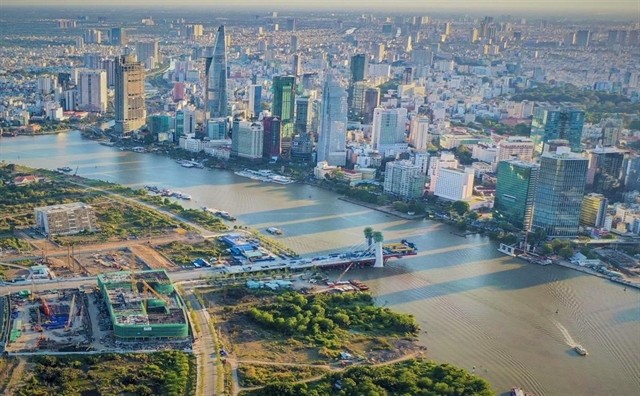
Previously, the city had approved 54 real estate business organizations to implement commercial housing projects on agricultural land areas, with a total area exceeding 6.55 million square meters. The selected land areas must meet criteria regarding land-use planning, approved housing development plans, and be situated in urban areas or within urban development plans.
This initiative is the concrete realisation of Resolution 171 of the National Assembly, allowing the implementation of commercial housing projects through agreements to utilise agricultural land, commercial service land, or non-agricultural land not designated for housing for commercial housing projects, provided they align with local housing planning and development programmes.
Based on this, the municipal People's Committee will issue permits to allow enterprises to transfer and change the land use purposes instead of requiring 100 percent residential land as per current regulations. The trial programme is expected to have significant importance for Ho Chi Minh City, where the supply of commercial housing has sharply declined over many years due to legal constraints.