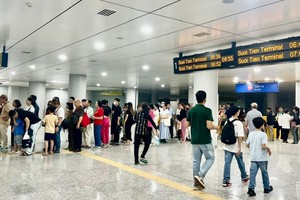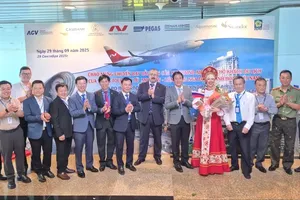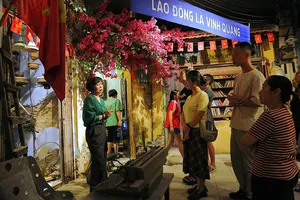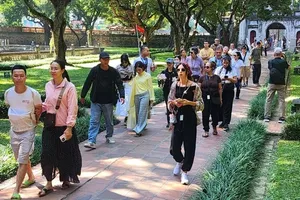
In this context, Vietnam’s tourism sector is under increasing pressure, yet it also presents an opportunity to restructure its markets and elevate the value of its destinations.
In an interview with Sai Gon Giai Phong (SGGP) Newspaper, Deputy Minister of Culture, Sports, and Tourism Ho An Phong shared insights into the sector’s response scenarios as well as its long-term strategic orientations.
According to Deputy Minister Ho An Phong, the Middle East serves as a critical transit hub within the global aviation network, particularly for routes linking Asia with Europe, North America, and parts of Africa.
The group of markets directly affected at Level 1 comprises the Middle East, which currently accounts for 0.24 percent of Vietnam’s total international arrivals. The indirectly affected markets at Level 2 include Europe, which accounted for 13 percent, and the Americas, which accounted for 5.2 percent, primarily due to disruptions to flight routes and rising tour costs.
Meanwhile, the group of markets indirectly affected at a Level 3, driven by increasing costs and travel hesitancy, includes Northeast Asia—accounting for nearly 55 percent of total inbound visitors, notably China, the Republic of Korea, Taiwan (China), and Japan, as well as Southeast Asia, which represents around 20 percent. In addition, India accounts for 3.5 percent and Oceania 3.2 percent of total international arrivals to Vietnam.
The disruption of transit routes through the Middle East is directly affecting the travel itineraries of certain international tourist groups to Vietnam, particularly from Europe and North America—markets that rely heavily on major transit hubs such as Doha, Dubai, and Abu Dhabi.
The conflict has resulted in longer flight durations, increased transportation costs, and a higher risk of cancellations and delays, thereby impacting international arrivals in March and posing challenges to the country’s target of welcoming 25 million international visitors this year.
In response, the Ministry of Culture, Sports, and Tourism has directed the tourism sector to proactively monitor, assess, and forecast developments in order to promptly report to the Prime Minister and propose timely and effective response measures to emerging risks, particularly in the context of tightening energy supply and rising costs.
In addition, the sector has been tasked with reviewing and developing contingency scenarios for transportation routes and supply chains of goods and fuel that may be disrupted. Efforts are also being made to reduce reliance on affected regions and step up the attraction of visitors from other key markets, including ASEAN, China, and Japan.
The ministry also views this as an opportunity to further restructure the visitor segments, prioritizing high-spending, long-stay travelers who are less sensitive to cost fluctuations, such as those engaging in high-end beach resort tourism, MICE (Meetings, Incentives, Conferences and Exhibitions), and cruise tourism.
Vietnam’s tourism sector needs to shift from a reactive mindset to a proactive, flexible, and sustainable strategy. This entails diversifying source markets and reducing reliance on distant or volatility-prone markets such as Europe and North America while stepping up efforts to tap into nearby and regional markets—including Northeast Asia, ASEAN, India, and the Middle East—as well as the domestic market to better disperse risks.
In addition, it is essential to restructure tourism products toward greater flexibility, with a focus on short-stay, reasonably priced, and easily adjustable offerings—such as intra-regional travel and wellness tourism—aligned with evolving market conditions and changing consumer behavior.
Additionally, the sector must enhance its forecasting capacity and develop multi-tiered response scenarios—covering short-, medium-, and long-term horizons—tailored to different types of risks. Strengthening the autonomy of the tourism system through the expansion of direct air connectivity, thereby reducing dependence on transit hubs, is also a key priority. Efforts should likewise be made to reinforce domestic tourism service supply chains to mitigate spillover impacts from external shocks.
In the context of rising airfares and tour prices driven by increasing global fuel and transportation costs, the sector recognizes that it cannot rely solely on measures to “force prices down.” Instead, the focus is placed on easing cost pressures while enhancing the overall value of the visitor experience.
The ministry has coordinated with relevant agencies and tourism enterprises to implement a range of solutions, including strengthening value chain linkages among aviation, travel services, accommodation providers, and destinations to develop optimized tourism packages; diversifying products with cost-appropriate segments such as green tourism, community-based tourism, and experiential travel; and accelerating digital transformation to reduce intermediary costs, improve operational efficiency, and enhance direct access to customers. At the same time, efforts have been intensified to strengthen state management over pricing.

In the long term, the key solution lies in restructuring markets and enhancing the competitiveness of destinations through quality rather than relying solely on price. It must be underscored that the tourism sector should prioritize high-spending, long-stay visitor segments that are less sensitive to cost fluctuations, including high-end resort tourism, MICE, golf tourism, wellness tourism, and in-depth cultural experiences.
At the same time, promotion activities should be intensified in a more flexible and market-responsive manner, with stronger public–private partnerships, the development of distinctive tourism products, improvements in service quality, and the continued advancement of a smart tourism ecosystem.
This approach will not only help sustainably ease cost pressures but also safeguard the competitiveness of Vietnam’s tourism sector amid current global uncertainties.
Whereas in the past, travelers tended to prioritize factors such as cost, experience, and procedural convenience, the question of “where to travel for greater safety and peace of mind” has now become a decisive consideration. This presents a timely opportunity for Vietnam to consolidate and affirm its image as a safe, friendly, and stable destination, with increasingly professional, civilized, and modern service capabilities.
The key requirement, therefore, is to ensure the right products, targeted and effective promotion, and a sufficiently high-quality visitor experience.
From this perspective, the Ministry of Culture, Sports, and Tourism is directing the implementation of several key solutions. These include renewing communication approaches and methods—not merely reiterating the message of a “safe and friendly” destination, but closely linking it with clearly defined tourism products such as beach resort tourism, culture–heritage–cuisine experiences, MICE, golf, wellness tourism, and community-based tourism. This will enable visitors to better visualize their experiences and clearly understand the reasons for choosing Vietnam as their destination.
The advantage of safety can only be translated into revenue when the on-site experience meets visitors’ expectations. Therefore, upgrading the entire destination ecosystem is a fundamental requirement—encompassing product development; service quality; human resources; regional linkages; as well as the application of digital technologies and green transformation.
This is not only a prerequisite for sustainable development but also a concrete commercial imperative to encourage visitors to stay longer, return more frequently, and spend more.
In a world marked by increasing uncertainties, it is essential to elevate Vietnam’s image from a “safe destination” to one that is “stable, reliable, and adaptive.” This constitutes a critical competitive advantage amid global volatility, positioning Vietnam not merely as a place that is “safe to visit" but as one that is “worth staying in, worth spending on, and worth returning to.”
Over the next 3–5 years, Vietnam’s tourism sector aims to become a spearhead economic sector, advancing along a green, sustainable, and high-value trajectory.
By 2030, Vietnam targets welcoming approximately 35 million international visitors with annual growth of 13 percent–15 percent and 160 million domestic travelers growing by 4 percent–5 percent per year, contributing 13 percent–14 percent to GDP and generating around 10.5 million jobs.