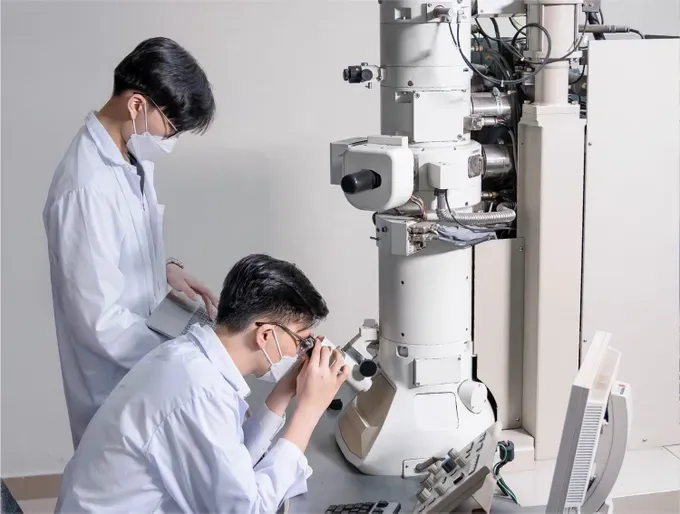
The Ministry of Education and Training has so far received 185 talent training programs proposed by 24 higher education institutions at the engineering and master’s levels across various domains of natural sciences, life sciences, mathematics and statistics, computer and information technology, engineering, engineering technology, manufacturing and processing, as well as architecture and construction.
The Education and Training Ministry will select approximately 80 talent training programs among them that fulfill the requisite criteria, allowing universities to commence implementation in 2026 with an estimated enrollment of 3,000 students. In subsequent years, there will be 100 training programs, accommodating an average of 6,000 enrolled students annually.
Simultaneously, the Education and Training Ministry will instruct institutions to formulate talent doctoral training schemes for deployment from 2026, encompassing roughly 60 programs and recruiting 300 PhD candidates. Successive years will feature 100 programs with approximately 800 to 1,000 PhD candidates per year.
Regarding the semiconductor industry, in 2025, the Ministry of Education and Training promulgated the standard curriculum for undergraduate and master’s levels, assigning 19 educational institutions to participate in its implementation. To date, 62 training programs from 26 higher education institutions have actively participated. The ministry has established a dedicated council and organized rigorous appraisals to select these programs.
Within the nuclear power sector, the Education and Training Ministry is deploying a human resource training scheme that encompasses establishing a standardized undergraduate curriculum for nuclear power, while simultaneously submitting a proposal for the Government to consider promulgating a Decree concerning scholarships, student credit, and preferential treatment for both lecturers and learners.
In the railway sector, the Ministry of Education and Training is executing a railway human resource training scheme that has already secured the Prime Minister’s official approval.
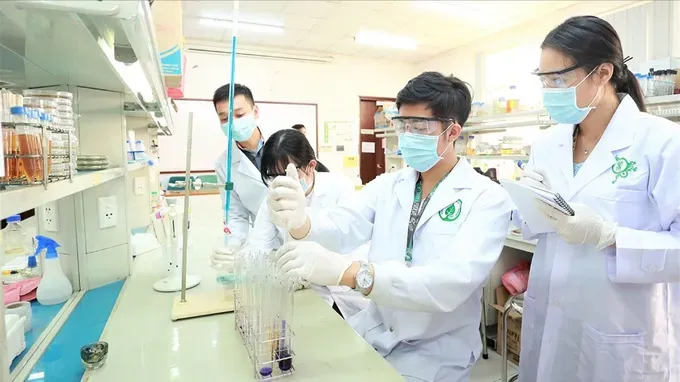
Head of the Academic Affairs Department at HCMC Industrial University Dr Nguyen Trung Nhan informed that the institution has formally registered bachelor’s and master’s programs across disciplines within the STEM (Science, Technology, Engineering, and Mathematics) fields. This constitutes a highly positive signal for attracting and cultivating strategic technological human resources for the nation’s new developmental era.
However, the overarching issue remains that financial provisioning must guarantee long-term sustainability, avoiding situations akin to the pedagogical sector where numerous universities bore the financial burden while awaiting delayed disbursements. Consequently, there must be unambiguous policies to stimulate public-private partnerships, thereby securing enduring financial resources for this specific educational system.
Meanwhile, former Director Hoang Ngoc Vinh of the Professional Education Department (under the Ministry of Education and Training), argued that selecting learners from the top 20-percent tier for talent engineering and master’s programs is a remarkably rational trajectory to ensure optimal input quality. Nevertheless, the policy must also account for a tangible risk, which is the escalating trend of students transitioning towards social sciences, whereas the recruitment pool for natural sciences and engineering exhibits evident signs of contraction.
Regarding finances, to achieve genuine sustainability, this policy can’t solely rely on the State budget; rather, it’s imperative to heavily promote the public-private partnership model. Specifically, enterprises must place explicit training orders, participate directly in financial subsidization, and jointly commit to post-graduation employment outcomes, thereby rendering the policy substantially more practical and sustainable.
Institutions possessing formidable strengths in STEM education, such as member universities of Vietnam National University – Ho Chi Minh City, HCMC University of Technology and Engineering, and Hanoi University of Science and Technology, alongside the Education and Training Ministry and relevant ministries, must unequivocally clarify the financial support mechanisms for learners.
Coupled with this is the critical issue of ensuring viable career trajectories for graduates to prevent mid-course disruptions that waste budgetary resources and adversely affect the students.
The Prime Minister officially promulgated Decision No. 29/2025/QD-TTg on August 28, 2025, concerning special preferential credit for students of high schools and universities, as well as PhD candidates pursuing science, technology, engineering, and mathematics disciplines.
Accordingly, learners are fully eligible for financial loans to cover tuition fees alongside a maximum monthly living allowance of VND5 million (US$190). Furthermore, these students receive comprehensive credit loan support throughout the entire duration of their academic courses at a highly preferential interest rate of 4.8 percent per annum.