Through Vietnam-South Korea cultural exchange activities, primary school students are improving foreign-language skills, broadening their knowledge, and building confidence in connecting with international peers as the education sector works toward developing global citizens.
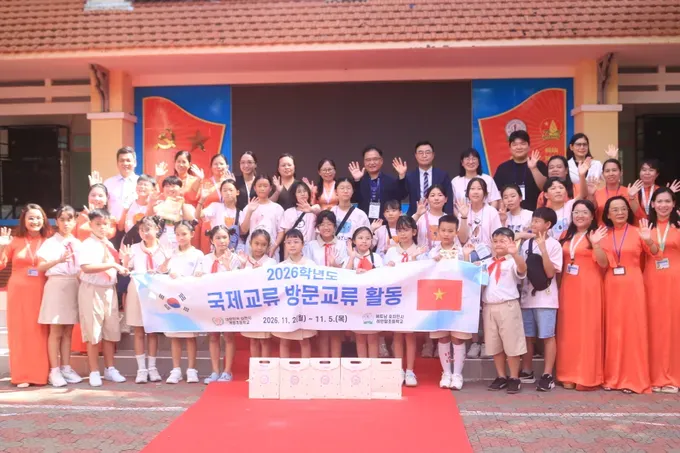
Le Van Tam Primary School in Tan My Ward, Ho Chi Minh City, recently welcomed a delegation of administrators, teachers, and students from Gaeryeong Elementary School in Gyeongsangbuk Province of South Korea, for a cultural and educational exchange program.
During the visit, Vietnamese and South Korean students enjoyed a series of performances and exchanged meaningful souvenir gifts. Students from Le Van Tam Primary School confidently introduced traditional Vietnamese childhood games such as hopscotch, o an quan, and jump rope. In return, South Korean students enthusiastically taught their Vietnamese counterparts how to play a traditional Korean folk game involving throwing arrows into a container.
Laughter and excitement were evident among students from both countries. Ho Tran Gia Khang, a fourth-grade student at Le Van Tam Primary School, said: “I am very happy and excited to interact directly with South Korean friends. Through this activity, I have not only learned more about their culture but also gained a foundation that will help me confidently step out into the world and become a global citizen.”
Student Kim Ain at Gaeryeong Elementary School said: “This exchange helped me better understand Vietnamese students and discover many interesting traditional games. After returning to South Korea, I will introduce these impressive cultural features to my friends.”
The cultural exchange program is not merely a one-off activity but part of a long-term development strategy for both the school and Ho Chi Minh City's education sector.
School principal Tran Tieu Quynh said that beginning in the 2024-2025 academic year, the school launched international exchange programs with delegations from the Gyeongsangbuk Provincial Office of Education in South Korea. Building on that foundation, the school expanded cooperation and established ties with Gaeryeong Elementary School. The two institutions signed a memorandum of understanding aimed at building a long-term partnership, strengthening exchange, experiential learning, and cultural activities, and creating more valuable learning opportunities for teachers and students in both countries.
The core objective of direct exchange activities is to give students opportunities to use foreign languages in real-life communication settings rather than limiting learning to theoretical knowledge from textbooks. Through direct interaction with international peers, students gradually develop confidence, learn to ask questions, proactively share their thoughts, and connect with people from different cultural backgrounds.
“We believe that international integration does not mean losing national cultural identity. In every exchange program, the school emphasizes introducing Vietnamese culture through gifts, cuisine, and traditional experiential activities. This helps students not only learn about and respect other cultures but also appreciate, take pride in, and know how to introduce the unique cultural values of Vietnam to the world”, Principal Tran Tieu Quynh said.
With more than 2.6 million students, Ho Chi Minh City is expanding opportunities for both students and teachers to access international learning environments. International cooperation models are also being implemented in a systematic and professional manner.
At Tran Dai Nghia Secondary and High School, the institution annually establishes an International Relations Advisory Council comprising members with expertise and experience in teaching, finance, and logistics. The council is responsible for advising on cooperation strategies, seeking potential partners, supporting program implementation, and gathering feedback from parents, students, and partners to improve the quality of international engagement activities.
Entering a new phase and recognizing international integration as a prerequisite for training global citizens, Ho Chi Minh City's education sector is focusing on five key solutions:
First, standardizing governance procedures by establishing standardized processes for international activities and strengthening decentralized management combined with rigorous oversight.
Second, developing core personnel by enhancing training and capacity-building for staff engaged in international relations and cooperation while modernizing educational management in line with international standards.
Third, digitalization and technology application by digitizing all diplomatic and international cooperation activities and promoting the use of artificial intelligence (AI) and digital transformation in governance.
Fourth, expanding international programs by strengthening partnerships with foreign education programs and broadening recognition of international diplomas and certificates.
Fifth, mobilizing comprehensive resources by optimizing social resources and creating favorable conditions for educational institutions to proactively access international learning environments.
These strategic solutions are expected not only to enhance the quality of educational international relations but also to create broader development opportunities, enabling Ho Chi Minh City students to confidently enter an era of global integration with modern knowledge and a strong cultural identity.
Resolution 71 of the Politburo on breakthroughs in education and training development states that education must balance broad access and excellence, comprehensive development and specialization, as well as national identity and global perspectives. It calls for educational development based on cultural foundations and traditional national values while embracing the finest achievements of humanity and international standards, with the goal of educating and training Vietnamese citizens to become global citizens.