Achieving double-digit economic growth in 2026 will hinge on pooling and deploying investment resources, with public funds playing a pivotal role, according to experts.
Massive capital demand
The National Assembly has targeted 10 percent GDP growth for 2026, a goal that demands enormous capital inflows. A scenario from Do Thien Anh Tuan, a lecturer from the Fulbright School of Public Policy and Management, puts public investment as high as VND1.65 quadrillion US$(63 billion).
At a recent policy forum, Tuan said total social investment currently runs at about 33 percent of GDP, with the public component around 10 percent of GDP, or 28 percent of overall investment. Assuming 10 percent real growth and 4 percent inflation in 2026, the nominal economy could top VND14 quadrillion.
The Ministry of Finance estimated that a 10 percent growth would require nearly VND4.93 quadrillion in total social investment, or 33-33.7 percent of GDP, up 18.7 percent from an expected VND4.15 quadrillion (32.3 percent of GDP) in 2025. While lower than some scenarios, the figure signals exceptional funding needs.
Meanwhile, the legislature approved VND1.12 quadrillion in state budget spending for 2026 development, of which public investment stands at VND1.08 quadrillion, including VND430 trillion from the central budget and VND650.26 trillion from local budgets, plus other allocations. Bridging the gap to VND4.93 quadrillion will require aggressive private-sector and foreign capital mobilisation.
Deputy Finance Minister Do Thanh Trung said fiscal policy will remain a growth catalyst, but capital markets must evolve into a primary channel for medium- and long-term funding to ease bank credit dependence. The business sector's role in aggregating and deploying resources also needs strengthening.
According to Vice Secretary General and Director of the Legal Department of the Vietnam Chamber of Commerce and Industry (VCCI) Dau Anh Tuan, a series of amendments to laws and policies, including the Investment Law, the Public Investment Law, and legislation on land, construction, and planning, are facilitating investment. Decentralisation and greater local authority over capital reallocation stand out as key enablers.
Improving investment efficiency a key
Tuan noted that Vietnam's post-pandemic Incremental Capital-Output Ratio (ICOR), a gauge of investment efficiency, averages 5.85, high relative to regional peers and signalling suboptimal capital use. Without improvement, 10 percent growth could demand social investment exceeding 47 percent of GDP, creating an unsustainable strain. A more viable path keeps investment near 40 percent of GDP while cutting the ICOR below 5.
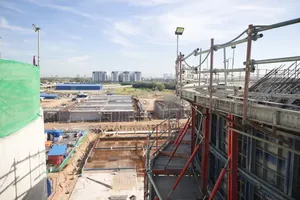
Accelerating disbursement is critical for public investment effectiveness, with research showing timing matters as much as scale, he said.
As of December 18, 2025, disbursement reached just 66.1 percent of the Prime Minister's plan, Tuan said, underscoring the need for more progress from project selection and preparation through site clearance and resolving bottlenecks in materials and procedures.
He advocated shifting oversight from mere disbursement rates to full life-cycle effectiveness, warning that an excessive emphasis on disbursement ratios could lead to the selection of inefficient projects or the pursuit of progress at any cost.