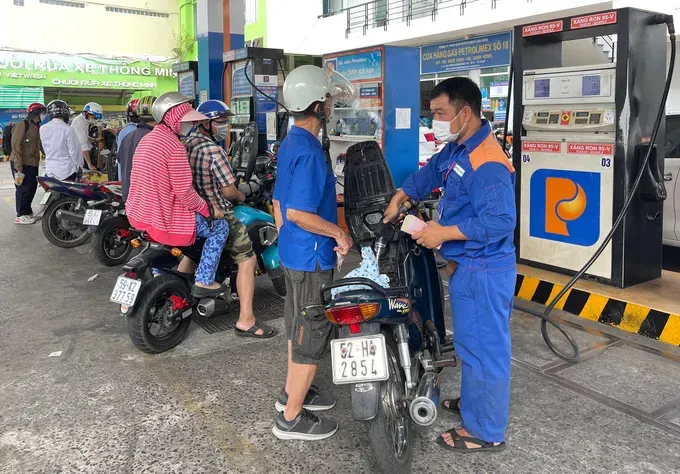
Prompt policy measures by the Government and relevant ministries have helped stabilize Vietnam’s fuel market and curb hoarding, despite sharp global oil price fluctuations driven by tensions in the Middle East.
Domestic fuel prices have been adjusted in line with global refined petroleum price movements. According to reports from local Departments of Industry and Trade, since March 8, following the latest price adjustment by the Ministry of Industry and Trade (MoIT) and the Ministry of Finance (MoF), cases of fuel hoarding and queues for stockpiling have declined.
Measures under Government Resolution No. 36/NQ-CP are also being implemented to diversify crude oil sources for domestic refineries. MoIT continues to inspect key fuel traders to ensure compliance with the minimum supply requirements for 2026, while working with relevant forces to strengthen market supervision and prevent speculation and stockpiling. The ministry is coordinating with MoF to develop price stabilization measures, including the possible use of the fuel price stabilization fund and proposals to reduce certain taxes and fees.
According to the task force for energy security, retail fuel prices in several countries have recently surged due to the impact of the Middle East conflict. Domestically, Vietnam’s two major refineries, Dung Quat Oil Refinery and Nghi Son Refinery and Petrochemical LLC, currently meet around 70 percent of the country’s fuel demand.
The remaining 30 percent is supplied through imports. Fuel importers reported that supply for March 2026 remains largely secure, though imports in April may face challenges as global prices rise and some countries limit exports to safeguard their own energy security.
In response to global price movements and in line with Resolution No. 36, MoIT and MoF have adjusted domestic fuel prices accordingly. Under the price adjustment on March 7, the base price of RON95-III gasoline rose to VND27,047 (US$1.03) per liter, up VND4,707 or 21.07 percent compared with the previous period, while diesel 0.05S increased to VND30,239 per liter, up VND7,202 or 31.26 percent.
Alongside price management aligned with global trends, market inspection and supervision have also been intensified. According to MoIT, following the price adjustment at 3 p.m. on March 7, fuel distributors in Hanoi reported stable supply conditions for the coming days. Daily sales between March 4 and 8 increased by about 50 percent compared with the average level recorded in January.
In recent days, concerns over rising prices and potential supply disruptions prompted some people to rush to purchase and store fuel in various forms, causing a short-term surge in demand. Such behavior was more common in northern provinces, particularly in Hanoi, while the phenomenon was less pronounced in central and southern regions.