At this time, pepper farmers in the country's pepper-growing regions are entering the harvest season for 2026. With current high prices, it is expected that pepper export revenue will surpass that of 2025, bringing high income to farmers and profits to businesses.
Central Highlands farmers reap profits as coffee, durian, and pepper prices surge
The recent Lunar New Year (Year of the Horse) was considered a big win for farmers in the Central Highlands provinces, as many key crops in the region, such as coffee and durian, fetched good prices. Even more joyful is that as soon as the coffee harvest season ended, farmers entered the main pepper harvest season, opening up a promising season with good income.
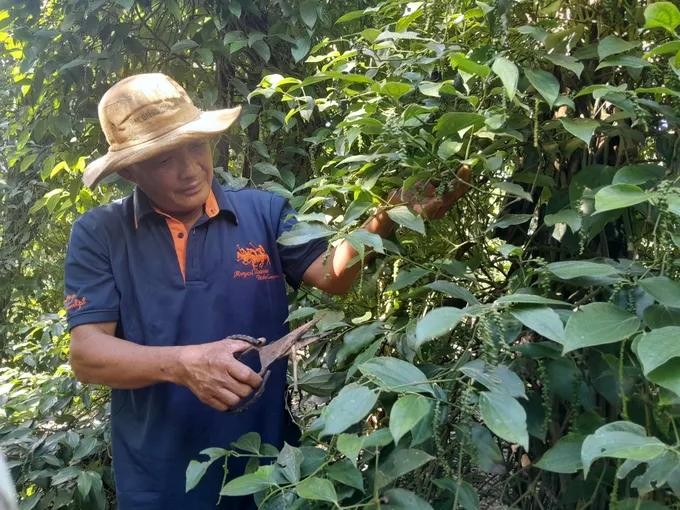
While diligently picking ripe peppercorns in her garden, farmer Le Thi Thom from Quang Phu Commune of Dak Lak Province, couldn't hide her joy when talking about this year's agricultural prices. Her family has nearly 1 hectare of land planted with coffee intercropped with pepper, along with 5 sao (approximately 0.5 hectares) of durian.
Before Tet (the Lunar New Year), when harvesting coffee, the price was VND102,000 a kg, and the price of durian also remained above VND70,000 a kg. At these prices, farmers made a high profit. After Tet, her family continued with the pepper harvest. The price at the beginning of the season was over VND150,000 a kg, which was ideal. “Many people in the area are waiting for the pepper harvest to finish before going to the showroom to buy a new car,” she said.
In Tan Hoi hamlet of Tan Tien border commune, Dong Nai Province, farmer Le Van Den's family has over 20 years of experience growing pepper. Currently, his family has more than 3,000 mature pepper plants and 600 newly planted pepper plants at the beginning of the 2025 rainy season. According to Mr. Den, in the past, when pepper prices were high, his family had more than 4,000 plants in their garden.
During the time when prices fell significantly, the family decided to eliminate some of the plants. A transformation occurred in 2024 when they harvested 4 tons of peppercorns, selling them for VND160,000 per kilogram. After accounting for expenses, the family realized a profit of around VND500 million. Although they faced challenges with fluctuating prices and pepper vines succumbing to disease, Mr. Den's family has now rightfully reaped the rewards of their dedication to cultivating the aromatic black peppercorns!
A paradox is unfolding during this harvest season as pepper prices remain high while cultivation areas continue to shrink. Hoang Phuoc Binh, former Vice Chairman of the Chu Se Pepper Association in Gia Lai Province, explained that although precise statistics are unavailable, evidence from key growing regions shows a steady decline in pepper acreage. He recalled that between 2018 and 2020, when selling prices fell below production costs, many farmers abandoned their plantations, leaving lasting effects on the industry.
“Like in 2020, the selling price at that time was only VND34,000-VND35,000 per kg, while the production cost was VND50,000 per kg. For every kilogram of pepper, growers lost up to VND15,000. In addition, unfavorable weather conditions and many pests and diseases caused the yield of the gardens to decrease, leading many farmers to abandon pepper cultivation,” Mr. Binh recounted. Since 2021, some people have started planting again, but the area is not large.
According to data from the Department of Customs under the Ministry of Finance, in 2025, Vietnam is projected to export over 246,000 tons of various types of pepper, reflecting a decrease of 1.5 percent compared to 2024. However, due to a significant increase in the average export price by 28.3 percent, the total revenue still rose by 26 percent, reaching US$1.66 billion, the highest ever recorded. The United States continues to be the largest destination for Vietnamese pepper exports.
Building sustainable, specialized cultivation areas
Due to limited production, businesses are forced to import pepper from abroad. Le Viet Anh, General Secretary of the Vietnam Pepper and Spice Association (VPSA), said that Vietnam's pepper inventory from 2022 and 2023 has been depleted.
In 2025, to meet order demands, the country’s pepper industry had to import 42,688 tons of pepper, an increase of over 16 percent in volume and approximately 51 percent in value compared to 2024. This year, businesses may continue to import more as global demand is expected to increase, while domestic production is forecast to decrease by 15-20 percent.
Meanwhile, according to the Agency of Foreign Trade under the Ministry of Industry and Trade’s forecast, global pepper supply in 2026 is likely to decrease sharply by 15 percent -20 percent, as inventories in most major producing countries worldwide are declining.
This is quite surprising because Vietnam is the world's number one pepper exporter, accounting for 50 percent of total global production, yet it still has to import a large amount from other countries annually. Vietnamese businesses mainly import pepper for processing and export.
According to VPSA, the 2026 pepper harvest in Vietnam will begin in late February and last until the end of April. VPSA predicts that farmers are unlikely to sell off their entire crop en masse; instead, they will only sell a portion to cover harvesting costs and fertilizer expenses. Some farmers with sufficient funds will store their pepper in warehouses, waiting for prices to rise. The limited supply has raised concerns about a challenging year for Vietnam's pepper exports.
Meanwhile, experts predict that global pepper demand will rebound this year, especially in the US market, after tariffs on pepper were reduced to zero percent and many countries increased purchases. In addition, new positive growth is expected from the Chinese market, as the country's reserves are believed to be low and insufficient to meet consumer demand.
For sustainable growth of Vietnam’s pepper industry, Director Huynh Tan Dat of the Department of Crop Production and Plant Protection under the Ministry of Agriculture and Environment has emphasized the need for businesses to expand raw material areas, strengthen cooperation with farmers, and adopt advanced cultivation techniques to boost productivity.
Vietnam’s pepper sector is being urged to invest in deep processing to capture premium markets, boost product value, and reinforce the country’s standing on the global pepper map.