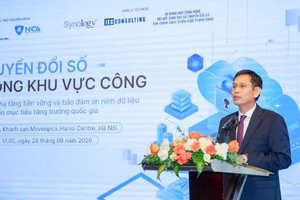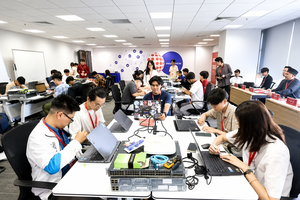
Director of Kaspersky Vietnam Ngo Tan Vu Khanh evaluated the dark side of AI application in cyber security. While AI helps protect netizens, it’s also reportedly being thoroughly exploited by malicious actors.
What he’s most concerned about is that AI tears down the technical barriers to executing a cyberattack. A layperson, even without a deep technological background, can still leverage AI to automate numerous attack stages and generate sophisticated phishing content. Thus, AI is essentially democratizing attack capabilities, meaning threats can emerge from anyone who knows how to exploit it.
The good news is that AI also democratizes defensive capabilities. When ill-intention people use AI to attack, security firms also apply AI and machine learning to analyze data, identify anomalous behaviors, and detect new malware variants. The system works relentlessly and automatically, even when experts are resting. At the end of the day, the modern security warfare has morphed into a direct confrontation between AI-supported defensive agents and AI-supported offensive ones.
To be more specific, currently, each Malware Analyst can handle thousands of malicious codes a day. When network safety monitoring experts take a break, the AI system still automatically operates with precision and compliance.
But that doesn’t mean those working in the security sector can just let their guard down. In the security industry, AI currently doesn’t replace humans; it merely helps people see faster, analyze deeper, and react sooner. This means security experts still play a crucial role in determining the context, assessing risks, and making final decisions.
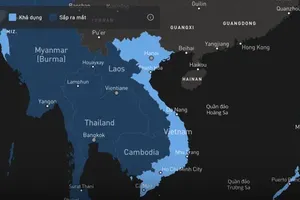
The world is shifting from a system protection mindset to building resilience against attacks, known as Cyber Resilience. That means people are preparing to detect sooner, react faster, and recover better. According to the 2024 Global Cybersecurity Index (GCI) by the International Telecommunication Union (ITU), Vietnam scored 99.74 out of 100 points, ranking 17th globally and 3rd in ASEAN on this matter.
Notably, the legal framework has been perfected with three major laws promulgated in 2025, namely the Cybersecurity Law, the Personal Data Protection Law, and the Artificial Intelligence Law, which have erected new fences helping the Vietnamese combat cyberattacks much better.

As to helpful methods to identify online scams involving AI, Director Ngo Tan Vu Khanh advised that Internet users need to watch out for several basic red flags.
Deepfake videos demanding urgent money transfers are a prime example. AI-simulated voices over phone calls requesting unusual actions also happen frequently. Emails and messages written with perfect grammar by AI, yet displaying unusual personalization to exert pressure, are quite common. Spoofed websites are professionally designed to look identical to real ones. Suspicious QR codes sent from hacked accounts are another tactic.
As for businesses, deep attacks are notoriously hard to detect; therefore, enterprises should build an AI-supported Security Operations Center (SOC) to analyze anomalies.
From international experience and in numerous practical cases, future defense can’t rely solely on technology. There’s an urgent need for a robust, parallel three-layer model encompassing Technology, Policy, and People. Technology is meant to prevent, policy to govern, and people to identify. Only when coordinating harmoniously can people forge a reliable digital foundation for national digital transformation.
In 2025, Kaspersky reportedly blocked 23.84 million web threats targeting Vietnamese users, equating to over 65,000 attacks a day.