Sticking with citizens’ matters to the very end
“Uncle, I’ve received my diploma. Thank you so much!” This joy-filled message from Kim Thi Anh Thoa to Mr. Nguyen Duc Minh, a specialist at HCMC’s Dong Hoa Ward, serves as a vivid testament to a transformative public service.
While prepping her study-abroad dossier, Thoa unexpectedly discovered incorrect data on her junior high school diploma. According to strict regulations, if choosing the “proper procedure,” ward-level officials hold the absolute right to refuse her case since they lack jurisdiction.
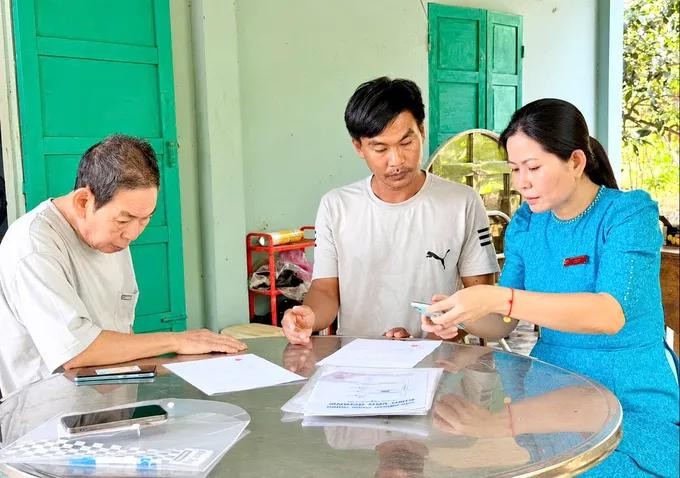
But Mr. Minh opted for a different approach so Thoa’s educational opportunity wouldn’t be derailed. He proactively contacted the Department of Education, patiently guiding her step-by-step to complete the paperwork. After three weeks of close support, the diploma was accurately adjusted.
Just a few years ago, this task would’ve forced citizens to painstakingly “knock on doors” across multiple agencies. “I don’t just choose what falls exactly under my duties; I choose how to get things done for the people,” Mr. Minh stated.
That dedication isn’t an isolated case; it’s deeply ingrained in Dong Hoa Ward. Beyond regular reception schedules, Chairman of the ward People's Committee Vo Trong Tai proactively sets aside four Tuesdays a month to directly untangle residents’ hurdles, ranging from land transfers to site clearance compensation. His operational principle dictates that officials must immediately handle matters within their purview. For cases exceeding their authority, they must coordinate with relevant agencies, never leaving citizens to seek help alone.
This spirit clearly manifests during pressing incidents. In late July 2026, when Bcons Center City apartment construction caused subsidence in numerous residential houses, rather than waiting for written reports, the Chairman directed officials to inspect the site immediately. After exactly one week of fierce intervention, the issue was definitively resolved. Residents agreed with the proposed solution, while the investor provided adequate compensation.
Looking closer, the ward also proactively supported disadvantaged households needing temporary shelter. “A meeting might wrap up in a few hours, but the job is only considered done when citizens receive final results,” Chairman Tai concluded.
It’s precisely this dedication that elevates grassroots service quality. Duc Nhuan Ward consistently maintains a 100 percent rate of on-time dossier processing, with satisfaction hitting approximately 99 percent. Regarding social welfare, party members in the ward must walk every alley to forge practical support solutions for vulnerable families.
Executing fiercely to deliver welfare benefits to those in need
Looking back at the revolution to streamline the political apparatus, there were initial apprehensions. However, the achievements gleaned serve as a compelling answer. Streamlining machinery creates massive financial headroom for social welfare policies.
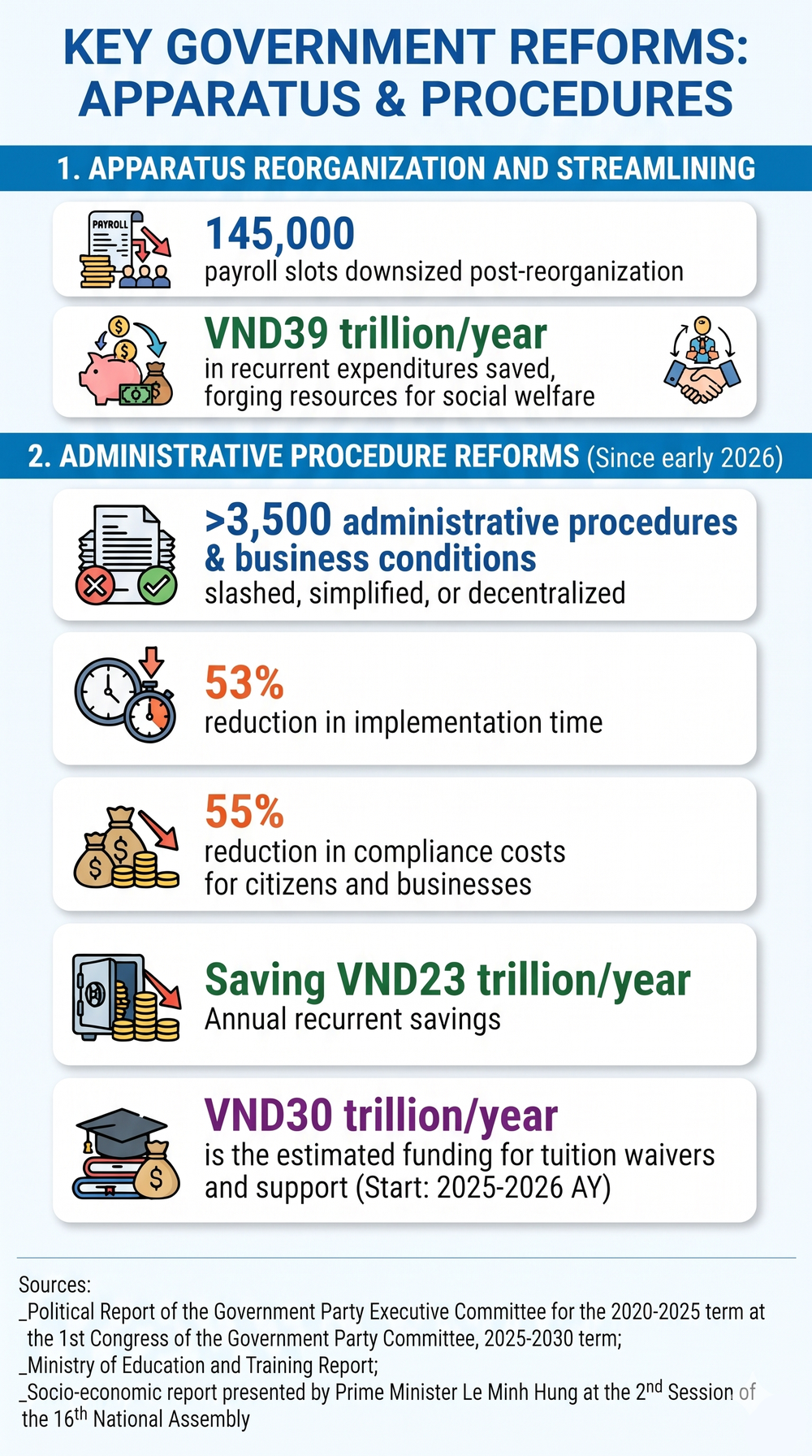
Specifically, downsizing 145,000 payroll slots nationwide helps save approximately VND39 trillion (US$1.5 billion) annually. Thanks to this, humane policies have been activated, including waiving tuition from preschool through public high school, with total estimated funding of roughly VND30 trillion ($1.16 billion) starting the 2025-2026 academic year.
Furthermore, scientific resource allocation grants localities the capacity to execute welfare projects. Using budget savings, HCMC proactively rolled out a free health checkup program for all residents alongside free public bus rides. HCMC’s execution of the Politburo’s Resolution 72-NQ/TW stands as a quintessential example of the “no backtracking” ethos. Being the most populous metropolis objectively creates risks for a 100 percent target; nonetheless, HCMC focused heavily on universal health screenings.
Faced with a colossal workload, health leaders expressed apprehensions about examining 100 percent of residents in 2026. However, HCMC Party Secretary Tran Luu Quang firmly concluded, “With the potential and medical facilities of the city’s health sector, failing to pull this off is unacceptable. We must get it done; whatever the hurdles or needs are, you report them so we can clear the way.”
This fierce directive ignited the entire system. By October 20, over 6.3 million people citywide had received free screenings, with Thanh An Commune notably becoming the first to screen 100 percent of its residents.
Implementing the two-tier local government model, roughly 70 percent of state management tasks from the Central level have been heavily decentralized and delegated down to local authorities. Directly absorbing this massive volume of state management duties, public service provisions, and administrative procedures, the commune-level apparatus has truly become the frontline, directly resolving the affairs of citizens and businesses with a service-oriented mindset.
Spreading an atmosphere of substantive action
A vibrant wave of action is spreading nationwide. The grassroots apparatus has decisively shifted from merely “listening to feedback” to proactively “seeking out tasks.”
In Hung Yen Province, Vu Thu Commune officials head into residential areas, “knocking on doors” to chat over tea while recording opinions. In Dong Nai City, the “Morning with citizens” model sees leaders directly visiting localities to hear proposals, promptly fixing resident-reported issues like damaged roads or flooding. Meanwhile, “No-Appointment Day” models applied in the provinces of Gia Lai, Lam Dong, Quang Ngai, and Hai Phong City are enabling citizens to receive same-day results for common administrative registrations such as copy authentication, signature verification, civil status extraction, birth and marriage registration, marital status confirmation, plus business and land registration.
This vivid reality demonstrates that eliminating intermediary layers within the two-tier local government model is effectively paying off. The passive mindset has given way to a more proactive spirit, clearing bottlenecks while fortifying the people’s trust in the public apparatus.
Yet, facing goals of elevating the country into a modern industrial nation by 2030 and a high-income developed nation by 2045, new governance requirements have emerged, where discipline and KPIs are applied as the “political lifeline metric of officials.”
To build a public service predicated on substantive action, Party Secretary Phan Thi Thanh Phuong of Duc Nhuan Ward in HCMC stated it’s imperative to synchronously overhaul everything from task delegation to official evaluation. Each mandate must clearly identify responsible personnel, deadlines, as well as deliverables, while leaders take on tough jobs to set an example.
Alongside explicitly assigning tasks, inspections must prioritize actual progress over mere registrations. Every briefing should answer what’s been done, what the results are, and how citizens benefit from that. Once leadership by example is quantified by tangible outcomes, this proactive spirit becomes the grassroots political system's daily habit.
For Mr. Hoang Nam, a Binh Dong Ward resident, the shift is palpable. Previously, flawed dossiers were returned, forcing citizens into arduous restarts. Nowadays, officials thoroughly explain issues, contacting relevant departments to verify data. Procedures once taking weeks now finalize in days. Through this dedicated attitude, citizens feel genuinely respected, rather than having to beg for resolutions.