Pioneering wooden boat voyages
Following the 1954 Geneva Accords, the nation was subjected to a temporary partition. As the Southern revolutionary movement flourished, particularly after the Ben Tre uprising, the demand for weaponry became increasingly desperate. Since the Truong Son overland artery couldn’t fully satisfy logistical requirements, opening a maritime supply route heading South became an absolute imperative.
Confronting this predicament, the Central Military Commission directed comprehensive studies regarding seaborne transportation. Several wooden boat expeditions journeying North between 1961 and 1962 actively surveyed viable routes as well as receiving ports.
On October 23, 1961, the High Command resolved to establish the 759th Water Transport Group, initially comprising approximately 38 soldiers.
At 92, veteran Huynh Van Tien, currently residing in HCMC, remains remarkably lucid. For Mr. Tien, recalling those maritime odysseys brings back crystal-clear memories of incredibly resilient marches amidst the vast ocean.
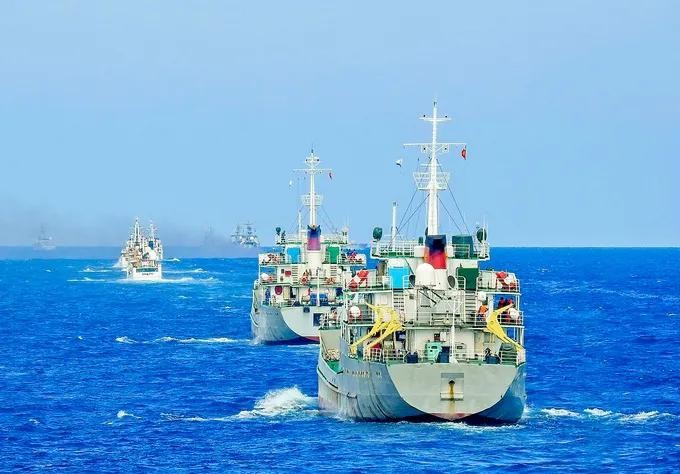
He recounted that their earliest vessels were merely wooden sailboats, carefully disguised as ordinary fishing boats. To maintain utmost secrecy, these ships didn’t bear fixed registration numbers, seamlessly blending into civilian operations. Their itineraries were constantly altered based on enemy operations. The legendary nickname “No-Number Fleet” fundamentally originated from that highly unusual operation.
On August 18, 1961, a vessel departed from Con Tra Port in Ben Tre Province (now Vinh Long Province). The crew included sailor Huynh Van Tien, who had joined the revolution at just 14. Prior to this secret mission, he only had time to bid his mother a hasty farewell, entirely unable to disclose his destination. It wasn’t until the South was entirely liberated, 15 years later, that he finally returned.
“The maiden voyage was fraught with immense hardships as our boat lost its bearings, encountered massive swells, and saw freshwater barrels shatter completely. We had to stretch blankets to catch morning dew before safely reaching Thanh Hoa Province,” Mr. Tien recalled.
In October 1962, the very first ship hauling 30 tonnes of munitions departed Do Son, docking at Vam Lung eight days later. Over a two-month span, four expeditions successfully transported 111 tonnes of weaponry. Transport modalities were gradually improved, eventually ushering in iron-hulled ships designed for heavier payloads. On January 29, 1964, Group 759 officially changed its designation to Group 125.
By 1964, hauling roughly 44 tonnes of arms, Mr. Tien’s Ship No.41 ran aground amidst a Hoang Sa coral reef. Despite razor-sharp coral mercilessly lacerating his flesh, he dove down to tie steel cables, relentlessly working to save the ship. He declared to his captain that he’d rather die in the deep abyss than lose the vessel, as they absolutely had to deliver those weapons to fight the enemy.
Shifting tactics, sustaining lifeline
As the Southern battlefield plunged into a fiercely decisive phase, seaborne voyages continually sought pathways through heavily policed waters. During the 1968 Tet Offensive and Uprising, logistical requirements became exceedingly frantic.
Between February 25-27, 1968, four vessels from Group 125 sequentially departed their bases, heading towards disparate destinations. Ship 165 targeted Vam Lung, Ship 56 aimed for Lo Giao, Ship 43 navigated to Duc Pho, while Ship 235 set a course for Hon Heo. This deliberate splintering aimed to effectively scatter the enemy’s surveillance efforts, which means each had to maneuver autonomously, handling unpredictable situations at sea by itself.
Despite navigating numerous roles, from serving as a sailor on Ship 56 to commanding Brigade 125, Colonel Ho Van Kiem hasn’t forgotten the intense battle of wits during that fateful 1968 crossing. For Colonel Kiem, currently Chairman of the Vietnam Association of the Ho Chi Minh Trail on the Sea, the memory remains vivid.
In late February 1968, Ship 56, hauling over 37 tonnes of weapons, pushed toward Lo Giao Port. When the vessel was approximately 40 nautical miles offshore, blinding enemy searchlights abruptly swept in. The onboard Party cell accurately deduced that stubbornly attempting to reach the port would inevitably expose them, so the soldiers reached a unanimous consensus to pivot back towards international waters.
Subsequently, Ship 56 altered its heading multiple times in a desperate bid to dock, but they were relentlessly tailed. Adversaries utilized loudspeakers demanding they cut their engines, mixing aggressive threats with coaxing attempts. Mr. Kiem, standing firmly at the helm, hyper-focused on observing every subtle movement. Suddenly, a hostile patrol boat brazenly blocked their path. Ship 56’s armaments were fully primed, as explosive charges were meticulously prepped to scuttle the vessel should the cover be entirely blown.
“Armed with a death-defying spirit to absolutely prevent the ship and cargo from falling into enemy hands, we gripped our rifles tightly,” Mr. Kiem elaborated regarding his comrades’ ironclad determination. Following several grueling hours of evasive movements, the ship received a direct order to return to base, successfully preserving the vessel and its crew.
Meanwhile, the three other participating vessels tragically didn’t make it back. Ship 165 was heavily besieged while entering Vam Lung after attempting to jettison its cargo into the sea; all 18 soldiers perished alongside their ship. Ship 235 successfully infiltrated Hon Heo, dropping payloads before being swarmed by multiple gunboats; 14 men made the ultimate sacrifice. Ship 43 fiercely battled hostile warships for over three hours off Quang Ngai before ramming into the shoreline to self-destruct. Three soldiers died heroically, while the survivors were shielded by local civilians.
These “no-number” voyages effectively penned a sweeping epic of bravery and determination. Today, Brigade 125 continues to shoulder military transport missions, standing guard to defend national sovereignty.
For Colonel Pham Minh Chien, Political Commissar of Brigade 125, this historical legacy remains profoundly relevant. He emphasized that the indispensable lessons regarding the tactical ingenuity exhibited by the “No-Number Fleet” remain absolutely valid.
On October 23, Brigade 125 organized a grand ceremony commemorating the 65th anniversary of opening the maritime Ho Chi Minh Trail. During the event, they proudly received the second-class Fatherland Defense Order, hosting a solemn awarding ceremony conferring the title of Hero of the People’s Armed Forces upon three distinguished martyrs: Nguyen Ngoc Luong, Nguyen Tuong, and Tran Nho, who perished during those legendary 1960s crossings.