Outbreaks become more complex
For the past week, whenever she walks behind her house and sees the empty pigpens, Nguyen Thi Nga of Trang Co Hamlet, Tran Van Thoi Commune, Ca Mau Province, has been overwhelmed with sadness. Nga said all the capital and effort she invested in raising pigs over the past two years vanished because of ASF.
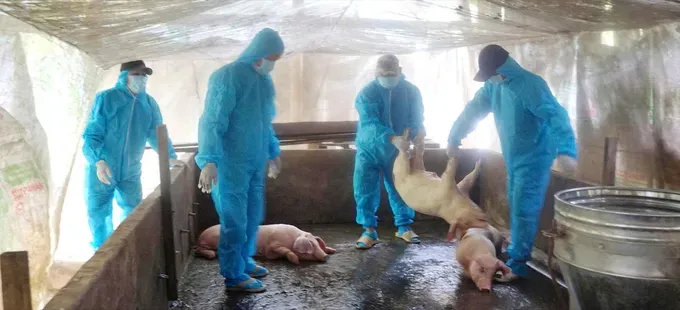
“In early October 2026, after learning there was an outbreak in the hamlet, I bought disinfectants and thoroughly sanitized the pens. I also fed the pigs more to improve their resistance. However, my two breeding sows and nine market pigs still contracted the disease. The family reported the case and veterinary authorities came to cull them on October 17,” Nga said.
Not far from Nga’s home, Nguyen Van Luc’s farm of more than 40 pigs also suffered an ASF outbreak, forcing the entire herd to be culled to prevent further spread.
“Most of the culled pigs were young pigs. I had only restocked the herd about 20 days earlier to raise them for the Lunar New Year market. Now the pigs are dead and I no longer have the money to restock. The coming Lunar New Year will likely be a sad one for my family”, breeder Nguyen Van Luc said.
Nguyen Van Cau, deputy head of the Economic Division of Tran Van Thoi Commune, said ASF is developing in a highly complex manner across the commune, with the number of infected pigs requiring culling increasing sharply in recent days. Over the past week, the disease spread to Binh Minh Hamlet, raising the number of affected hamlets in the commune to seven.
According to the Ca Mau Province Department of Agriculture and Environment, 23 ASF outbreaks have been recorded in 18 communes, affecting 138 livestock households. More than 1,660 pigs, weighing over 106 tons in total, have died or been culled. Nine outbreaks remain active and have not yet passed the 21-day monitoring period, concentrated in the communes of Tran Van Thoi, Vinh My, Da Bac, Khanh Binh, Chau Thoi, Vinh Loi, Hoa Binh, Tri Phai, and Vinh Thanh.
In Can Tho City, 11 outbreaks have emerged in eight communes since early October 2026, bringing the total number of infected pigs that have died or been culled since the beginning of the year to more than 900.
In An Giang Province, the number of communes affected by ASF doubled from five to 10 within just 15 days, from October 5 to October 20.
Authorities in An Giang Province have culled 319 pigs. Representatives of agriculture and environment departments across Mekong Delta localities said most ASF outbreaks have occurred among small-scale livestock households.
These farms have not strictly complied with disease-prevention regulations, including failure to fully isolate pig housing facilities and shortcomings in sanitation, disinfection, and decontamination measures.
Meanwhile, in Dong Nai City - known as the country’s “pig-farming capital" -authorities had recorded 78 African swine fever (ASF) outbreaks across 44 wards and communes by mid-October. The outbreaks resulted in the deaths or culling of 27,742 pigs.
Fourteen wards and communes still have outbreaks that have not passed the 21-day monitoring period, particularly in Bu Gia Map, Dak Lua, Dau Giay, Dinh Quan, La Nga, Nha Bich, and Binh Phuoc.
Strict control of culling, transport, and trade
Le Van Chi, deputy head of the Ca Mau Province Department of Livestock Production and Animal Health, forecast that the risk of ASF outbreaks emerging and spreading will remain very high during the final months of 2026.
He attributed the threat to erratic seasonal weather changes that weaken livestock immunity, along with a sharp increase in the transportation, trading, slaughtering, and consumption of pork products at year-end.
Agricultural authorities throughout the Mekong Delta are now focused on simultaneously implementing measures to prevent, control, and contain the disease to stop ASF from spreading further.
Quach Thi Thanh Binh, deputy director of the Can Tho City Department of Agriculture and Environment, said the department has asked commune and ward authorities to closely monitor disease developments, promptly collect samples for testing, and handle suspected infections.
Local governments are also carrying out the second-round vaccination campaign of 2026, targeting vaccination coverage of at least 80 percent of the total livestock herd.
Leaders of the Ca Mau Province Department of Agriculture and Environment have instructed the Department of Livestock Production and Animal Health to deploy more technical personnel to affected areas to directly assist and guide local authorities in completely eliminating outbreaks that remain within the 21-day monitoring period.
The department has also established inspection teams to monitor the transport of animals and animal products entering and leaving the province and outbreak areas, while coordinating with relevant agencies to tighten oversight of slaughterhouses and livestock trading facilities.
Nguyen Truong Giang, head of the Dong Nai City Department of Livestock Production and Fisheries, said the locality is mobilizing all available resources to eliminate outbreaks completely.
He stressed that burial and incineration operations are being carried out under strict procedures, with animal carcasses absolutely prohibited from being buried near rivers, canals, streams, or water sources.
The agency is also compiling accurate data on livestock households, farms, and total herd numbers for inclusion in a management database, while taking a firm stance against unlicensed and spontaneous livestock production that increases the risk of disease outbreaks.
Dong Nai City's livestock sector has warned that ASF is likely to remain complicated through the upcoming Lunar New Year. In outbreak areas, farm owners and livestock households are advised to temporarily suspend breeding activities and refrain from introducing new piglets until the disease situation is fully under control.
Fearing potential losses during the Tet holiday season, many pig farmers are holding off on restocking their herds.
The spread of African swine fever (ASF), coupled with a sharp decline in live hog prices, has left pig farmers facing mounting financial pressure. In Dong Nai City, live hog prices have fallen to VND45,000 per kilogram (US$1.7/ kg), down nearly VND10,000 from last month and VND6,000–VND7,000 from the same period last year. With animal feed costs also rising sharply, many farmers said that they could suffer losses at current prices.
Nguyen Van Ban, who owns a farm in Trang Dai Ward in Dong Nai City, shared that he still has over a thousand pigs that have exceeded their target market weight since mid-October. Although traders paid a deposit at the start of the rearing cycle, they have yet to arrive to collect the animals.
According to farm owner Nguyen Van Ban, one reason farmers are struggling to sell their stock is that several local livestock operations were recently found to be using banned substances. Concerned about food safety, a significant number of consumers have reduced their consumption of pork.
With the complex spread of ASF, low live hog prices, and difficulties in finding buyers, many farm owners are becoming cautious about restocking for the upcoming Tet season. In Trang Bom Ward of Dong Nai City, there were nearly 30 livestock farms with a total herd of approximately 15,000 pigs as of mid-2026. To date, more than 10 of these operations have suspended production for the Tet season, fearing potential losses.






)