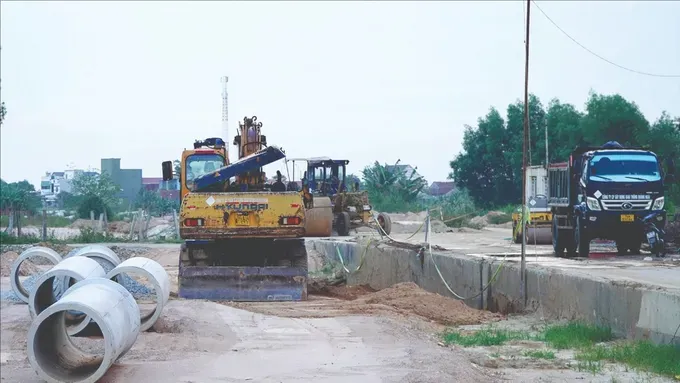
Despite being squarely in the peak construction season of June and July 2026, the atmosphere at many key transport projects across the Central region is reportedly quite subdued. Machinery lies dormant and laborers work sparingly. Consequently, numerous components are left glaringly unfinished simply due to a sheer lack of cleared land.
In Quang Ngai Province, the Hoang Sa – Doc Soi Road project, boasting an investment of roughly VND3.5 trillion ($134.2 million), still has many civilian houses and trees that haven’t been relocated, specifically through Truong Quang Trong Ward.
Sharing a similarly grim fate, the road connecting Thach Bich Bridge to Tinh Phong, costing nearly VND700 billion ($26.8 million), remains severely fragmented by site clearance bottlenecks even after nearly five years. The section connecting to National Highway 24B has been asphalted, but it screeches to a halt right in front of four uncleared houses.
For Mr. Nguyen Tan Duc, a retired official in Cong Hoa Neighborhood of Truong Quang Trong Ward, the prolonged schedule poses a real threat of stunting local developmental opportunities. He noted the project holds paramount importance in connecting the central area with VSIP and Tinh Phong Industrial Parks, while concurrently alleviating traffic pressure on National Highway 1A.
Over in Dak Lak Province, the coastal road project connecting Tuy An and Tuy Hoa, spanning 14.7km with a total capital of VND2.23 trillion ($85.5 million), is still entangled with uncleared properties of hundreds of households.
Meanwhile, the Phuoc Tan - Bai Nga Road project, stretching 3.8km with a VND489 billion ($18.7 million) investment, is still hindered by a single household in Da Ngu Neighborhood after more than a decade. It appears this agonizing delay inherently makes the route a potential hotspot for traffic safety hazards.
Speaking at a conference in July, Nghe An Province Party Secretary Nguyen Khac Than emphasized that compensation and site clearance act as the linchpin to unblock projects and propel growth. Sluggish clearance doesn’t merely squander investors’ opportunities but also fundamentally strips away developmental momentum. He sternly demanded that local administrations recognize site clearance as their explicit responsibility. They must fiercely execute these duties without passively waiting around.
A similar situation is unfolding as amidst the scorching July heat, the construction site of the Tam Tien Bridge in Tam Xuan Commune, Da Nang City, remains eerily desolate. The project, boasting VND220 billion ($8.4 million), was approved in 2019 to bridge the Truong Giang River. However, construction has only reached about 45 percent of its volume following numerous schedule extensions.
According to the Da Nang City Department of Construction, the locality currently has 21 bridge projects lagging in operational rollout. Upon thorough review, 18 of these projects are falling behind strictly due to site clearance bottlenecks.
Numerous other projects along the Central region are missing deadlines. The project to extend To Huu Street to Phu Bai Airport in Hue City, backed by over VND1.14 trillion ($43.7 million), still features chaotically excavated sections due to land entanglements. Meanwhile, the Song Cay road upgrade in Thach Ha urban area remains a messy quagmire of potholes and thick mud.
According to the Nghe An Province Department of Agriculture and Environment, by mid-July 2026, the entire province still had 30 public investment projects hopelessly bogged down by compensation issues. This massive bottleneck directly impacts over VND5.7 trillion ($218.5 million) of the 2026 capital plan.
Prolonged projects primarily inflict direct impacts on the daily lives of households. For Ms. Ho Tuong in Da Nang City’s Tam Xuan Commune, the reality is deeply frustrating. She complained that the Tam Tien Bridge project has lagged for years while the old bridge deteriorated severely. Consequently, citizens needing administrative procedures must take a convoluted detour through neighboring wards. Shockingly, vehicles still traverse the dilapidated structure despite explicit prohibition signs.
At Quang Ngai Province’s Hoang Sa – Doc Soi Road project, Long Ban residents reported their livelihoods along National Highway 24B are severely compromised as thick dust blankets their homes.
Not too far away, the 876-meter Chu Van An Road project has seen only 150 meters completed after a staggering decade. Initiated in 2012 with VND320 billion ($12.3 million), the project remains entirely mothballed today. It isn’t just spawning pollution and safety hazards; the agonizingly drawn-out resettlement process leaves residents in perpetual anxiety.
In the provinces of Ha Tinh and Nghe An, residents living along various road and embankment upgrades have endured arduous commutes for years, battling blinding dust and treacherous mud. Meanwhile, the colossal scheme to clear land for Hue City’s Imperial Citadel monument, boasting over VND4 trillion ($153.4 million), still has nearly 500 households refusing to hand over land after eight years.
In areas like Xa Tac Esplanade, Luc Bo Cultural Space, Hoc Hai Lake, numerous households continue living in an interspersed manner. This glaringly unsynchronized clearance process leads to massive construction waste backlogs, inevitably ruining the monuments’ aesthetic.
Functional agencies state most dossiers remain stalled because they heavily involve state-owned assets or complex land disputes. Furthermore, it appears some households simply don’t agree with the proposed compensation and resettlement plans to get the ball rolling.