The Politburo has agreed to designate November 24 each year as “Vietnam Culture Day,” a paid public holiday nationwide.
The decision is set out in Resolution No. 80 of the Politburo on the development of Vietnamese culture, signed by Party General Secretary To Lam.
The resolution affirms that culture and people are the foundation and a vital endogenous resource, a powerful driving force, a key pillar, and a regulatory system for the country’s rapid and sustainable development.
Cultural values are to be closely and harmoniously integrated into all aspects of social life—from politics, the economy, and society to the environment, national defense and security, as well as foreign affairs—becoming a genuine source of national soft power in the new era.
According to the Politburo, investment in culture is investment in the country’s sustainable development and the future of the nation. November 24 has therefore been designated as Vietnam Culture Day, with the principle that it will be a day off with full pay, enabling people to better enjoy cultural activities, encouraging artists and cultural practitioners to create, and promoting cultural and civilized lifestyles across society.
By 2030, the Politburo aims to accelerate the building and development of an advanced Vietnamese culture imbued with a strong national identity and to foster a healthy cultural environment from families and schools to society at large and the digital space.
Alongside the development of cultural industries and the formation of a start-up ecosystem for cultural industries and creative arts, the Politburo has called for the establishment of several internationally competitive cultural industry groups, based on high technology and innovative business models.
Specific targets include completing the national cultural infrastructure system, ensuring that 100 percent of two-tier local administrations and the armed forces have cultural facilities that meet the needs of grassroots communities, officials, and soldiers, and that 90 percent of grassroots cultural institutions operate regularly and effectively.
The Politburo has also set the goal of completing the digitization of 100 percent of nationally ranked and special national cultural heritage sites by 2026 and ensuring that all pupils, learners, and students in the national education system regularly and effectively access and participate in artistic activities and heritage education.
It requires resources commensurate with cultural development, with at least 2 percent of total annual state budget expenditure allocated to culture, to be increased gradually in line with practical needs.
In addition, cultural industries are expected to contribute 7 percent of GDP, with five to ten national brands in cultural industries to be formed in areas with strong potential, such as cinema, performing arts, cultural tourism, design, and fashion.
Aiming for the top 30 globally in soft power
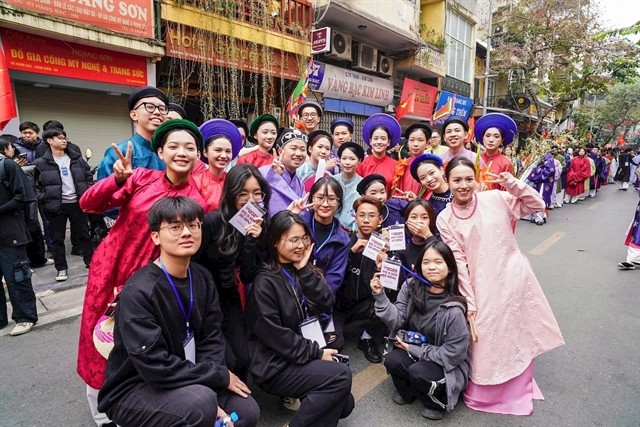
Looking to 2045, the Politburo underscored the goal of affirming Vietnam's cultural standing as a high-income, socialist-oriented developed country. By then, Vietnam is expected to be an attractive destination for major regional and international cultural and artistic events and to become one of the dynamic centers of cultural and creative industries.
The country aims to have 10 internationally recognized art festivals and cultural events and to secure the UNESCO recognition and inscription of an additional eight to ten cultural heritage sites.
Another target is for Vietnam to rank among the top three in ASEAN and the top 30 globally in the Soft Power Index, as well as in the export value of cultural industry products.
On implementation, the Politburo called for a fundamental renewal of thinking and a high degree of unity in awareness and action to develop culture in the new era, alongside improvements to institutions to create strategic breakthroughs and unlock resources for cultural development.
Measures include piloting new cultural business models linked to digital platforms, encouraging private sector investment in training institutions and cultural facilities, and offering preferential policies on land and corporate income tax exemptions or reductions for innovative start-ups in the cultural sector.
The Politburo also allows pilot implementation of urgent measures to create breakthroughs in cultural development in cases where legal frameworks are not yet in place, or existing regulations differ.
To realize these goals, it called for reforms in cultural governance towards a facilitative, service-oriented approach; stronger application of science, technology, innovation, and digital transformation as drivers of cultural development; and the building of a cultural ecosystem to promote creativity.