Health screenings for more than 6.8 million residents in Ho Chi Minh City have initially identified over 355,000 individuals falling into high and very high cardiovascular risk categories, according to a report delivered at the Ho Chi Minh City People’s Council meeting on October 30.
Initial assessment of residents’ health

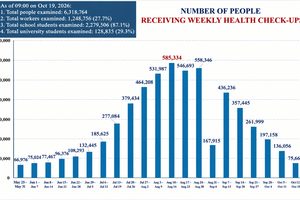
At the third working session of the 11th-term Ho Chi Minh City People’s Council’s sixth session on October 30, Director of the municipal Department of Health Tang Chi Thuong reported that, as of 5 p.m. on October 29, a total of 6,833,898 residents had received health checkups, equivalent to 53.5 percent of the city’s population. More than 6.1 million of them had been issued electronic health records, representing 90 percent of those examined.
Among the three key target groups, students recorded the highest screening rate, with over 2.3 million out of 2.6 million children examined, reaching nearly 90 percent. Meanwhile, the group of new students and trainees saw more than 163,000 check-ups (37.25 percent), and formal laborers accounted for more than 1.5 million people (34.4 percent).
During the recent peak campaign, the city provided checkups for an additional 180,000 people, averaging more than 60,000 a day—the highest daily rate since the program was launched. The results reflect accelerated implementation, supported by coordination among relevant agencies and organizations.
According to the municipal health department director, the program’s value extends beyond the number of checkups conducted. More importantly, for the first time, the city has obtained large-scale, real-world data on residents’ health, rather than relying primarily on findings from nationwide surveys as it had previously.
Data analysis from the health screenings indicates that among individuals aged 60 and older, 51.58 percent suffer from hypertension. In the 18–60 age group, this rate stands at 18.3 percent; notably, the majority of these cases had not been previously diagnosed.
For students, 35 percent suffer from refractive errors, and 24.9 percent have tooth decay. These figures highlight the necessity of stepping up early detection, consultation, monitoring, and treatment to limit impacts on the children's health, studies, and daily lives.
Crucially, by applying the World Health Organization (WHO) guidelines for stratifying 10-year cardiovascular disease risk, the health sector evaluated nearly 2 million eligible health records and identified 355,290 individuals categorized under high and very high cardiovascular risk groups.
Ho Chi Minh City needs to screen over 5.9 million residents in year-end push

Outlining upcoming tasks, the Director of the Ho Chi Minh City Department of Health stated that the city must conduct health check-ups for more than 5.9 million residents during the final 63 days of 2026. On average, approximately 94,000 people need to be screened daily to meet the set target.
The remaining workload centers on three main groups. Laborers account for nearly half, with around 3 million individuals; the community-based population stands at roughly 2.4 million people, mostly elderly residents, homemakers, freelance workers, and retirees. Regarding the educational sector, the city still has over 260,000 school students and more than 270,000 university and vocational students requiring health check-ups.
Given the substantial workload within a tight timeframe, the health sector cannot achieve the goal independently without coordination from businesses, educational institutions, and local authorities across 168 wards, communes, and special zone.
Five solution groups to accelerate health screening progress
According to leaders of the Ho Chi Minh City Department of Health, accelerating screening progress requires designating the business sector as the primary breakthrough target, as it accounts for nearly half of the remaining population to be examined. The health sector proposed that the Ho Chi Minh City People's Committee, through the municipal Federation of Labor, assign specific targets and timelines to individual units and enterprises. The health sector expressed readiness to coordinate with industrial zones, export processing zones, and enterprises to conduct on-site screenings at workplaces, operating across shifts, after hours, or on days off.
For community-based residents, each locality must compile lists of unexamined individuals based on personal identification numbers, conduct door-to-door reviews down to neighborhood groups, and directly mobilize residents under the approach of "going to every alley, knocking on every door, and checking every individual." Mobile screening points will be expanded, alongside evening and weekend sessions, to accommodate residents.
For the school sector, the health sector aims to fully complete health check-ups in November. A major bottleneck regarding eligible screening subjects has been resolved following approval to extend free health check-ups to students and residents whose current residence is verified via VNeID, regardless of whether their permanent or temporary registration is inside or outside the city.
The program currently involves over 400 public and private medical facilities, with more than 4,600 doctors trained to deliver public health check-ups.










)