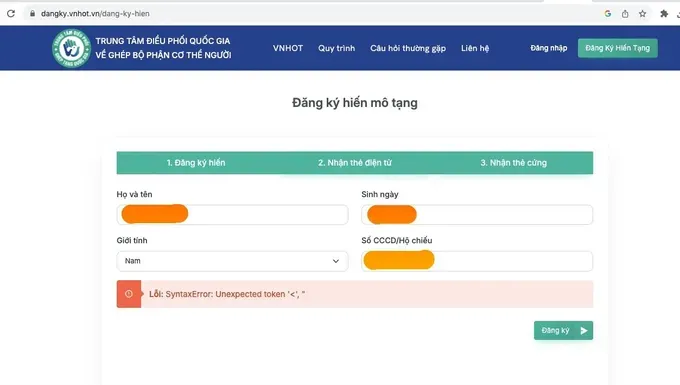
On the afternoon of October 30, the National Coordination Center for Human Organ Transplantation announced the temporary suspension of online registration for organ and tissue donation as part of a review aimed at improving service quality.
As of the morning of October 31, the center's website was still displaying a maintenance notice, meaning members of the public could not temporarily register online (https://dangky.vnhot.vn/dang-ky-hien).
The center said the online registration function would resume shortly. Meanwhile, it continues to accept organ and tissue donation applications submitted in person or by post.
Previously, information circulated on social media alleging that an individual had used another person's full name and citizen identification (ID) number to register for organ and tissue donation on the center's website and that the system had accepted the application.
According to the reports, the registration process did not require verification that the applicant was the legitimate holder of the provided ID number, nor did it verify ownership of the phone number or email address supplied. The information raised concerns over identity verification and personal data protection in the online organ and tissue donation registration process.
Speaking to the press earlier, a representative of the National Coordination Center for Human Organ Transplantation said that online registration was intended to record citizens' wishes to donate organs and tissues. The service is entirely free and does not require medical examinations or tests. Registrants can also obtain an electronic organ donation card.
However, registering one's intention to donate does not mean that the person's organs and tissues will necessarily be retrieved after their death.

Speaking at a recent press conference on the draft amended Law on Donation, Removal, and Transplantation of Human Tissues and Organs and Donation and Removal of Cadavers, organized by the Ministry of Health, Associate Professor Dr. Duong Duc Hung, Director of Viet Duc Friendship Hospital, stressed that tissue and organ donation and retrieval must strictly comply with legal regulations and rigorous professional procedures. The determination of brain death must be conducted through a stringent, independent, and objective process.
Addressing reports that people could register to donate tissues and organs using only their full name and citizen identification (ID) number, he said that registering one's intention to donate did not mean that organ donation would necessarily take place. When an actual organ donation case arises, the hospital must still consult the family, explain the process, and seek its consent. The entire process must also be fully documented, with all records properly maintained.
From a policy-making perspective, Nguyen Huy Quang, former Director of the Ministry of Health's Legal Affairs Department, stressed that information on regulations governing tissue and organ donation must be made public and transparent to ensure the public understands them correctly.
He said that for issues involving personal rights, human health, and life, the legal basis and safeguards must be clearly explained to build public consensus.











)