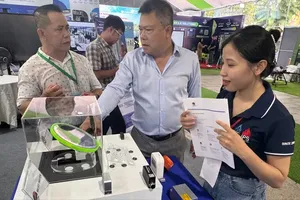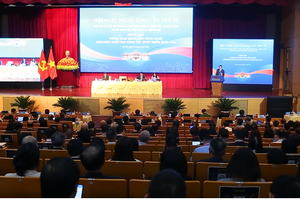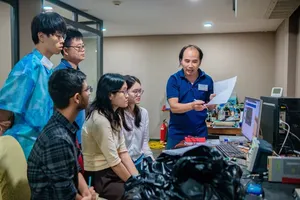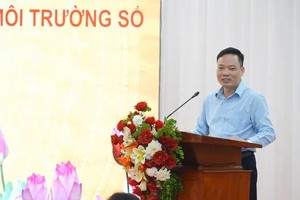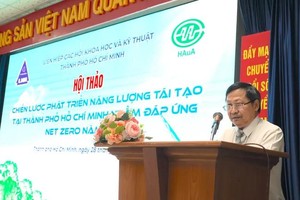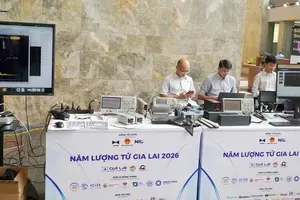
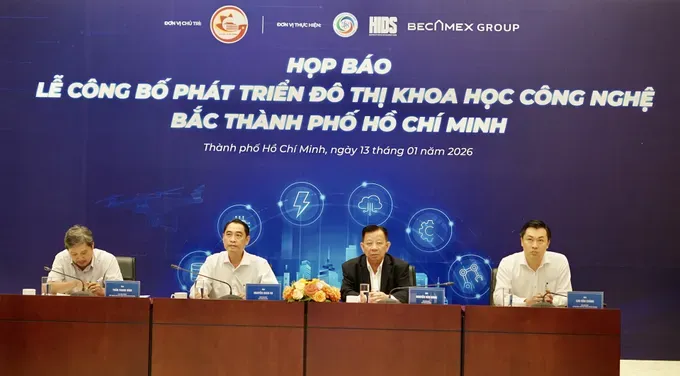
On January 13, at the Convention and Exhibition Center in Binh Duong Ward, the Ho Chi Minh City People’s Committee, in coordination with the Ho Chi Minh City Department of Science and Technology, the Ho Chi Minh City Institute for Development Studies, Ho Chi Minh City Exporting Processing and Industrial Zones Authority, Becamex Group, and Vietnam-Singapore Industrial Park (VSIP), held a press conference on the development of the “Northern Ho Chi Minh City Science and Technology Urban Area.” The event was attended by leaders and representatives from various municipal departments and agencies.
According to Director of the Becamex Group’s Institute for Research and Development, Dang Tan Duc, the Northern Ho Chi Minh City Science and Technology Urban Area project is designed to create a large-scale science and technology development space closely linked to the high-tech manufacturing corridor in the northern and northwestern parts of the city. The initiative aims to establish a new growth pole driven by science and technology, innovation, and the knowledge-based economy, thereby strengthening Ho Chi Minh City’s long-term competitiveness and reinforcing its role as the nation’s economic engine in a new phase of development.
The project plays a critical role in shaping Ho Chi Minh City’s science, technology, and innovation ecosystem. It represents a long-term strategic vision jointly pursued by Becamex Group and the city to develop a science and technology urban area that brings together the three key pillars: government, academia, and the business community.
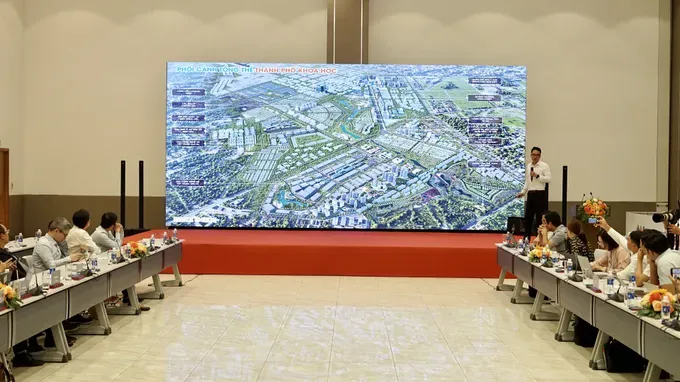
The project is structured as an integrated development space. At its core is a science and technology development center covering approximately 103 hectares. Additionally, approximately 220 hectares are allocated for research and development facilities, high-tech manufacturing, and small-scale pilot testing. These two components form the central innovation hub, concentrated in Binh Duong Ward, serving as the strategic starting point of the entire ecosystem.
The center is being implemented in phases, gradually shaping a convergent space for science and technology activities, education and training, and innovation. It is expected to play a leading and catalytic role, generating spillover effects across the entire Northern Ho Chi Minh City Science and Technology Urban Area and laying the foundation for an industrial ecosystem with higher value-added content.
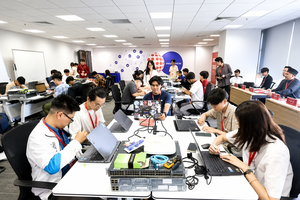
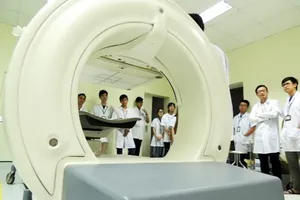
The project is designed to bring together universities and highly skilled human resources, attract major technology corporations, startups, and investment funds, and provide supporting technical infrastructure. It is expected to have the capacity to train approximately 9,000 engineers in semiconductor technologies, laying the groundwork for the development of semiconductor parks, data centers, and related high-tech facilities.

According to experts, the initiative is envisioned as a large-scale science and technology and innovation hub closely linked to high-tech manufacturing, serving as the “scientific and technological brain” of the high-tech production corridor in northern and northwestern Ho Chi Minh City. Within this framework, the science and technology complex repurposed from the Binh Duong Administrative Center will capitalize on existing infrastructure and help foster a scientific community that underpins the entire project.
The project represents a concrete step in implementing major national policies, particularly Resolution No. 57-NQ/TW on the development of science and technology, innovation, and digital transformation. Additionally, it seeks to fully unlock Ho Chi Minh City’s newly expanded development space following administrative consolidation, moving toward a model of a multipolar, multicenter megacity characterized by high levels of connectivity. In this model, each area is assigned a clearly defined functional role while remaining closely linked and mutually reinforcing within an integrated urban system.