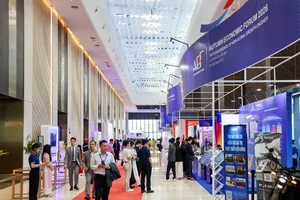
The Ho Chi Minh City People's Committee has submitted a draft resolution regulating free trade and integrated logistics zones in the city.
This step concretizes provisions under the Urban Development Law, which empowers the Ho Chi Minh City People's Council to establish specific rules regarding the procedures and processes for creating and adjusting boundaries and coverage areas, as well as management, organizational, and operational policies for both models.
Leveraging advantages in seaports, industry, and trade
According to the proposal, following the administrative reorganization at the provincial level, Ho Chi Minh City's regional gross domestic product (GRDP) reaches approximately VND2.71 quadrillion (US$105 billion), accounting for about 23.5 percent of the national GDP. The city converges advantages in industry, trade, services, finance, seaports, and logistics, facilitating connections between economic, financial, and commercial hubs with large-scale industrial production zones and deep-water seaport systems.
Currently, the city hosts around 60 to 70 percent of the country's logistics enterprises, with more than 15,300 companies operating in logistics, transportation, warehousing, bonded warehouses, seaports, and related services.
In the first quarter of 2026 alone, total retail sales of goods and consumer service revenue reached approximately VND474.5 trillion, accounting for about 24.9 percent of the national total—a 13.3 percent increase year-on-year. The scale of these activities drives substantial demand for transportation, storage, distribution, and transshipment of goods.
However, existing logistics capacity still faces bottlenecks. The proposal notes that Vietnam’s logistics costs stand at roughly 16 to 17 percent of GDP, with transportation costs accounting for 50 to 70 percent of total logistics expenses, depending on the sector and transport mode. Warehousing systems remain fragmented, lacking large-scale distribution centers and logistics hubs. Freight transport relies heavily on roadways, while connectivity among roads, inland waterways, railways, seaports, and aviation remains uncoordinated. Cargo moving through densely populated urban areas further increases the risk of traffic congestion and transit costs.
The Ho Chi Minh City People's Committee evaluated that developing free trade zones and integrated logistics zones will help restructure the production-logistics-trade chain toward tighter integration. Under this model, free trade zones will create space to attract investment, manufacturing, import-export, and high-value-added services, while integrated logistics zones will provide infrastructure, warehousing, distribution, processing, and cargo transshipment services.
Numerous incentives for investors
For the Free Trade Zone, the city proposes that investors be allowed to register projects under special investment procedures in accordance with investment laws. Foreign investors establishing economic entities within the zone would be eligible for a mechanism exempting them from obtaining an investment registration certificate prior to incorporation.
Infrastructure projects listed as priorities to attract strategic investors include seaport construction projects with investment capital from VND75 trillion, Integrated Logistics Zone infrastructure projects from VND25 trillion, and functional industrial, urban, and service zone infrastructure projects from VND20 trillion or more.
Regarding incentives, the draft proposes applying a 10 percent corporate income tax rate for 20 years, alongside a tax exemption for the first four years and a 50 percent tax reduction for the subsequent nine years on income derived from new investment projects in designated sectors. These specified fields include the semiconductor industry, artificial intelligence, research and development, advanced materials, digital infrastructure, and energy. This policy is expected to take effect starting from the 2027 tax period.
An Integrated Logistics Zone within the Free Trade Zone may be considered for establishment if it concurrently meets multiple criteria. These include ensuring connectivity with at least two transport modes and combining logistics services with manufacturing, processing, digital trade, and e-commerce. Investment plans must also incorporate smart logistics infrastructure, data management and sharing, automation, efficient resource utilization, emission reduction, and green building practices.
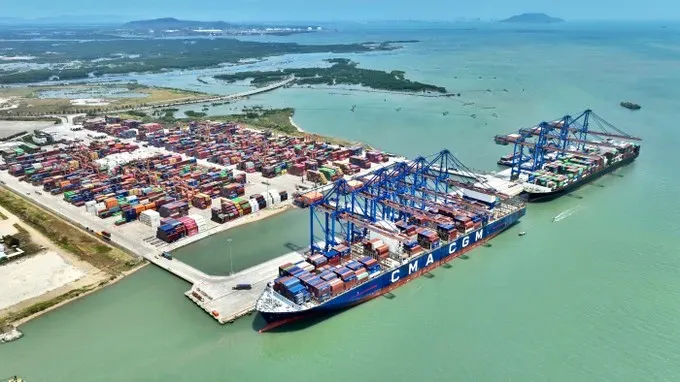
The Ho Chi Minh City Free Trade Zone associated with the Cai Mep Ha seaport area spans approximately 4,165.4 hectares and was established by the Ho Chi Minh City People's Committee under Decision 4560/QD-UBND dated July 23, 2026. The area offers strategic connectivity to the Cai Mep-Thi Vai deep-water port cluster, the Can Gio International Transshipment Port, and Long Thanh International Airport.