According to the Central Committee of the Vietnam Farmers’ Union, as many localities have fulfilled the criteria for new-style rural development, the current priority is not only to further improve farmers’ living standards but also to create momentum for the emergence of a professional farming workforce.
This new generation of farmers should be capable of operating large-scale production, applying business-oriented approaches, developing brands, and participating more deeply in agricultural value chains.
Expanding opportunities for prosperity through agriculture
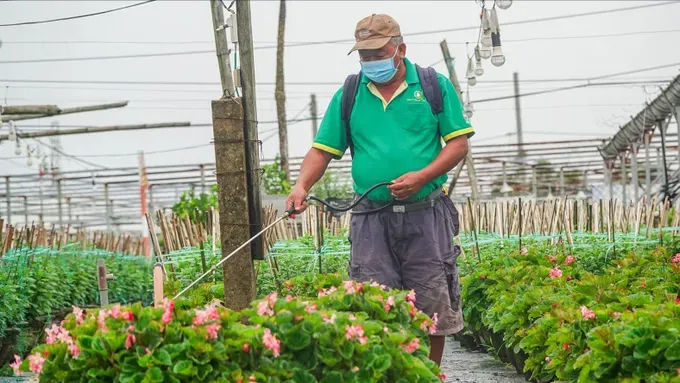
Mr. Vo Tuan Tu, 64, a resident of Chau Truc Hamlet, Phu My Bac Commune, Gia Lai Province, is one of the outstanding farmers who has successfully transitioned from a production-oriented mindset to an agricultural business mindset. In 1997, he began investing in the breeding and cultivation of black eel in the Tra O Lagoon. Before establishing the model, he devoted considerable time to researching market demand, local natural conditions, and the product’s long-term development potential.
After nearly 30 years of dedication, his black eel farming operation has expanded to more than two hectares. By applying microbiological techniques in aquaculture, maintaining a strong focus on quality, and building a reputable brand, he now supplies 4–5 tons of commercial black eel annually, along with a large quantity of fingerlings to provinces across the Central, Central Highlands, and Southern regions. With market prices ranging from VND500,000 (US$19) to VND600,000 (US$23) per kilogram, the model generates annual revenues worth billions of Vietnamese dong.
Recently, he has continued to expand the model by integrating product promotion, hands-on experiences in black eel farming, and ecotourism activities at Tra O Lagoon. He is currently completing procedures to certify the product’s origin and register barcodes, creating favorable conditions for marketing black eel products on e-commerce platforms.
To participate in the digital economy, products must first have clear traceability, a recognized brand, and legal protection. Only then can consumers’ interests be safeguarded while producers can protect the value of their products in the digital marketplace, Mr. Tu said.
At 43 Farm Cooperative in Thang An Commune, in Da Nang City, the cooperative has invested in freeze-drying technology combined with granite stone grinding, enabling agricultural products to retain more than 90 percent of their natural nutrients. This has helped enhance the economic value of its products while extending their shelf life.
Meanwhile, in Thanh Phu Commune, Vinh Long Province, Mr. Dang Van Bay has emerged as a successful example of transitioning from traditional shrimp farming to high-tech aquaculture. With more than 40 hectares of shrimp farms certified under international ASC (Aquaculture Stewardship Council) and BAP (Best Aquaculture Practices) standards, his family's profits are now five to six times higher than those generated under previous farming methods.
In Bac Ninh, many agricultural cooperatives have adopted digital technologies to manage cultivation areas, ensure product traceability, and facilitate product distribution. These innovations have contributed to increasing the value of agricultural products and improving the incomes of cooperative members.
Further enhancing farmers’ pivotal role
According to agricultural experts, investment in deep processing is opening up new development opportunities for many local agricultural products, helping reduce dependence on the sale of fresh produce while enhancing competitiveness in the marketplace.
Agricultural expert Hoang Trong Thuy from Hanoi noted that, beyond deep processing, many localities are now expanding the scope of rural economic development by integrating agriculture with experiential tourism. Farmstay models that combine high-tech agriculture with tourism experiences in Da Nang have demonstrated significantly higher economic efficiency compared to traditional production methods.
Similarly, in localities such as Dong Thap, Vinh Long, Tay Ninh, and Ho Chi Minh City, a growing number of agri-tourism models have emerged in recent years. These initiatives have helped significantly increase farmers’ incomes while creating additional employment opportunities for local communities.
These models demonstrate that today’s farmers are no longer merely selling agricultural products; they are also marketing services, experiences, and the unique stories associated with their products.
According to Ms. Le Thi Minh Tam, Chairwoman of the Farmers’ Union of Da Nang City, strengthening production linkages along value chains associated with product consumption is a key solution for increasing farmers’ incomes and improving their living standards in 2026 and the years ahead.
To achieve this goal, the Farmers’ Union of Da Nang City is focusing on enhancing the movement promoting outstanding production and business performance in conjunction with entrepreneurship, value-chain linkages, and digital transformation.
According to Ms. Le Thi Minh Tam, Chairwoman of the Da Nang Farmers’ Union, strengthening production linkages along value chains associated with product marketing and consumption is a key solution to raising farmers’ incomes and improving their living standards in 2026 and the years ahead.
To realize this goal, the Da Nang City Farmers' Association focuses on enhancing the movement of excellent production and business practices, linked with entrepreneurship, value chain integration, and digital transformation.
Beyond mobilizing and promoting grassroots movements, the Farmers’ Union also serves as a direct facilitator, acting as a bridge to promote OCOP (One Commune One Product) goods and support cooperatives and cooperative groups through credit guarantee schemes and production financing assistance.
From black eel farming models in Gia Lai that integrate brand building and product traceability to deep-processing initiatives, farmstay projects, and value-chain linkage models in Bac Ninh, Ninh Binh, Hanoi, Da Nang, Ho Chi Minh City, Dong Nai, and Tay Ninh, it is evident that opportunities for farmers to generate wealth are expanding through a wide range of new development pathways.
According to the Central Committee of the Vietnam Farmers’ Union, during the 2026–2031 term, Farmers’ Union organizations at all levels nationwide will continue to promote the role of farmers in agricultural development, rural economic growth, and the building of new-style rural areas.
The Union’s activities and operational approaches have been renewed with a focus on guiding, supporting, and accompanying farmers in expanding production, increasing incomes, and participating more deeply in agricultural value chains.
According to President of the Vietnam Farmers' Union, Luong Quoc Doan, when the traditional agricultural production mindset is replaced by an agricultural economic mindset and when every farmer becomes a digital entrepreneur, the growth achievements of the agricultural sector will be transformed into lasting prosperity for farmers.
Alongside fostering new approaches to agricultural production, Farmers’ Union organizations at all levels will continue to support farmers in participating in collective economic models, building brands, ensuring product traceability, applying science and technology, and advancing digital transformation.
The overarching goal is to cultivate a professional farming workforce capable of proactively engaging in production linkages, connecting with markets, and participating more deeply in modern agricultural value chains.
According to the Central Committee of the Vietnam Farmers’ Union, approximately 6.5 million farming households register each year to participate in the movement promoting outstanding production and business performance, mutual support for wealth creation, and sustainable poverty reduction.
The Farmers’ Union organizations at all levels have also mobilized and guided the establishment of 1,028 agricultural cooperatives and 5,225 cooperative groups, attracting nearly 1.3 million farming households to participate.