During the plenary discussion on the afternoon of August 22 regarding the draft resolution on personal and corporate income tax reductions, National Assembly deputies endorsed the tax reduction policy while urging measures to prevent the artificial splitting of revenue to qualify for incentives.

According to Deputy Nguyen Duy Thanh from Ca Mau, while revenue serves as the eligibility criterion, the actual support received depends on taxable income and the tax liability. This creates a potential paradox where the greater the financial hardship and the thinner the profit margins, the lower the support derived from the income tax reduction. Conversely, loss-making enterprises with no tax liability receive no reduction at all.
Deputy Nguyen Duy Thanh illustrated this point by explaining that an enterprise with revenue of no more than VND10 billion, currently subject to a 17 percent tax rate, would see its effective rate drop to 11.9 percent following the 30 percent reduction. However, if revenue slightly exceeds the threshold, the rate reverts to 17 percent, and this 5.1 percentage-point disparity could disadvantage such enterprises.
Consequently, the deputy proposed exploring a transitional mechanism; specifically, a phased reduction of the tax benefit across a certain revenue range above the VND10 billion mark.
Echoing this view, Deputy Thach Phuoc Binh from Vinh Long argued against a sudden rate hike at the VND10 billion threshold, which could create a disincentive for businesses to grow. He urged the drafting agency to design a transitional range with gradually diminishing incentives or to adopt an alternative technical approach to ensure businesses do not abruptly lose benefits upon exceeding the threshold.
The Government should also clearly explain the economic and fiscal rationale behind the VND10 billion threshold and the 30 percent reduction rate to bolster the policy's persuasiveness. According to the head of the Ministry of Finance, the country currently has nearly 2.7 million business households with revenue of up to VND10 billion, accounting for 99.98 percent of all business households; there are also over 865,000 enterprises with revenue of up to VND10 billion, representing approximately 81.11 percent of the total number of enterprises.
Regarding the 30 percent reduction, Minister of Finance Ngo Van Tuan calculated that a revenue of VND10 billion equates to roughly VND833 million per month. With a profit margin of around 12 percent, the monthly tax payable by an enterprise would be approximately VND15 million–VND17 million.
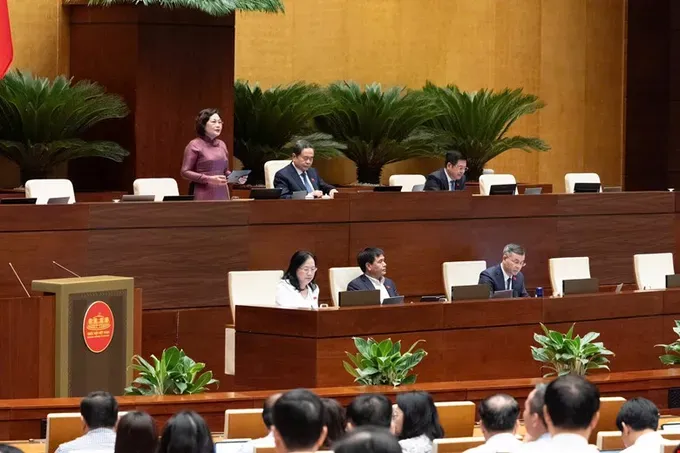
A 30 percent reduction amounts to between VND4 million and over VND5 million. "This VND5 million figure is equivalent to the regional minimum wage specifically that of Region I," the Minister noted, adding that these funds would provide enterprises and business households with additional resources for growth.
This matter will be further considered within the Law on Support for Small and Medium-sized Enterprises Development, which is scheduled to be submitted to the National Assembly during the October session, the Minister added. Accordingly, to provide greater relief, the drafting agency plans to raise the revenue threshold for the simplified tax calculation method where income tax is calculated as a percentage of revenue from the current VND3 billion to VND10 billion.
To address National Assembly deputies' concerns that businesses might split their revenue to exploit the policy, the Minister stated that the draft Government Decree explicitly excludes subsidiaries and affiliated companies to prevent any abuse of these incentives.