Behind the active construction sites across the southern metropolis lies a growing logistical bottleneck over waste management. City authorities recently designated eight disposal sites with a combined capacity exceeding 26 million cubic meters. However, long haulage distances threaten to drive up transport expenses significantly.
The crisis highlights an urgent need for streamlined waste classification, quality control, and regulatory frameworks to repurpose the dredged sediment into usable fill and construction material.
Dredging works put on hold
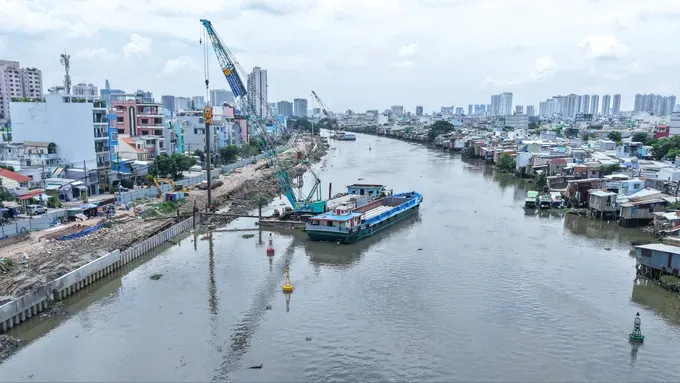
According to Nguyen Hoang Anh Dung, Deputy Director of the Ho Chi Minh City Urban Infrastructure Construction Investment Project Management Board, the agency is managing 55 technical, environmental, and irrigation projects for the 2026–2030 period. These developments are projected to generate approximately 17.2 million cubic meters of excavated soil and dredged sludge, comprising 8.8 million cubic meters of excavated earth and 8.4 million cubic meters of sludge.
Four key priority developments are currently facing delays in their dredging schedules, including the Tham Luong–Ben Cat–Nuoc Len Canal project, the Xuyen Tam Canal restoration project, the Xom Cui Creek drainage project, and the Doi Canal north bank rehabilitation project.
Field observations in mid-August 2026 at the Tham Luong – Ben Cat – Nuoc Len project showed finished concrete embankments and protective fencing along completed sections. However, exposed tide mudflats remained visible along the canal bed at low tide, choked with thick, undredged sludge deposits. Similarly, work at the Doi Canal north bank rehabilitation project remained limited to pile-driving and shore-side debris clearing, with deep-bed dredging stalled.
Sy Tu, Deputy Director of Hanoi Hydraulic Engineering Company—a major contractor on the project—stated that dredging operations remain suspended due to the lack of designated disposal and receiving sites.
While waiting for relevant authorities to finalize a waste management solution, the contractor has shifted focus to other construction components to minimize overall project delays.
Receiving sites available, but transportation costs remain a concern
On August 26, the Ho Chi Minh City People’s Committee issued a decision to announce a list of areas and locations designated for receiving and disposing of dredged materials, easing the difficulties in finding disposal sites for dredged sediment within the city. The list comprises seven onshore sites and one offshore site off Vung Tau.
Nguyen Hong Nguyen, Deputy Director of the Ho Chi Minh City Department of Agriculture and Environment, said the sites were primarily intended to receive dredged materials from seaport waters and inland waterways. Dredged sediment from canals and drainage channels could also be accepted, provided it was appropriately classified.
However, a representative of a contractor involved in a canal improvement project in Ho Chi Minh City said most of the designated receiving sites were located far from project sites, meaning that transporting large volumes of dredged sediment could significantly increase costs. Of the seven onshore sites, six are located in areas that were formerly part of Ba Ria–Vung Tau Province, while the remaining site is in an area formerly belonging to Binh Duong Province.
Previously, the Ho Chi Minh City People’s Committee assigned the Department of Agriculture and Environment to take the lead in identifying suitable sites for receiving dredged sediment. Acceptance of the sediment can only proceed with the consent of local wards and communes.
According to Deputy Director of the Ho Chi Minh City Department of Construction Bui Hoa An, authorities had previously planned to establish two dredged-sediment receiving sites in the areas of the former Cu Chi and Nha Be districts, each covering about 50 hectares. However, the plans could not be implemented due to land constraints and concerns among local authorities.
To date, not only canal dredging projects but also dredging and waterway clearance operations have faced difficulties in finding suitable sites for receiving dredged sediment.
Mr. Nguyen Hoang Anh Dung added that the Ho Chi Minh City Urban Infrastructure and Investment Construction Project Management Board regularly sends information on the volume of dredged sediment requiring disposal to wards and communes, but finding suitable receiving sites remains difficult. Some schools and individuals have expressed interest in receiving the sediment for landfilling, but the volumes they can accommodate are insignificant.
In the area of the former Binh Tan District, a residential development had previously needed filling material and had the capacity to receive dredged sediment. However, after the project changed investors, the original plan was no longer approved.
A proposal to transport dredged sediment to the site of Go Vap Cultural Park has also yet to be implemented, as the project itself remains stalled due to unresolved investment planning issues.
Eight sites designated to receive dredged materials in Ho Chi Minh City
Among eight sites designated to receive dredged materials in Ho Chi Minh City, there are seven onshore sites including the Van Thuong Industrial Park project in Tan Hai Ward; the Long Son My General Port project and a land plot in Phase 2 of the SP-PSA International Port project, both in Phu My Ward; a rice field plot identified as Lot 223, Map Sheet 45 in Co Trach Hamlet, Thanh An Commune; the Ben Dinh Islet urban area in Vung Tau Ward; the Port Logistics Services Project in Phuoc Hoa Ward; and a land plot in Phuoc Thang Ward, Lot 79, Map Sheet 109.
The seven onshore sites have a combined capacity of approximately 12.547 million cubic meters of dredged materials. The offshore receiving site off Vung Tau has a capacity of about 13.609 million cubic meters.
The Ho Chi Minh City Department of Agriculture and Environment pointed out that, in reality, the city still lacks sufficient entities with the functions, equipment, technology, and suitable sites needed to fully and promptly meet demand for the collection, transportation, and treatment of construction solid waste.
Connections between sites where potentially reusable materials are generated and construction works, projects, organizations, and individuals that need such materials remain neither convenient nor timely. This has resulted in larger volumes requiring transportation and treatment, higher costs, and potential delays to project schedules.
In addition, waste generators remain uncertain about the management, determination, classification, and collection of certain types of dredged sediment generated during construction and other activities.



)