From public education sites and surveillance cameras to grassroots outreach models, stronger ties between police and residents are helping build a solid security network as Ho Chi Minh City works toward eliminating drug crime.
Community education proves effective
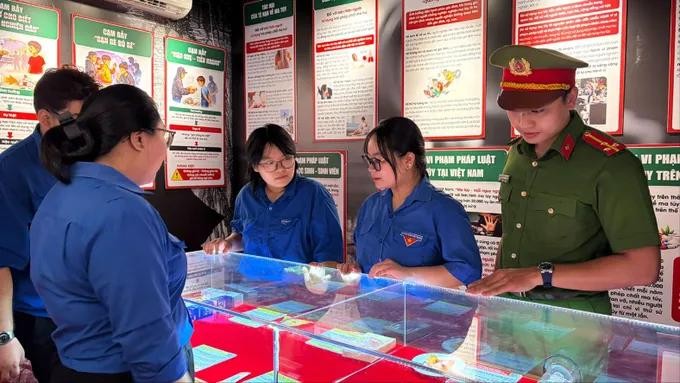
On a day in late August, many residents brought their children to the Chanh Hung Ward Public Service Supply Center – Facility 2 in Ho Chi Minh City to learn about the harms of drugs. The site serves as a community education center for drug prevention and control in the ward.
The open space features numerous images, professional materials and visual replicas, helping residents easily identify different types of drugs as well as the methods and tactics used by drug criminals, particularly drugs disguised as food products and electronic cigarettes.
Maj. Vo Thanh Danh, Deputy Chief of the Chanh Hung Ward Police, said the community activity site was chosen for the model to make it easier for everyone to access. Since its establishment in April 2026, the community education site has held 10 awareness sessions for about 2,000 residents.
In June, ward police broke up a drug case involving a number of teenagers. The group had gathered to use “pod chill,” a type of drug disguised as an electronic cigarette. Notably, most of the teenagers did not know that the electronic cigarettes they were using contained addictive substances.
Therefore, stepping up public awareness, particularly among students, is crucial to implementing the roadmap to green the area and achieving the goal of building drug-free wards before 2030.
According to Duong Van Dan, Vice Chairman of the Chanh Hung Ward People's Committee, in addition to the community education site, the ward has diversified its drug prevention and control outreach efforts. Notably, the ward has signed coordination commitments with schools on student management; incorporated awareness content into weekly flag-raising ceremonies conducted by police officers; and organized short skit competitions to communicate the harms of drugs in an engaging and easy-to-understand way.
Vice Chairman Duong Van Dan stressed: “Public awareness is very important and needs to be strengthened. In particular, students facing family difficulties or psychological instability can easily be manipulated or enticed by bad actors into drug use. Schools therefore need to proactively review and monitor the situation and promptly coordinate with ward police to provide counseling and strengthen students’ resilience against social ills.”
Ho Chi Minh City expands drive for drug-free communities
Many other areas in Ho Chi Minh City are also implementing activities aimed at creating drug-free areas. A notable example is residential area 7 in Hoa Hung Ward, where a methadone treatment facility serves nearly 300 people.
The concentration of large numbers of people undergoing drug treatment presents challenges for public security and order, requiring local police to closely coordinate with agencies, organizations and residents to build a closed “network of eyes and ears” to maintain security in the area.
In response, the Party cell of residential area 7 has implemented several effective drug awareness models, including the 1+2, 1+3, 1+4 and 1+5 models.
Secretary Phung The Vinh of the Party cell in Residential Area 7 explained that outreach models are tailored to the complexity of each area. In neighborhoods with multiple hotspots, the 1+2 model is applied, where one exemplary official or Party member engages directly with two individuals. In less complex areas, the 1+3, 1+4, or 1+5 models are used, expanding outreach to three, four, or five people respectively. These initiatives focus on disseminating key directives, including Resolution No. 02-NQ/TU dated December 12, 2025, issued by the HCMC Party Committee, along with other resolutions, circulars, and legal regulations on drug prevention.
Residential area 7 has also focused on installing security cameras in complex areas and encouraging residents to install cameras at their homes. There are currently nearly 300 cameras throughout the area.
Thanks to this network, authorities and residents have promptly detected, uncovered and handled numerous violations or suspected violations related to drug-related social ills.
Maj. Nguyen Van Nam, Deputy Chief of the Hoa Hung Ward Police, said ward police regularly coordinate with Party cells and residential area management boards to communicate important, in-depth information about the dangers of drugs and the methods used by drug offenders.
“It is precisely the connection among ward police, Party cells, residential area management boards, residents and grassroots security forces — an extended arm of ward police — that has formed a closed ‘network of eyes and ears’ to maintain security and order in the area,” Maj. Nguyen Van Nam said.
In the first six months of 2026, Ho Chi Minh City police detected and handled 4,064 drug-related cases and arrested 10,304 suspects, an increase of 1,449 cases and 3,135 suspects from the same period in 2025.
Drug crime is clearly becoming younger, with the proportion of offenders under 30 rising from 34.8 percent for all of 2025 to 39.7 percent in the first six months of 2026.
With the goal of making the city drug-free by 2030, the city established more than 1,000 Task Forces 26 at communes and wards in the first six months of the year, held more than 22,000 public awareness sessions for over 837,000 participants and successfully established more than 2,200 safe residential areas.