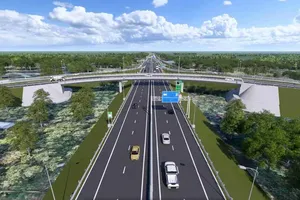
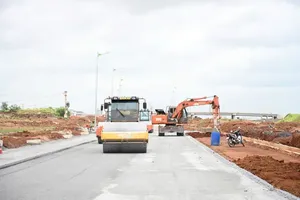
Among the most prominent are the North–South high-speed railway and the Lao Cai–Hanoi–Hai Phong rail line.
Finalizing the legal framework
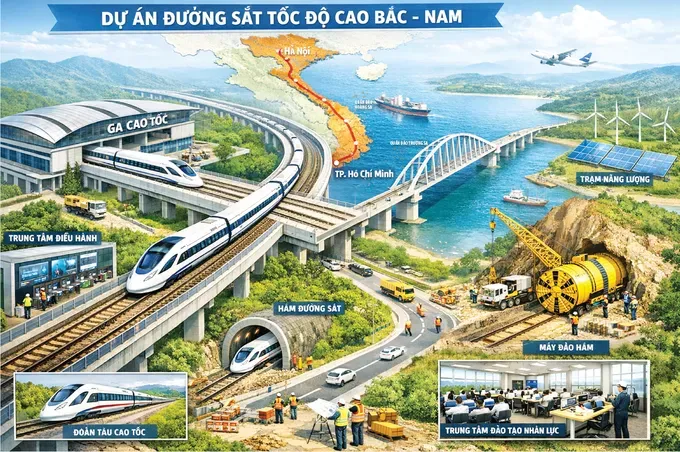
Immediately after the National Assembly approved the investment policy for key national railway projects, the Ministry of Construction, together with relevant ministries and agencies, moved swiftly to develop and finalize the legal framework. To date, four laws directly linked to the implementation timeline of these projects have been enacted, including the amended Railway Law, the Construction Law, the Planning Law, and the Investment Law.
This was followed by the issuance of a series of resolutions, decrees, and guiding circulars. Notably, for the first time, Vietnam has established standards and technical regulations for high-speed rail, comprising nine construction codes, 219 specialized national standards, 37 general national standards, and 146 standards aligned with European and international norms.
Mr. Nguyen Tien Thinh, Deputy Head of the Vietnam Railway Authority, said agencies had reviewed the full range of newly approved mechanisms and policies authorized by the National Assembly to ensure they are applied and adapted most appropriately and effectively.
In addition, intensive efforts have been made to develop special mechanisms and policies to advance investment in urban railway systems in Hanoi and Ho Chi Minh City, aimed at addressing some of the most pressing challenges of modern urban development.
According to Mr. Nguyen Tien Thinh, Deputy Director General of the Vietnam Railway Authority, the overarching objective is to establish tailored and exceptional policy frameworks that emphasize simplification and streamlining, cutting administrative procedures, and shortening project preparation and construction timelines. Beyond infrastructure development, these policies also prioritize technology transfer and the growth of a domestic railway industry, enabling Vietnam to gradually master core technologies in line with the sector’s long-term, sustainable development strategy.
Investment preparation

At the fifth meeting of the Steering Committee for national key projects in the railway sector in early January 2026, Prime Minister Pham Minh Chinh stressed the need for a decisive shift from institution-building to execution, underscoring an approach aimed at seeing each task through to completion.
Regarding the North–South high-speed railway, the Government has instructed the Ministry of Construction to complete the selection of an international consultant by January 2026, while urgently appointing a consulting firm to prepare the feasibility study report for submission to the Prime Minister by January 15.
Deputy Minister of Construction Bui Xuan Dung said relevant authorities are reviewing the full range of domestic and international standards and regulations, international best practices, and Vietnam’s on-the-ground conditions to propose the most suitable technology options, which will serve as the basis for submission to the competent authorities for decision-making.
Minister of Construction Tran Hong Minh has instructed agencies to urgently complete reports on special mechanisms, investment models, and investor selection criteria, among other requirements, to ensure that construction can begin by the end of 2026.
According to the latest information from the Ministry of Construction, Minister Tran Hong Minh has issued a decision appointing the Thang Long Project Management Board as the investor for the North–South high-speed railway, replacing the Railway Project Management Board. The Thang Long Project Management Board will be responsible for preparing the project’s feasibility study and will bear full accountability for quality, progress, and cost control.
For the Lao Cai–Hanoi–Hai Phong railway, sub-project 1, which involves the construction of station-connecting lines, has already broken ground. Sub-project 2, covering the main railway infrastructure, has been instructed to accelerate the preparation of its feasibility study, with approval targeted for June 2026. Under the current plan, the signing of agreements on rail connectivity and the construction of cross-border railway bridges with China are expected to be completed in March 2026, followed by appraisal of project documents by July 2026, paving the way for construction to begin by the end of the year.
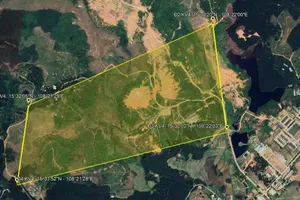
Relevant local authorities are currently moving swiftly to define project boundaries, complete cadastral records, and prepare compensation and land clearance plans. The Ministry of Finance has also been instructed by the Government to balance and allocate sufficient funding, including borrowing options if necessary, to ensure that project timelines are not disrupted by funding shortfalls.
Another critical component of project implementation is workforce preparation. The national plan for training and developing Vietnam’s railway human resources through 2035, with a vision to 2045, has been approved and is now being rolled out, with hundreds of engineers and specialists undergoing training both domestically and overseas. Land clearance, often a persistent bottleneck in major infrastructure projects, is also being placed under the direct oversight of the Steering Committee for Key National Projects.
Local authorities along the North–South high-speed railway, the Lao Cai–Hanoi–Hai Phong rail corridor, and key urban rail lines have been instructed to conduct accurate assessments of funding needs and schedules for relocating technical infrastructure, particularly power facilities of 110 kV and above. These tasks are to be carried out under the special mechanisms authorized by the National Assembly, with the aim of delivering cleared sites on schedule.
According to the Vietnam Railway Authority, 2026 has been identified as a pivotal year for the railway sector. The Ministry of Construction, together with relevant ministries, agencies, and local governments, is working to implement Prime Minister Pham Minh Chinh’s directives, with the objective not only of breaking ground on schedule but also of ensuring that projects are executed in a scientific, transparent manner, preventing corruption and waste, and safeguarding a balanced alignment of interests among the State, the public, and businesses.