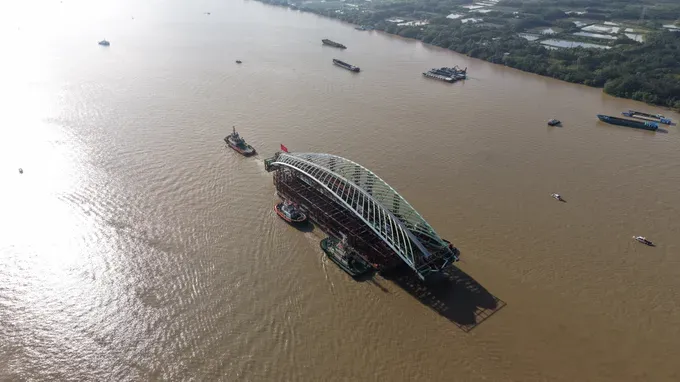
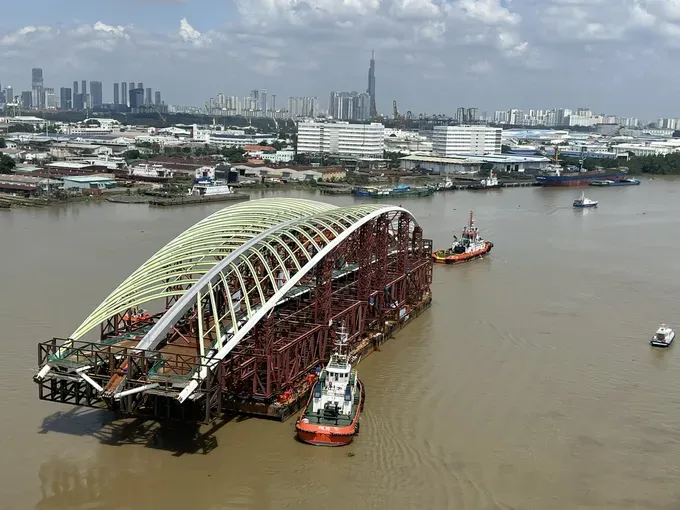
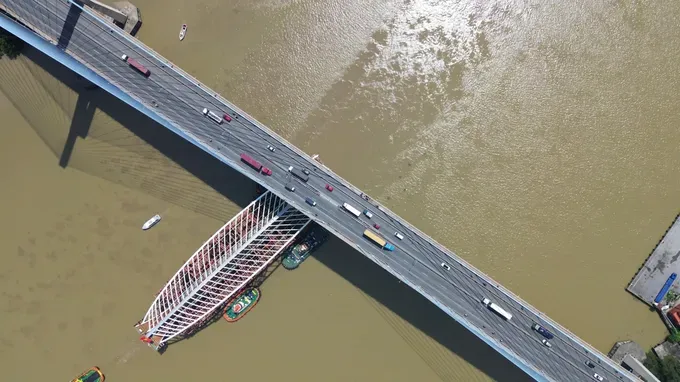
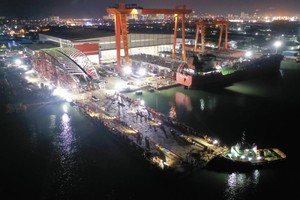
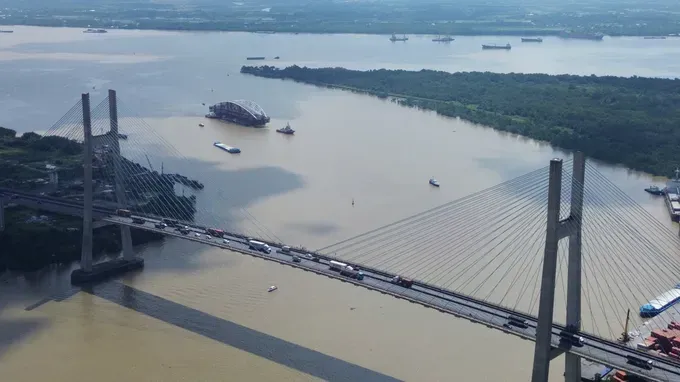
At 6 a.m. that day, the towing convoy was observed traveling along the Soai Rap River near Hiep Phuoc and Binh Khanh communes. The massive steel bridge span, loaded onto a specialized barge, moved through the river landscape beneath Binh Khanh Bridge, whose towering piers rose above the waterway. Below, vessels continued to navigate the river route connecting southern areas of Ho Chi Minh City.
The main span weighs 3,400 tons, measures 187 meters in length, and stands more than 20 meters high. It consists of a steel arch and supporting framework. The structure was launched into the water in the early hours of October 16 for transport to its installation site. The convoy comprises a main tugboat, two escort tugboats positioned alongside the barge and a backup tugboat. The towing journey covers approximately 124 kilometers.
The Saigon River pedestrian bridge will have a total length of 720 meters, comprising the main bridge and approach spans. The main bridge features an arch-and-steel-girder design, with a 187-meter main span and a deck 7–11 meters wide. The navigational clearance between the two main piers is 80 meters wide and 10 meters high. Inspired by the image of nipa palm leaves, the project is sponsored by Nutifood Nutrition Food Joint Stock Company.
The bridge will connect Ton Duc Thang Street in Saigon Ward with Nguyen Thien Thanh Street in An Khanh Ward, strengthening links between the two banks of the Saigon River. The main span is scheduled to be joined to the bridge structure on October 21.
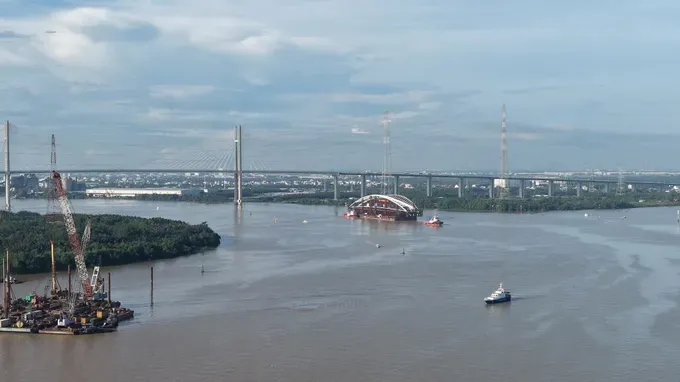
At the construction site, contractors are mobilizing workers and equipment to accelerate steel structure assembly, complete joints, and carry out the remaining work. Once completed, the bridge is expected to provide additional space for walking, sightseeing, and enjoying river views while adding a distinctive architectural feature to central Ho Chi Minh City.
At 9:50 a.m., the convoy reached Mui Den Do (Den Do Cape) in Tan Thuan Ward. The area features a sharp bend at the confluence of the Saigon, Dong Nai, and Nha Be rivers, requiring close coordination among the tugboats to ensure safe passage. The main tugboat, VNL Vision, repeatedly adjusted its course, while the two escort tugboats, VNL Future and VNL Voyager, helped maintain the convoy's formation. The steel arch successfully navigated the bend at around 10 a.m.
At approximately 10:30 a.m., the convoy continued its journey past Phu My Bridge toward Kim Cuong Island and Bach Dang Wharf.
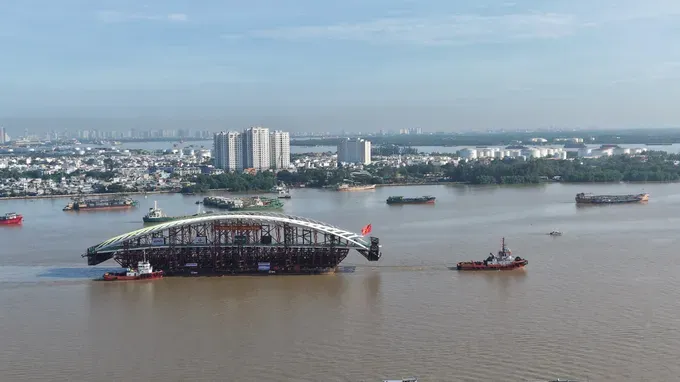
According to Dai Dung Group, the convoy was expected to reach its designated mooring position at the pedestrian bridge construction site at around 1 p.m. that day, approximately two hours ahead of the original schedule. Once the main span arrives at the site, contractors are expected to proceed with joining it to the bridge structure on October 21.