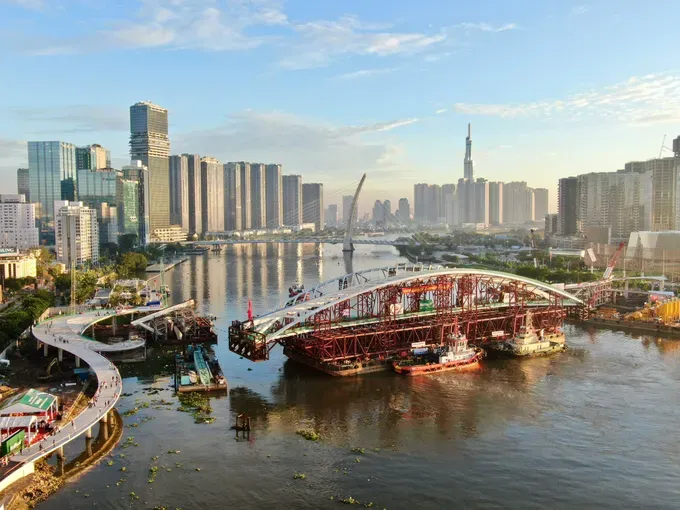
In the early hours of October 21, the pedestrian bridge spanning the Saigon River and connecting the Ben Bach Dang area in Saigon Ward with the Thu Thiem New Urban Area in An Khanh Ward entered the main-span joining stage.
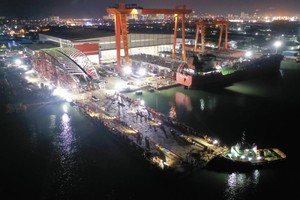
The installation of the approximately 1,400-tonne steel arch, shaped like a nipa palm leaf, was carried out overnight, requiring a high degree of precision and strict safety measures during construction over the river.
The bridge is approximately 720 meters long, with a deck width ranging from 6 to 11 meters. Its architectural design draws inspiration from the nipa palm leaf, a distinctive feature of the waterways of the Southern region.
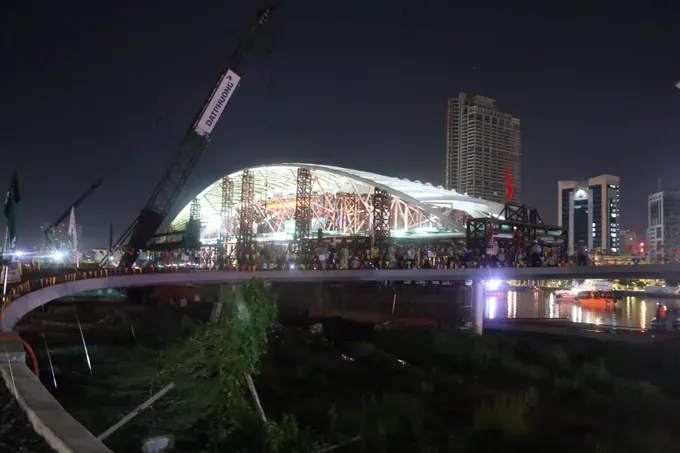
Upon completion, the project is expected to provide additional riverside pedestrian space, improve connectivity between the two banks and create a new architectural landmark for Ho Chi Minh City.
At around 3 a.m. on October 21, the construction team released the barge's turning lines, adjusted its orientation and arranged a system of mooring cables secured to anchor piles downstream. By around 4 a.m., the barge had been positioned and began moving gradually with the assistance of two pusher boats, two tugboats and specialized equipment.
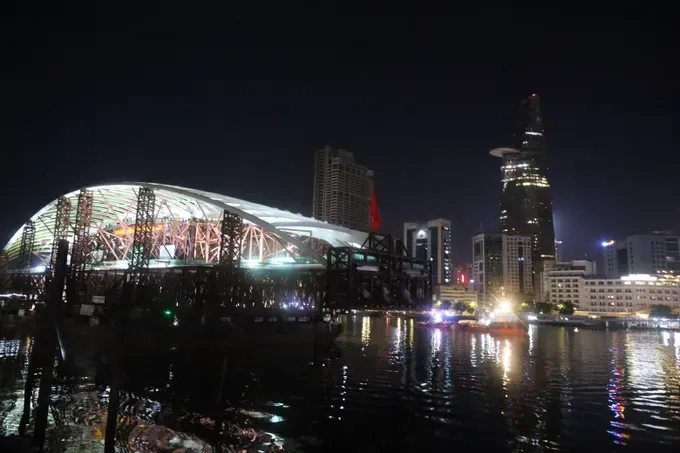
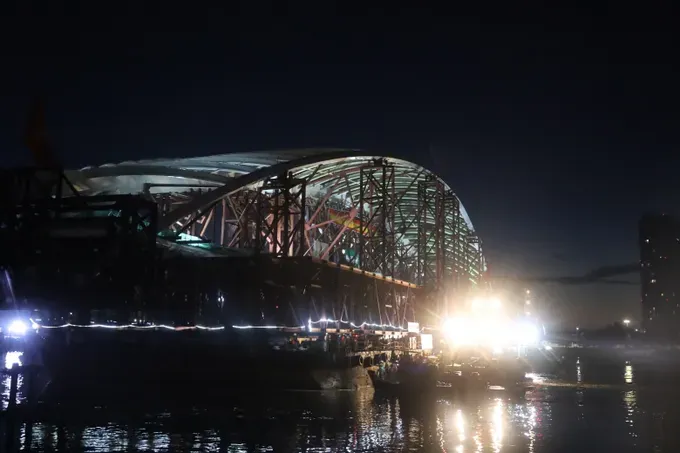
Mr. Nguyen Huu Hoang, a representative of the project's sponsor, stated that the maneuvering operation was calculated based on hydrological data, selecting a period of receding tide and stable current to minimize risks. The greatest challenge occurred when the barge turned perpendicular to the river's flow, taking on significant force from the current while carrying the massive steel structure. Every operation had to be carried out slowly and with centimeter-level precision to prevent collisions with the bridge piers.
The process of turning, securing, and positioning the barge lasted approximately two hours, requiring close coordination among the vessels and technical crews.
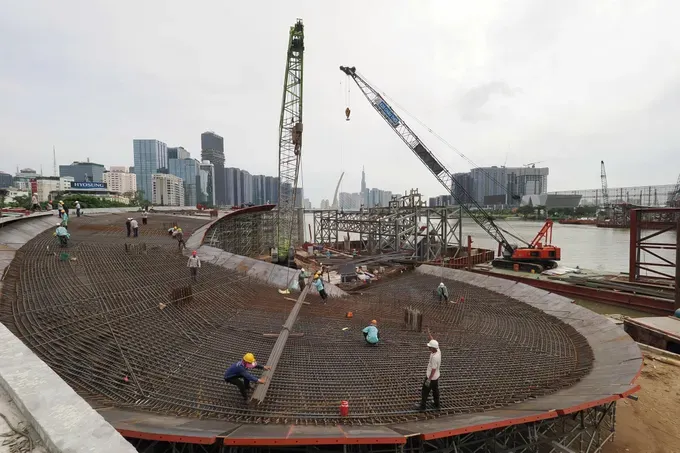
At around 6 a.m., the barge reached the unloading position. Water was pumped into its ballast compartments to adjust its elevation and bring the bridge girder into position near the supporting piers. This stage was completed at around 7:30 a.m., allowing engineers to align the bridge centerline precisely with the support structures on both riverbanks before welding the joints. Approximately 150 personnel were mobilized for construction work that morning.
During foundation construction, contractors faced significant challenges posed by river currents, ground conditions, and underground obstacles. Bored piling operations uncovered numerous concrete piles, large wooden piles, and the wreckage of a wooden boat buried beneath the riverbed. To address these obstacles, the contractor proposed replacing the steel sheet pile cofferdam method with prefabricated reinforced concrete caissons installed directly underwater. The solution was approved by the construction supervision consultant and project owner to meet quality and schedule requirements.
Installing components weighing more than 20 tons required close coordination between divers, surveying teams, and crane operators on the water's surface. Positioning, formwork installation and joint treatment were scheduled during slack tide to minimize the effects of currents.
After completing the main girder connection, the contractor will proceed with finishing the bridge deck, installing railings, artistic lighting and auxiliary facilities. To ensure construction safety, the Saigon River channel through the construction site will be temporarily closed to navigation from 2 a.m. to 6 p.m. on October 21 and 22.
The Saigon River pedestrian bridge will have a total length of 720 meters, comprising the main bridge and approach spans. The main bridge features an arch-and-steel-girder design, with a 187-meter main span and a deck 7–11 meters wide. The navigational clearance between the two main piers is 80 meters wide and 10 meters high. Inspired by the image of nipa palm leaves, the project is sponsored by Nutifood Nutrition Food Joint Stock Company.
The bridge is expected to be completed and opened to the public before the 2027 Lunar New Year, helping strengthen connectivity between central Ho Chi Minh City and Thu Thiem New Urban Area while creating additional public spaces for community activities along the Saigon River.