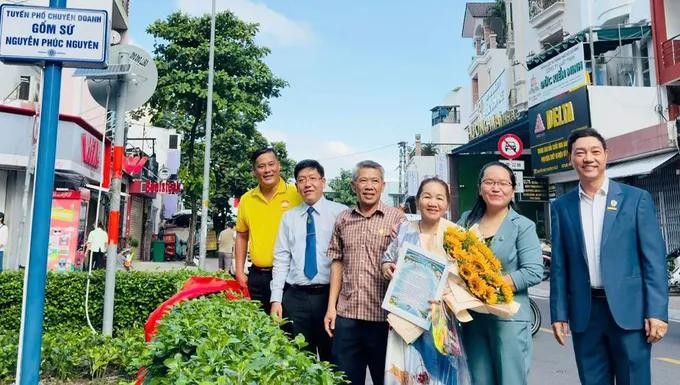
On a mid-week afternoon, Su Su Faux Flower Shop situated on Thap Muoi Street in Binh Tay Ward merely saw sporadic foot traffic. Inside the establishment, four employees were diligently assembling fabric flowers to fulfill pending orders.
According to staff members, ever since the locality officially launched the Cho Lon artificial flower specialized-trade street, the storefront successfully garnered an additional influx of provincial customers. However, compared to previous eras, they noted that overarching footfall has plummeted quite drastically. To actively hunt for potential clients, the shop now heavily focuses on promoting its merchandise across digital platforms.
For Ms. Nguyen Thanh Mai, who traveled from Dong Nai specifically seeking out the Cho Lon artificial flower street, local promotional efforts heavily fostered a profound sense of security. “Whenever I require wholesale supplies, seeing the street actively promoted by the locality makes me feel entirely reassured to explore and properly purchase goods,” she explained. Because she resides quite far away, after initially establishing an in-person rapport with wholesale proprietors, she vehemently prioritizes placing online orders to optimally conserve travel time.
Beyond the Cho Lon artificial flower hub, Binh Tay Ward also boasts other specialized commercial streets. These include fashion accessories on Nguyen Huu Than Street, retail and food on Hau Giang Street, alongside the bustling Cho Lon night market. Each specific route harbors its own distinctive industry characteristics and bespoke demographic, heavily contributing to the locality’s quintessential commercial facade.
Nevertheless, as contemporary shopping habits rapidly evolve, the sheer volume of patrons arriving to browse and purchase goods in-person across numerous streets has noticeably dwindled compared to the past.
According to Chairman Nguyen Quoc Duong of the Binh Tay Ward People’s Committee, the locality is proactively acknowledging severe hurdles plaguing business facilities to formulate highly appropriate solutions.
The ward has recently launched Binh Tay Ward Merchants Club, seamlessly integrating direct dialogues between local leadership and corporate entities, cooperatives, and individual business households. Furthermore, the ward is heavily concentrating on forging robust product and service supply chains amongst manufacturing and commercial facilities within its jurisdiction. Simultaneously, it’s drastically expanding cooperation with disparate localities and units both inside and outside HCMC, thereby effectively assisting enterprises in hunting down strategic partners and broadening distribution channels.
HCMC has long been renowned for its highly specialized commercial streets, encompassing the Ho Van Hue wedding-dress street, Nguyen Trai fashion street, Soai Kinh Lam fabric zone, Phung Hung stationery street, Ngo Gia Tu furniture street, Phan Xich Long food zone, alongside Ho Thi Ky Floral Market and food hub.
The last one above remains one of the most magnetically appealing specialized-trade zone, largely thanks to its seamless amalgamation of fresh flower trading alongside immersive culinary experiences. To strongly support small merchants, Vuon Lai Ward officially rolled out a bespoke tourism product suite dubbed “Vuon Lai – Floral Tales, Street Tales.” Herein, Ho Thi Ky Floral Market acts as the quintessential centerpiece for an overarching journey exploring cultural heritage and the vibrant night-time economy.
From the methodological approach executed at the Ho Thi Ky specialized-trade street, other wards can glean profound insights on how to dynamically cultivate specialized avenues in an entirely novel direction. This involves synergistically naming these commercial streets while concurrently bridging small merchants and propelling e-commerce.
Over in Thu Duc Ward, to firmly support the Vo Van Ngan fashion street, the local administration has rigorously coordinated with various units to propagate, mobilize, and assist merchants in radically transforming operational modalities via digital tech applications. They’re proactively promoting merchandise across social media platforms, orchestrating sales livestreams, adopting cashless payment systems, and drastically elevating overarching customer care proficiencies.
Vice Chairman of the Thu Duc Ward People’s Committee Le Thuong Duy Lap stated that moving forward, the locality will heavily focus on organizing diverse shopping, promotional, and demand-stimulating activities. Moreover, they’ll vehemently encourage storefronts to forge alliances, collaborate, and diligently research online transaction modalities to eloquently introduce merchandise while seamlessly connecting buyers with sellers.
Binh Tay Ward is currently architecting a “Digital Binh Tay Map,” thoroughly integrating tourism, culinary, and shopping data so residents and tourists can effortlessly hunt down prime commercial venues. The locality is also actively strategizing to link specialized commercial streets with the iconic Binh Tay Market, the Cho Lon night-life street, alongside diverse food and cultural hotspots. This effectively forges highly favorable conditions for tourists to seamlessly intertwine sightseeing, experiential activities, and shopping sprees.
Vice Chairman Pham Ngoc Hai of the HCMC Tourism Association voiced that wards must act as quintessential focal points, actively gathering business households across each specific street to orchestrate robust alliances, thereby supporting commercial operations and general merchandise promotion.
Every individual thoroughfare intrinsically requires a distinguished identification methodology within the digital environment so citizens and tourists can effortlessly locate it, instantly recognizing the specific industry sector alongside its quintessential flagship products.
Each ward can proactively coordinate with small merchants to conduct dynamic livestreams geared toward showcasing products and seamlessly connecting vendors with their main client base. More importantly, local wards, acting in tandem with travel enterprises, must rigorously architect tourism tours that flawlessly combine visits to profound cultural and historical landmarks with vibrant shopping and culinary experiences.
To secure a coveted spot on these tour itineraries, commercial venues must uncompromisingly guarantee high-quality merchandise, exceedingly reasonable price tags, crystal-clear listings, and fiercely healthy competition. They absolutely must avoid any scenario where a handful of opportunistic business households engage in predatory tactics, which would severely tarnish the collective brand prestige.
When methodically orchestrated, these specialized commercial streets will inevitably morph into highly captivating destinations.