Producers turn agricultural waste into financial gain
Eight years ago, owner Phung Van Hoa of Hoa Tien Farm in Kim Long Commune left his office job to pursue farming with a cost-saving mindset. On a 1.2-hectare plot, he progressively combined various crops and livestock, using byproducts from one stage as input materials for another.
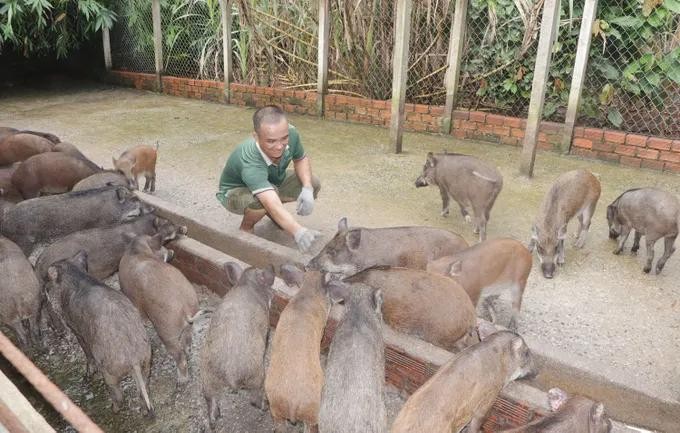
Hoa Tien Farm's circular model began with avocado trees, yielding an average of 10 to 15 tons per hectare per year. The owner of Hoa Tien Farm repurposed sub-standard avocados as feed for wild boar hybrids. From an initial trial of 20 pigs, the herd occasionally expanded to nearly 200 heads.
To treat waste and eliminate odors, Phung Van Hoa planted 300 four-season bamboo roots (scientific name Bambusa beecheyana), harvesting bamboo shoots while using treated manure and wastewater to tend the plants. Shoots are harvested year-round, generating an average income of VND3 million to VND4 million per 1,000 square meters per month, depending on the season. Cleaned bamboo branches are repurposed to feed a herd of roughly 100 bamboo rats.
The farm also holds about 5,000 eels, nearly 10 deer, and around 400 fighting cocks. The crops and animals form a circular production chain. Deer manure is used to raise earthworms, which serve as supplementary feed for fish and chickens. Water from the eel pond is reused to irrigate the bamboo, while bottom-layer water is channeled to lower ponds to raise catfish. Consequently, numerous byproducts and waste materials are repurposed, lowering input costs and creating extra income streams.
While Hoa Tien Farm built its circular model through diversified crops and livestock, Trang Linh Pig Farm in Xuyen Moc Commune operates on an industrial scale with about 3,600 sows and 100,000 slaughter pigs.
Pigs are raised in climate-controlled barns using biological bedding made of rice husks mixed with microorganisms, alongside automated feeding and watering systems. The bedding decomposes waste inside the barn floors, keeping the environment dry and minimizing wastewater generation. After each 4.5-month raising cycle, the bedding is collected and transferred to an organic fertilizer production area, where it is composted for roughly two months before being applied to crops.
According to Pham Truong Giang, Executive Director of Trang Linh Company Limited, the core of circular livestock farming lies in utilizing waste to create new value. From livestock byproducts, the enterprise is developing nearly 40 hectares of medicinal plants, 25 hectares of precious timber trees with about 22,500 trees, and organic noni growing areas.
New policies drive scaling efforts across the city
Across Ho Chi Minh City, a growing number of localities have adopted circular agriculture models to promote sustainable production and improve resource efficiency. These initiatives include mushroom cultivation combined with organic fertilizer production and fruit growing; the conversion of agricultural waste into organic fertilizer; integrated farming systems that combine avocado cultivation with pig raising, earthworm farming, bamboo shoot production, and bamboo rat breeding; as well as aquaculture operations using recirculating water technology.
Initial results indicate that these models have been effective in maximizing the use of agricultural byproducts, reducing production costs, and minimizing environmental pollution. The approach is increasingly viewed as a practical solution for advancing sustainable agricultural development while enhancing economic efficiency for farmers.
Chairman Nguyen Huu Hiep of the Farmers' Union of Kim Long Commune noted that circular agriculture offers dual benefits: byproducts from one production process become inputs for another, preventing waste, supplementing feed supplies, and generating extra income. Combining multiple crops and livestock also helps spread risks when agricultural prices fluctuate.
According to Ho Truc Thanh, Deputy Director of the Ho Chi Minh City Department of Agriculture and Environment, the Ho Chi Minh City People's Committee issued Decision No. 2148/QD-UBND on October 15, 2025, approving a plan to develop circular agriculture in the livestock sector. The plan aims for over 60 percent of household-scale farming facilities and 100 percent of farm-scale facilities to adopt technologies and techniques for treating and reusing livestock waste by 2030.
For sustainable development, circular agriculture needs to link stakeholders along value chains, converting byproducts into raw materials for production. When stages are effectively connected, farmers gain opportunities to cut costs, boost income, and lessen environmental impacts.
Ho Chi Minh City is home to 342 large scale livestock farms, 865 medium scale farms, and 1,904 small scale operations, reflecting the sector’s significant role in the city’s agricultural economy. As part of efforts to promote sustainable agricultural development, seven livestock facilities have successfully adopted circular farming models to date.