Preparing for new regulations
On August 14, 2026, the Prime Minister promulgated Directive No.33/CT-TTg on bolstering food safety within educational facilities. Executing this vital directive, the HCMC People’s Committee issued Official Document No.7916/UBND-VX, formally designating ward, commune, and special zone People’s Committees to strictly assume responsibility for appraising dossiers, evaluating legal status, and selecting meal providers for local educational institutions.
Subsequently, on September 13, Official Dispatch No.64/CD-TTg stipulated that commune-level People’s Committees bear absolute responsibility for selecting and signing contracts with catering providers for public educational institutions under their local jurisdiction.
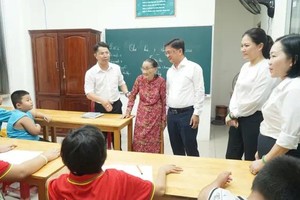
To effectively roll out these new regulations, the HCMC Food Safety Department has organized professional guidance classes across all 168 wards and communes. The content meticulously focuses on appraising legal status, food quality, and exact protocols for selecting catering units.
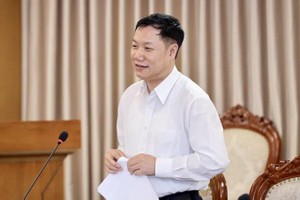
For the department’s Deputy Director Mr. Le Minh Hai, the main goal is to help localities execute regulations following correct protocols. In tandem with routine reviews, management tasks must be conducted continuously, closely tracking practical operations.
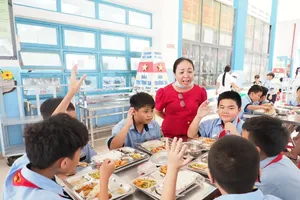
Concurrently, the HCMC Department of Education and Training requires all preschool and general educational facilities to finalize legal procedures with meal providers, ensuring boarding meals are organized properly while rigorously guaranteeing food safety.
They heavily urged local authorities to pragmatically evaluate all providers, deliberately avoiding dangerous situations where a single catering unit supplies too many educational facilities, thereby severely exceeding its actual physical capabilities.
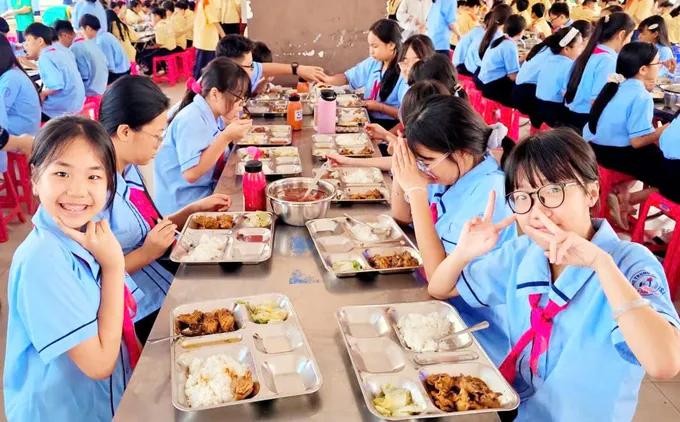
Two parallel approaches simultaneously exist
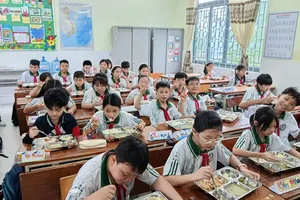
Following these new regulations, several HCMC wards like Chanh Hung, Xom Chieu, and Dong Hoa established appraisal teams to review capacity dossiers and select qualified units to supply meals for local schools. However, boarding meal organization across numerous schools is being executed the old way, where principals directly select and sign contracts with meal providers.
As stated by Chairman Nguyen Huu Chau of the Lai Thieu Ward People’s Committee, current operations mean schools are fully responsible for signing contracts with catering and food providers for students. The locality bears the responsibility of inspecting the organizational process at the schools.
Accordingly, the ward’s Socio-Cultural Office collaborates with specialized units to establish inspection teams verifying food safety compliance for school boarding meals; they also coordinate with the HCMC Department of Industry and Trade to roll out the “Responsible Green Tick” model, aiming to cultivate transparency in food traceability and distribution chains while ensuring school meal quality.
Similarly, in Binh Tan Ward at present, school principals are still shouldering the responsibility of appraising and signing contracts with boarding meal providers. The ward’s People’s Committee supervises, accompanies, and coordinates the inspection of boarding meal organization.
Adopting this exact approach, the Socio-Cultural Office of Hoa Hung Ward’s People’s Committee stated that the locality is currently empowering schools to proactively select and sign contracts with catering units, while the locality’s major responsibility is reviewing and appraising dossiers alongside supervising the implementation process.
Concrete guidance desperately needed
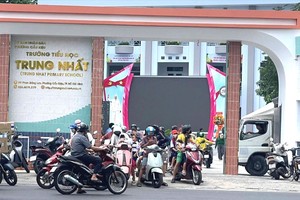
For Principal Le Ngoc Phong of Nguyen Truong To Primary School, the Government’s Directive No.33/CT-TTg practically acts as the most crucial legal foundation for managing boarding meals. However, executing this at the grassroots level undeniably requires additional concrete guiding documents. Finalizing all procedures could drag on until October 2026.
Furthermore, numerous localities are currently merging schools. Therefore, alongside inherently complex bidding procedures, meticulous preparation is absolutely required. Consequently, some educational facilities haven’t immediately organized boarding meals for their students.
Another pressing issue is the intricate relationship between managing fee collections and signing provider contracts. On September 15, 2026, the HCMC People’s Committee promulgated a comprehensive list of collection items and fee levels for public schools. Accordingly, schools decide fees based on parents’ consensus, ensuring revenues strictly offset expenditures without breaching stipulated ceilings.
Stemming from this reality, several localities argue principals should persistently sign contracts with meal providers, since schools directly orchestrate these services and manage collections. However, management agencies must rigorously clarify this matter against new regulations empowering commune-level People’s Committees to select catering units.
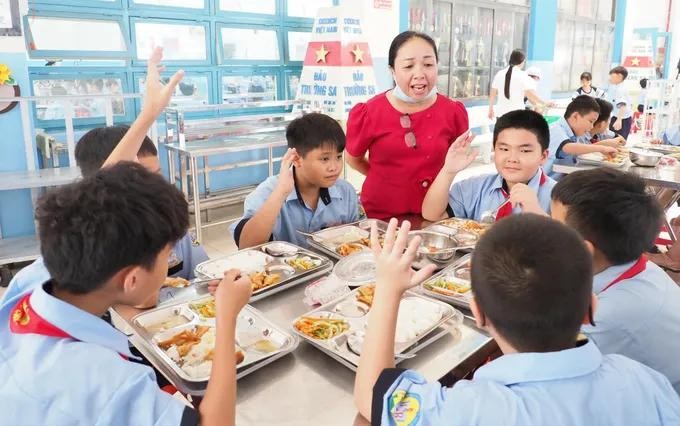
Principal Dinh Phu Cuong of Phu Dinh Junior High School stressed that regardless of the management model employed, schools must perpetually retain their role in directly supervising meals. Administrators, medical staff, and teachers collectively participate in inspecting meals, absorbing feedback from parents to promptly handle emerging issues.
While waiting for the new mechanism to be uniformly rolled out, HCMC must explicitly determine the transition timeline alongside responsibilities for every single party involved. Unifying these contents will ostensibly provide localities a solid foundation for synchronized execution, avoiding chaotic scenarios while seamlessly guaranteeing food safety for students.
Expanding “Responsible Green Tick” program
Over recent times, the “Responsible Green Tick” program successfully connected nearly 500 suppliers, approving roughly 6,000 products meeting rigorous standards. For Deputy Director Nguyen Nguyen Phuong of the HCMC Department of Industry and Trade, leveraging this model is crucial. The department actively drives the formation of “Green Tick kitchens,” aiming to stringently control food sources while cultivating transparency across school meals.
To date, this model is being piloted across several localities. Having food-supplying enterprises register for the program invariably helps schools and parents easily trace boarding meals. The entire pipeline from importing raw ingredients to final products is strictly required to be transparent in real-time. With input factors tightly controlled, enterprises’ business operations will drastically improve.
According to the Deputy Director, the program has garnered immense support from local schools. He fervently expects this boarding meal model will soon be replicated, contributing to a safe food ecosystem forging an additional health protection layer for HCMC students.
Binh Dong Ward stands out as a pioneer seamlessly integrating the “Responsible Green Tick” into school meals. While parents previously accessed information passively, they’ve now transformed into active supervisors via QR codes printed directly on meals. Consequently, local parents remain incredibly supportive.