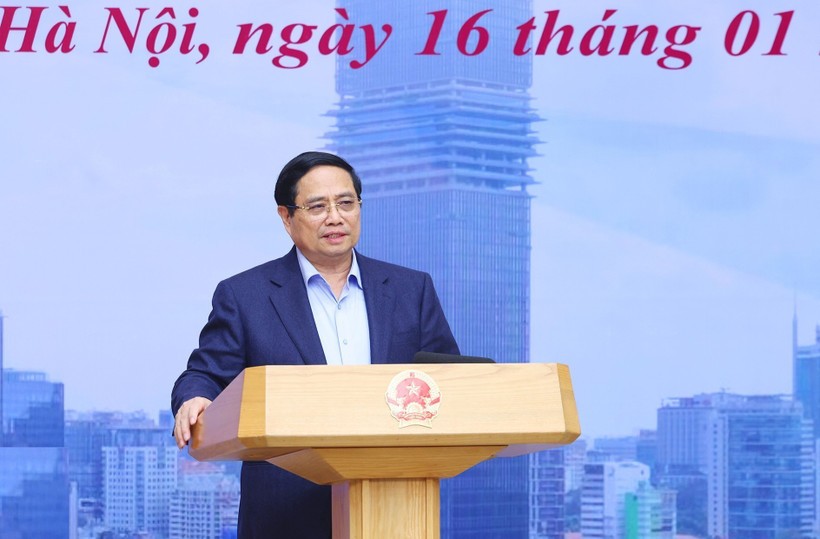
Prime Minister Pham Minh Chinh has underlined the importance of making an institutional breakthrough for the development of the International Financial Center (IFC) in Vietnam and viewed this as the core competitive edge.
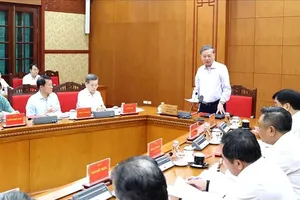
The PM made the remark while chairing the first meeting of the Steering Committee for the IFC in Vietnam on January 16.
He said developing an IFC is a new task, but the Government, ministries, sectors, and localities have been exerting efforts and gained some initial important results, including the Politburo’s issuance of conclusions and directions on the IFC establishment, the National Assembly’s Resolution No. 222/2025/QH15 on the IFC in Vietnam, the Government’s eight decrees guiding the implementation of Resolution No. 222/2025/QH15, and the formation of the central steering council for the IFC and the steering bodies in Ho Chi Minh City and Da Nang, where the IFC is based.
Pointing out certain challenges related to the competition among regional and global IFCs, high-quality human resources, urban infrastructure and services, and risk management mechanisms, PM Pham Minh Chinh stressed that credibility, trustworthiness, stability, and predictability are core factors of the IFC’s success.
Therefore, he stated, all policies must be transparent and consistent; processes standardized; individual responsibilities clear; issues handled quickly but correctly; openness controlled; and innovation encouraged without compromising system security.
Outlining tasks for the coming time, he asked HCMC and Da Nang to build a strategy for the IFC development until 2035, with a vision to 2045, ensuring it matches current conditions and trends while being feasible and effective. Besides, they need to continue preparing master plans, infrastructure, personnel, and facilities to support the operation of the IFC Steering Council. Exchange activities should also be promoted to learn international experiences.
The Government leader demanded that the IFC should debut in HCMC on February 9 at the latest, while an international arbitration center and a specialized court should also be launched by that time.
Emphasizing the viewpoint that institutional breakthroughs should be made as the core competitive edge, he said institutional frameworks must be superior, distinctive, and in line with international practices. At the same time, they must suit Vietnam's conditions and ensure sovereignty, financial security, and data safety.
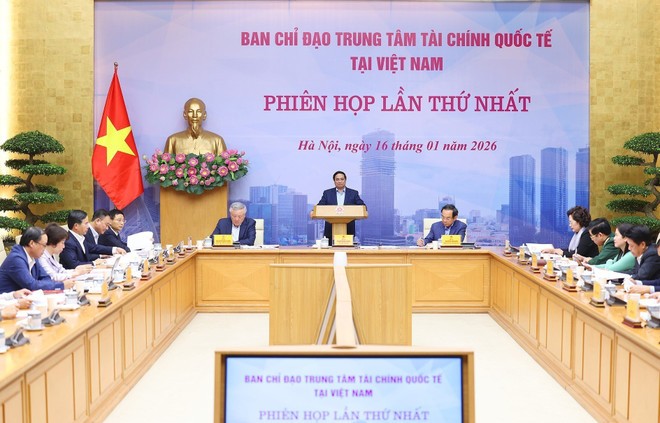
Amid intense competition among regional and global financial centers, the PM requested that mechanisms must be sufficiently distinctive, attractive, and transparent; implementation decisive, disciplined, and professional; and risk management rigorous, but procedures streamlined and efficient.
It is also important to adhere to the principle of harmonizing interests and sharing risks while guaranteeing macroeconomic stability and the financial system’s safety, preventing management loopholes or those for money laundering and terrorist financing, he went on.
Saying people should be placed at the center and viewed as both the goal and driving force, the PM noted that to develop the IFC, it is essential to first have a team of qualified administrators, managers, experts, and human resources in finance, technology, law, and auditing who possess professional ethics and a sense of discipline.
In addition, infrastructure should be treated as the foundation of the IFC, including transportation, electricity, water, digital infrastructure, data, cybersecurity, data centers, trading platforms, identification, authentication, and information sharing.
In his speech, PM Pham Minh Chinh also said markets and products should be the benchmarks, asking relevant sides to identify which institutions, products, markets, and customers the IFC needs to attract; what value it generates for the economy; what contribution it makes to growth and employment; and how it creates ripple effects on other sectors.
He emphasized the need for clearly differentiated and complementary roles between the IFC branches in Ho Chi Minh City and Da Nang to avoid internal competition, overlap, or fragmentation.
Assigning specific tasks to the two cities, ministries, and sectors, the PM reiterated the guideline of “breakthrough mindset—decisive action—substantive results” and asked the steering committee to keep making efforts to develop a modern, transparent, and efficient IFC where Vietnam affirms its stature, capability, and role in the global financial network.
He voiced his belief that with strong resolve, great efforts, consensus, and active engagement of the entire political system, support from international partners, and endeavors by the steering committee, the country will succeed in developing the IFC and gradually become a global financial hub, contributing to the goals of double-digit growth and a strong and prosperous nation in the new era.