Many traditional cultural education models have been boldly implemented by schools in Ho Chi Minh City, not only contributing to the preservation and maintenance of traditional cultural values at risk of fading away, but also becoming educational highlights toward holistic student development.
Don ca tai tu enters school classrooms under Resolution 80
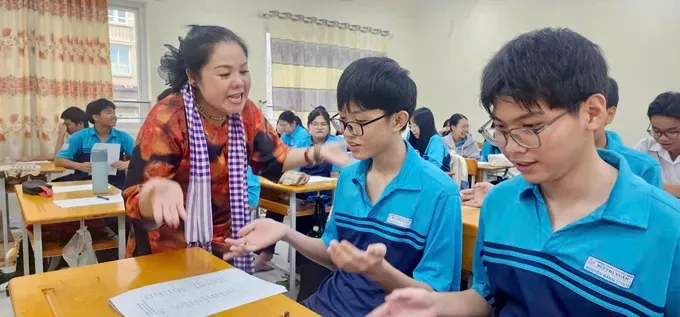
Once a week, students in class 11A3 at Bui Thi Xuan High School, Ben Thanh Ward, are introduced to Don ca tai tu (Southern Vietnamese folk music) during their Don ca tai tu class. This is a special subject integrated into the curriculum by the school for the 2026-2027 academic year, piloted in two 11th-grade classes and one 10th-grade class. The instructors are artisans from the Music Branch of the Ho Chi Minh City Theater Association.
After more than two years of nurturing the idea to bring Don ca tai tu into the main curriculum across the 35 weeks of actual study in the 2026-2027 school year, Principal Huynh Thanh Phu of Bui Thi Xuan High School, said that Resolution 80 provided the motivation and a solid institutional framework for Don ca tai tu to "step" into the classroom.
"For the people of the Southern region, Don ca tai tu is a closely bonded musical form, an underlying stream of traditional culture. However, in the current context, Don ca tai tu is somewhat overshadowed among young people by modern genres. Wanting to bring Don ca tai tu into the classroom so that students understand, love, and preserve the heritage requires more than just determination from school leaders; there must be a sustainable mechanism to allocate time, and a team of artists with expertise and passion to join hands. Resolution 80, by placing culture at the center of national development, helped the school realize this aspiration by creating a mechanism for us to invite artisans to teach," the principal of Bui Thi Xuan High School said.
Previously, introducing Don ca tai tu into teaching was also a model pioneered by Nguyen Thai Hoc Primary School, Ben Thanh Ward, starting from the 2020-2021 academic year, with a desire to nurture a love for national music and traditional culture among primary students. However, a lack of mechanisms and funding caused the model to experience interruptions.
Principal Tran Be Hong Hanh of Nguyen Thai Hoc Primary School recalled that despite being steadfast in the goal of traditional cultural education for students, there was a long period when the club had to temporarily suspend operations due to a lack of funds.
Starting from the second semester of the 2025-2026 school year, the Don ca tai tu class was revived at Nguyen Thai Hoc Primary School, continuing strongly into the 2026-2027 school year and attracting a large number of students. To light up the class again, Principal Tran Be Hong Hanh stated that the school flexibly applied Resolution 80 on the development of Vietnamese culture. A portion of the club's operating expenses was allocated from funds used for implementing the advanced integrated school model.
Schools bring traditional music into classrooms under Resolution 80
Meanwhile, traditional music is a special subject introduced into teaching for 10th and 11th graders at Nguyen Du High School, Hoa Hung Ward, for the 2026-2027 academic year. The instructors are lecturers from the Ho Chi Minh City University of Theater and Cinema.
According to school principal Nguyen Van Do, traditional cultural education for students was always prioritized in previous school years, but mostly remained limited to topical themes and experiential educational activities. Making it a sustainable main curriculum subject requires a mechanism regarding institutions and policies to assist the school in coordinating with specialized artists, artisans, and lecturers to build appropriate instructional content.
"The school was very pleased when Resolution 80 was issued. In reality, students are very fond of and passionate about traditional cultural education content when it is systematically invested in and suited to their reception. With Resolution 80, implementing traditional cultural education content first helps the school gain high consensus among staff, parents, and students, and particularly provides a strong mechanism to coordinate with specialized units. From there, traditional cultural heritage education achieves high efficiency, not stopping at preservation education but also igniting love, inheritance, and continuity among students," Principal Nguyen Van Do shared.
Similarly, since the second semester of the 2025-2026 school year, the "Ethnic Cultural Space" has become an ideal traditional cultural education destination for teachers and students at Tay Thanh High School, Ho Chi Minh City. The model is considered an initial result of efforts to flexibly apply Resolution 80 in schools. This physical space gathers cultural models and serves as the venue for vibrant, practical cultural classes, educational activities, topical sessions, and talk shows.
Looking back at the previous process of traditional cultural education, Principal Nguyen Van Yen of the school, noted that resources and mechanisms remained major barriers to bringing this requirement into teaching on a large, systematic, and in-depth scale. Most initiatives stopped at temporary themes, making it difficult to reach students deeply.
The requirements set forth in Resolution 80 on comprehensively innovating thinking on mobilizing all resources for cultural development were studied and applied by the school, which viewed them as a path-clearing mechanism and a major motivation to resolve previous bottlenecks. Currently, school managers have a dedicated traditional cultural space, making it a mandatory requirement in implementing the school's educational program, Principal Nguyen Van Yen said.