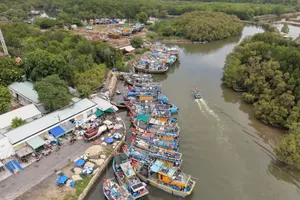
The move is viewed as a strategic effort to reshape the city’s spatial development, drive sustainable urban growth, and enhance the quality of life for residents.
Residents eager for prompt relocation
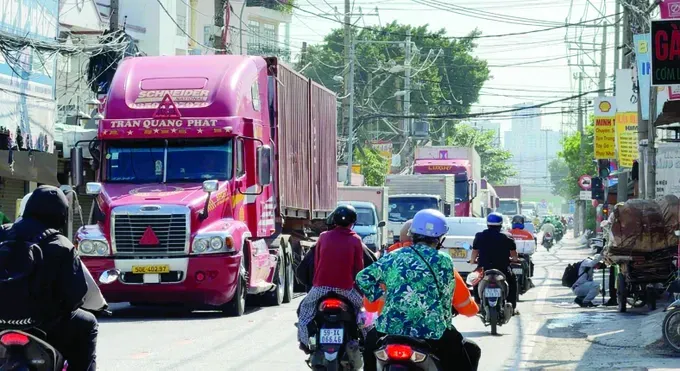
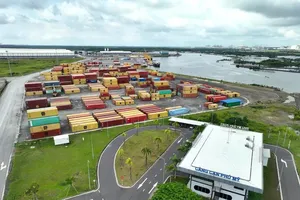
Residents living along Nguyen Duy Trinh Street in the wards of Phu Huu, Long Truong, and Truong Thanh daily witness thousands of container trucks and tractor-trailers queuing to enter and exit the Cat Lai and Phu Huu port clusters. Severe traffic congestion is frequent on multiple stretches, posing constant safety risks. Meanwhile, near Gate G of Tan Cang-Cat Lai Port, deteriorating road conditions cause thick clouds of dust as heavy vehicles continuously move in and out, directly impacting the daily lives of local households.
As a result, the policy to relocate seaports away from the city center has drawn widespread support from the vast majority of residents, particularly those along these routes who bear the heavy burden of port-bound traffic.
Tran Van Cuong, a resident living on Nguyen Duy Trinh Street in Long Truong Ward, said locals would strongly welcome the port relocation. For years, residents have endured pollution, dust, and the constant fear of traffic accidents.
According to a representative from the Ho Chi Minh City Department of Construction, the city outlined the policy to relocate several inner-city seaports years ago, though concrete implementation plans have yet to materialize. The department is currently drafting detailed proposals and gathering input from relevant agencies before submitting a final plan to the Municipal People’s Committee for further action.
Mr. Pham Anh Tuan, CEO of Portcoast Consultant Corporation, noted that the city's relocation strategy is an inevitable trend. However, given Ho Chi Minh City’s expanding footprint, the primary gateway port hub must unequivocally center around the Cai Mep – Thi Vai – Can Gio complex.
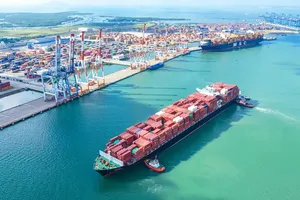
He explained that central port relocation could follow two approaches: completely shutting down operations at inner-city terminals in favor of Cai Mep–Can Gio, or shifting the primary hub responsibilities outward while repurposing central ports as domestic transshipment points. In the latter scenario, inland waterways would serve as the primary link between these transit nodes and the main gateway ports.
Furthermore, to prevent new bottlenecks, Mr. Tuan recommended establishing a transportation network with inland waterways as its backbone, supported by river ports and terminals acting as logistics hubs for cargo collection and distribution.
Prioritizing public space development
Shifting inner-city ports to river mouths and coastal areas is an inevitable trajectory seen in many nations worldwide, such as the United States (from Manhattan to New Jersey), Germany (from Bremen to Bremerhaven), and Thailand (from Bangkok to Laem Chabang). Relocation is required not only to expand urban space but also to adapt to evolving maritime industry trends. Ultimately, completing this transition promises to transform the urban landscape and modernize the region's port infrastructure.
According to Mr. Pham Anh Tuan, land cleared from relocating ports along the Saigon River should be prioritized for public spaces, commercial development, and service hubs. The riverbanks could transform into waterfront boulevards and parks linked to a maritime museum and commercial districts, fostering riverfront tourism, the riparian economy, and a vibrant nightlife sector.
Because most port operators are private entities, he emphasized that the timeline and roadmap for relocation must be carefully calibrated to avoid disrupting business and production activities. Furthermore, the city should create favorable conditions for affected businesses to invest in and construct new port facilities.
Meanwhile, Associate Professor Dr. Nguyen Ngoc Vinh, Deputy Director of the Institute for Regional Development Research and Consulting (IRDRC), a Unit under the University of Economics Ho Chi Minh City, regarded the move as a strategic step for the city to restructure its economic space and advance sustainable urban development.
The initiative will not only ease inner-city traffic congestion by removing thousands of daily container trucks and heavy vehicles from major thoroughfares but also improve living conditions by curbing noise pollution, fine particulate matter, and exhaust emissions—ultimately enhancing residents' quality of life.
Complete port relocation out of central Ho Chi Minh City, Vinh added, will seamlessly connect architectural and service corridors. This will free up valuable land to expand public spaces, construct parks, upgrade transportation infrastructure, and develop high-value commercial amenities.
Under Decision 407/QD-BXD issued by the Ministry of Construction, which approved the detailed master plan for Ho Chi Minh City’s seaport land and waters for the 2021–2030 period with a vision toward 2050, the city’s seaport system comprises several key port areas, including Cat Lai – Phu Huu, Saigon River, Hiep Phuoc, Nha Be, Long Binh, the Can Gio International Transshipment Port, potential terminals in Can Gio, along with buoy berths and anchorage grounds for heavy weather and storms.
Regarding infrastructure, looking ahead to 2050, Ho Chi Minh City will continue investing in the Can Gio International Transshipment Port to partner with the Cai Mep – Thi Vai complex, aiming to form a mega-scale international transshipment hub of regional and global stature. The city will also complete the relocation of existing terminals along the Saigon River in alignment with its urban spatial development plans.