However, to turn these opportunities into a sustainable competitive advantage, domestic enterprises must enhance their technological capabilities, improve corporate governance, and meet the increasingly stringent standards of international markets.
Major opportunities, ambitious goals
According to the Statistics Office, as of June 30, Vietnam had attracted a total of US$34.65 billion in newly registered foreign direct investment (FDI), up 61 percent year-on-year. Ho Chi Minh City alone secured more than US$7.5 billion in FDI during the first six months of the year, fulfilling 68.1 percent of its annual target and marking an 89.68 percent increase compared with the same period last year. Notably, FDI inflows have increasingly been directed toward high-tech industries, manufacturing, and knowledge-intensive services.
Deputy Director of the Ho Chi Minh City Investment and Trade Promotion Center (ITPC), Cao Thi Phi Van, said these economic indicators demonstrate that Vietnam remains an attractive destination amid the ongoing restructuring of global supply chains. They also present significant opportunities for the supporting industries sector to expand and strengthen the position of Vietnamese enterprises in global value chains.
Faced with these opportunities, Vietnam has set ambitious targets for the development of its supporting industries. Under the Supporting Industry Development Program for 2026–2035, the country aims to raise the average localization rate of key industries to 40–45 percent by 2030, while positioning its industrial competitiveness among the top three in ASEAN. By 2035, most supporting industry sectors are expected to attain advanced technological capabilities and integrate deeply into global value chains. Meanwhile, Resolution No. 10 on the development of the foreign-invested sector targets an average localization rate of 45–50 percent in key industries by 2030, while striving to have around 10,000 domestic enterprises participate in the value chains and supply chains of foreign-invested enterprises.
For Ho Chi Minh City, the 2026–2030 development strategy identifies supporting industries as a key pillar for improving the quality of economic growth, with a focus on high-tech applications and deeper integration into global supply chains. By 2030, the city aims to achieve localization rates of over 40 percent in mechanical engineering, over 30 percent in electronics, over 30 percent in the automotive industry, over 15 percent in high-tech industries, over 65 percent in footwear, and over 60 percent in the textile and garment sector.
Coordinated measures to strengthen the sector
According to Mr. Vo Son Dien, Chairman of the Ho Chi Minh City Supporting Industries Association (HASI), amid shifts in reciprocal tariff policies and ongoing supply chain disruptions, multinational corporations are seeking to diversify their supply chains across Southeast Asia. This presents a valuable opportunity for Vietnamese supporting industry enterprises to integrate more deeply into global value chains. However, these opportunities can only be fully realized if enterprises can meet increasingly stringent requirements in product quality, technological capability, corporate governance, traceability, and sustainable development.
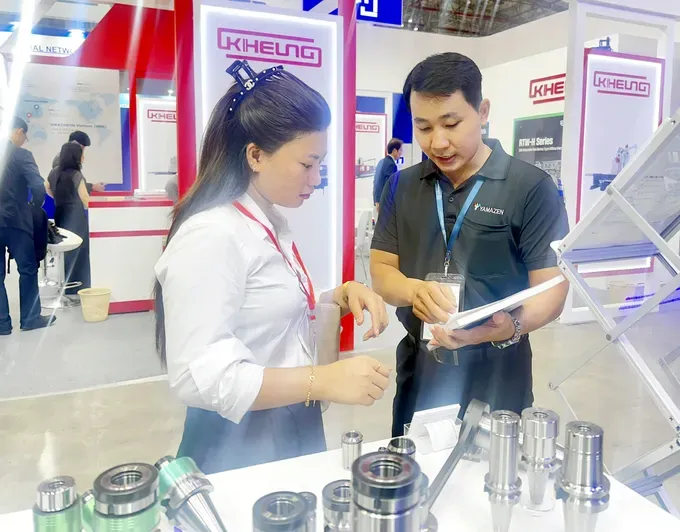
In recent years, Ho Chi Minh City has implemented a range of trade promotion activities to connect supporting industry enterprises with foreign-invested companies. Through successive business-matching events, 175 FDI enterprises have participated in more than 2,500 direct business meetings with over 620 supporting industry manufacturers whose products matched market demand.
During the 2026–2027 period, the city plans to finalize policy mechanisms and a list of key supporting industry products while launching infrastructure development for a mechanical engineering industrial park and a high-tech supporting industry park. Ho Chi Minh City has also established a Steering Committee for Supporting Industry Development.
Head of the Industrial Management Division under the Ho Chi Minh City Department of Industry and Trade, Nguyen Minh Tam, said that to achieve the city's localization targets for the 2026–2030 period, Ho Chi Minh City will continue implementing a range of support measures, including the investment stimulus program under Resolution No. 09 and Resolution No. 523 of the Ho Chi Minh City People's Council.
Under the program, enterprises are eligible to borrow up to VND200 billion per project, with the city budget covering 50 percent to 100 percent of interest payments, depending on the sector. Between 2019 and 2025, although only 32 projects undertaken by 28 enterprises participated in the program, it enabled businesses to invest in modern machinery and equipment, upgrade technologies, and expand production capacity.
Having benefited from Ho Chi Minh City's investment stimulus policy on multiple occasions, Chairman of the Board of Nhat Long Mechanical Trading Co., Ltd., Nguyen Ngo Long, said the preferential financing had played a crucial role in supporting the company's long-term strategy of continuously upgrading technologies and enhancing its competitiveness as a supporting industry enterprise.
Director of the Center for the Fourth Industrial Revolution in Ho Chi Minh City (HCMC C4IR), Le Truong Duy, said the center is advising the city on the introduction of a Smart Manufacturing Transformation Program, accompanied by a comprehensive support ecosystem for enterprises.
Similarly, the Ho Chi Minh City Supporting Industries Association (HASI) plans to step up three key initiatives to strengthen the sector. These include implementing programs to enhance suppliers' capabilities, building supply-demand networks linking domestic and international buyers with Vietnamese suppliers, and helping enterprises adopt new standards in smart manufacturing, environmental, social, and governance (ESG) practices, product traceability, and modern corporate governance.