Since late May, Vietnam’s domestic diamond market has experienced unprecedented turmoil. A series of diamond trading businesses have lost liquidity, abruptly closed, or announced the suspension of buyback services, leaving consumers scrambling and exposing legal loopholes in the market.
Wave of panic selling
After authorities initiated criminal proceedings in a diamond smuggling case involving executives of PNJ-Lab and charged several diamond shop owners, a crisis of confidence triggered a wave of panic selling. The resulting liquidity pressure forced many retailers to suspend buyback services or shut down operations, leaving customers holding diamonds with few options.
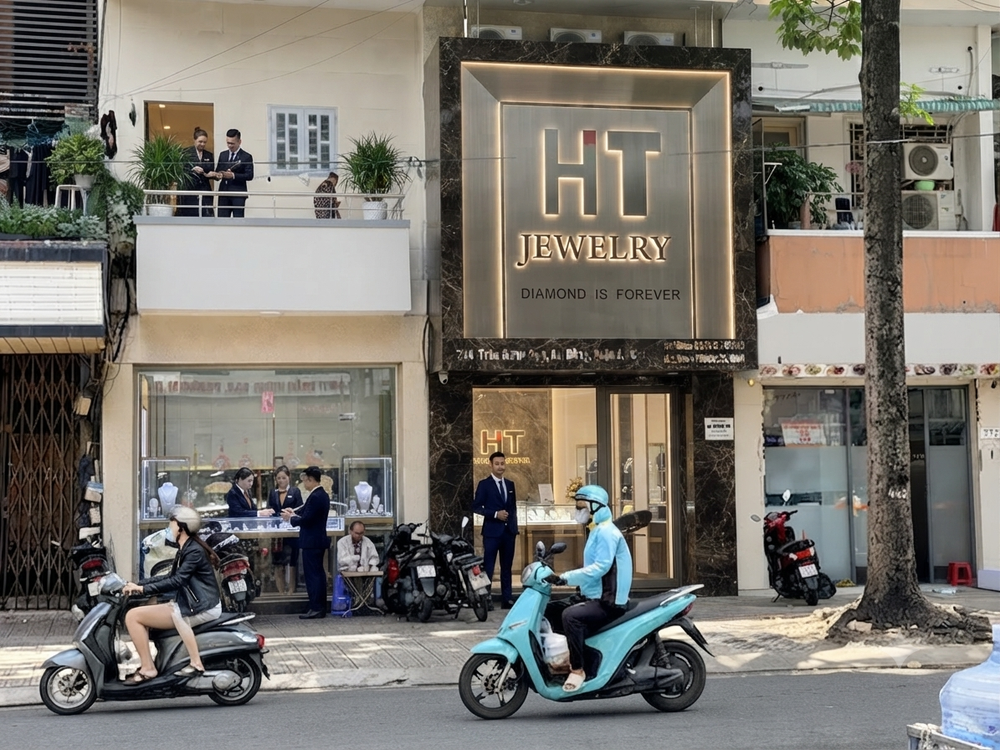
Xuan Le, a resident of Nhieu Loc Ward in Ho Chi Minh City, purchased a 6.3 mm diamond ring for about VND250 million (about US$9,600) from H.T Jewelry on Le Thanh Ton Street. Last week, when she tried to sell it back, the store said it would take three months to process the transaction and failed to honor its earlier buyback commitment. When she objected, she was told to return in 10 days.
"On July 18, I went back and the store said it was closed for inventory checks. The next day it was still closed, and later the company posted on Facebook that it had temporarily suspended operations without saying when it would reopen," she said.
Phan Han, a resident of Dien Hong Ward in Ho Chi Minh City, faced an even more difficult situation. She had purchased diamonds from several different stores, all of which have now closed. She said she bought a diamond tennis bracelet, with stones measuring 5.4 mm each, for VND450 million (about US$17,300) and a diamond necklace for about VND1 billion (about US$38,500) from T.T.N. in Ben Thanh Ward. Last week, the store offered to buy them back at a loss of 30 percent to 60 percent. She decided not to sell because the losses were too large. On July 18, the store unexpectedly closed, citing repairs and maintenance.
On July 21, a series of diamond and gemstone stores across Ho Chi Minh City temporarily suspended operations. Shops including K.D, K.K, and K.C on An Duong Vuong and Tran Hung Dao streets in An Dong Ward, as well as C.H Diamond, PJA, Q. Diamond, H.T Jewelry, Q. Jewelry, and T.T.N on Le Thanh Ton Street in Ben Thanh Ward and Vo Van Tan Street in Ban Co Ward, were all shuttered. In Can Tho, K.D., one of the city's largest diamond retailers, also announced that it was "temporarily suspending transactions to handle internal matters."
According to attorney Le Van Hoan of the Ho Chi Minh City Bar Association, Article 351 of the 2015 Civil Code stipulates that businesses failing to fulfill or improperly executing their commitments must bear civil liability. Financial hardship is not considered a force majeure event under Article 156 of the Civil Code, as it is classified as a standard business risk.
Diamond buyback restrictions expose vulnerabilities in unregulated market
Until recently, most diamond retailers commonly promised to repurchase loose diamonds at 80 percent to 95 percent of the original price, deducting 5 percent to 20 percent depending on quality and size. Because the secondary diamond market depends largely on the original seller, liquidity becomes extremely limited when retail chains close, increasing consumer anxiety.
According to Head Nguyen Thi Thu Huong of wealth management at FIDT Investment Consulting and Asset Management, the biggest risk in the diamond market stems from legal gaps and a lack of transparency. Unlike the gold market, which is tightly regulated, the diamond industry does not have a unified regulatory framework or a transparent public trading platform.
She also noted that there is no mechanism ensuring the independence of appraisal organizations from retail businesses. As a result, sellers hold a significant informational advantage, while buyers bear most of the risk, even when purchasing from major brands.
Deputy Dean Nguyen Van Tien of the Civil Law Faculty at Ho Chi Minh City University of Law said fixed-rate buyback commitments are one of the most common sales methods used to build consumer trust.
However, when market conditions deteriorate, customers may find themselves refused buyback services on the grounds of financial difficulties or temporary suspension of operations. Such actions can be viewed as a unilateral termination or refusal to perform contractual commitments, violating agreements and directly infringing on consumers' lawful rights.
To protect their legitimate rights and interests, buyers should collect all invoices, receipts, diamond certificates, and any written agreements related to the transaction, and submit complaints to the competent authorities for review and resolution, Deputy Dean Nguyen Van Tien said.
On July 21, Phan Quoc Cong, General Director of Phu Nhuan Jewelry Joint Stock Company (PNJ), announced that instead of fully paying diamond-selling customers on the same day as before, PNJ will apply a daily maximum payment limit based on actual capacity for all buyback transactions nationwide, effective July 21.
According to the General Director of Phu Nhuan Jewelry Joint Stock Company (PNJ), this is a temporary liquidity management measure implemented during a period of unusual fluctuations in the diamond market, and PNJ will review and adjust it once market conditions stabilize.