Expanding sites for receiving dredged sediment
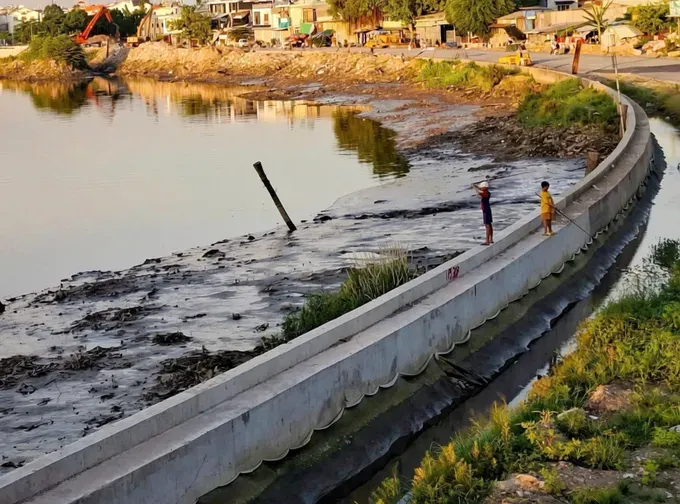
Deputy Director of the Ho Chi Minh City Department of Agriculture and Environment, Nguyen Hong Nguyen, said the department has issued interim guidelines on the management of construction solid waste; dredged materials generated from the dredging and maintenance of inland waterways; sludge from drainage systems; and sediment dredged from canals, ditches and irrigation works across the city.
The guidelines aim to provide project owners, investors, landowners, waste generators, regulatory agencies, and the People’s Committees of communes and wards with a consistent approach to managing and handling dredged materials in accordance with regulations. The department is also drafting and advising the municipal People’s Committee on official regulations governing the collection, transportation, and treatment of construction solid waste, sludge, and other related waste.
Under the interim guidelines, for sediment dredged from canals, ditches, and irrigation works, project owners and facility operators must determine the source and estimated volume of the dredged material, as well as its composition, by coordinating with competent agencies to collect and analyze samples. They must also separately collect and sort waste and other removable contaminants, assess signs of contamination, and review the history of the dredging site.
If the material is determined to be hazardous waste, the waste generator must manage it in accordance with regulations and must not place it at temporary storage sites designated for ordinary materials or use it for landfilling or embankment purposes.
Another solution under consideration is to expand the number of sites capable of receiving dredged sediment. The Ho Chi Minh City Department of Agriculture and Environment has asked commune-level People’s Committees to review unused land within their jurisdictions, including public land and land managed or used by organizations and individuals, for use as sites for storing dredged materials and temporarily stockpiling construction solid waste.
Commune-level People’s Committees are also stepping up public communications, particularly in outlying and remote communes where substantial areas of vacant or unused land remain, to inform residents about legal provisions allowing dredged materials from dredging projects in seaport waters and inland waterway areas to be received and managed at designated sites.
Proposed auction of dredged sediment
Dredged sediment can become a useful source of materials if properly classified and treated. General Director of Saigon Green Biotechnology Co., Ltd., Vu Ngoc Tam, said the company is capable of treating around 500 cubic meters of dredged sludge and 800 cubic meters of bentonite slurry per day. The processing capacity for polluted canal dredged material reaches approximately 1,600 cubic meters per day.
After classification and the removal of contaminants, part of the material can be used as feedstock for producing clean soil, landscaping soil, construction fill, or non-fired bricks. However, if multiple projects undertake dredging and transfer sediment at the same time, the resulting volume could exceed the licensed receiving capacity of treatment facilities. Ho Chi Minh City therefore needs an integrated mechanism to coordinate the volume of sediment generated by projects, from classification, transportation, and reception to recycling and reuse.
Regarding difficulties in handling dredged sediment from the Tham Luong–Ben Cat Canal and Nuoc Len Canal Infrastructure Construction and Environmental Improvement Project, the Ho Chi Minh City Urban Infrastructure Construction Investment Project Management Board has proposed applying new regulations on the “recovery of Group IV minerals.” This is a new approach introduced under the Law on Geology and Minerals, which took effect in July 2025.
Under the proposal, millions of cubic meters of dredged sediment would be put up for auction, with the winning bidder responsible for carrying out the dredging, transportation, and treatment in compliance with environmental regulations. The project’s initial estimate put the cost of dredging the canal bed at around VND295 billion (US$11.3 million). Based on current fuel prices and transportation rates, the estimated cost is expected to rise significantly.
Recently, Hoi Chau Ngu Joint Stock Company, a contractor specializing in construction works, submitted a document to the relevant authorities proposing to dredge and recover soil and sludge from work packages under the project. Under the proposal, the company would organize the collection, transportation, and treatment of the dredged material or recover sediment that is suitable for reuse while fulfilling its financial and tax obligations in accordance with current regulations.
Mr. Le Ngoc Linh, Deputy Director of the Ho Chi Minh City Department of Construction, confirmed that the department had issued a written response to the company’s proposal. Accordingly, the recovery of minerals during dredging is consistent with legal regulations and would help make more efficient use of natural resources, reduce project implementation costs, and save the city’s budget.
The company has proposed that the Ho Chi Minh City People’s Committee assign the Department of Agriculture and Environment to take the lead in guiding the Ho Chi Minh City Urban Infrastructure Construction Investment Project Management Board through the procedures related to the recovery of dredged minerals from the project, Mr. Linh said.
According to Director of Hoi Chau Ngu Joint Stock Company, Le Van Hao, only a small portion of the dredged sediment can be recovered, while the remainder must still be classified and treated in accordance with regulations. The company’s proposal is currently only at the stage of seeking policy approval, and the specific approach will depend on a decision by the competent authorities.

According to Dau An Phuc, Director of the Ho Chi Minh City Urban Infrastructure Construction Investment Project Management Board, the board is studying the use of additives to treat and stabilize dredged sediment, turning it into material that meets technical standards for road embankments. The solution is expected to make use of dredged sediment on site while reducing demand for construction sand and stone.
Depending on the results of geological surveys at each location, consultants will determine the appropriate mix ratio of cement or other additives to bind the sediment particles into a solid material that meets road embankment standards. This requires careful calculations from the survey and design stages.
Recently, the department has worked with experts from Ho Chi Minh City University of Transport and consultants to prepare a proposal for a pilot project on a section of the project. If successful, the city will be able to make use of dredged sediment on site, save construction materials and reduce costs associated with waste disposal, Mr. Dau An Phuc said.

According to Mr. Truong Ngoc Thanh Nhan, Vice Chairman of the Tan Vinh Loc Commune People’s Committee, the locality will promptly review surplus or unused land and assess demand for dredged sediment and fill materials among residents and businesses whenever requested by the competent authorities. Based on the land review, the commune People’s Committee will proactively provide information and coordinate with the city’s specialized agencies to update the list of sites capable of receiving dredged sediment.
To improve coordination, relevant parties need to monitor, consolidate, and promptly update information on sources of dredged material, estimated volumes, and dredging schedules, as well as demand and the timing for when materials are needed. This will facilitate connections, exchanges, and reuse, helping minimize long-distance transportation and reduce the volume of sediment requiring treatment.

According to Dr. Pham Viet Thuan, Director of the Ho Chi Minh City Institute of Natural Resources and Environment Economics, the city should develop a centralized treatment process, scientifically plan sites for receiving dredged sediment, and manage them under a unified mechanism. If properly classified, dredged sediment could become a source of materials for infrastructure projects or be recycled, rather than being treated simply as waste to be disposed of.
In the immediate term, the city could arrange temporary storage sites where sediment can be kept pending treatment, such as the Phuoc Hiep site in the former Cu Chi District, or identify suitable locations in the former Thu Duc City area. After the storage period, the sediment would be recycled or treated using an appropriate method. Temporary storage sites must also meet environmental protection requirements, such as installing high-density polyethylene (HDPE) geomembranes at the bottom to ensure safety.
For a long-term solution, the Ho Chi Minh City Urban Infrastructure Construction Investment Project Management Board has proposed building a sludge treatment center at the Nhieu Loc – Thi Nghe Wastewater Treatment Plant in Cat Lai Ward. The facility is expected to initially treat 95 tons of sludge per day, with capacity later increasing to 170 tons.
The treated sludge would be converted into clean soil for urban green spaces, including parks and green buffer zones. The first phase of the project is estimated to require a total investment of around VND330 billion (US$12.7 million).




)