Starting in the 2026–2027 academic year, artificial intelligence education is being implemented for general education students in Ho Chi Minh City, yet schools face six major bottlenecks regarding teacher capacity, infrastructure, and official guidelines.
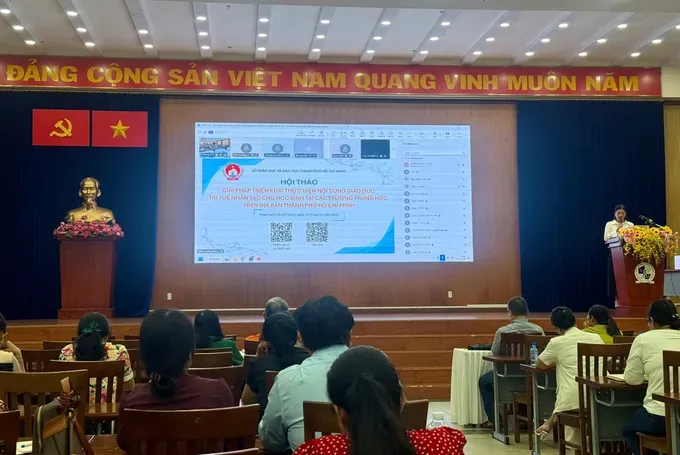
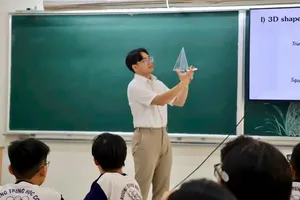
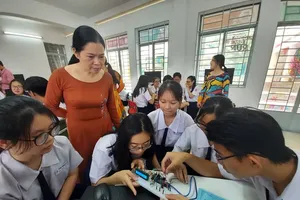
On the afternoon of November 12, at Le Hong Phong High School for the Gifted in Cho Quan Ward, the Ho Chi Minh City Department of Education and Training held a workshop on solutions for implementing artificial intelligence (AI) education content for students at secondary schools across the city.
According to Pham Thi Be Hien, Head of the General Education Division under the Ho Chi Minh City Department of Education and Training, starting from the 2026–2027 academic year, AI education content is being rolled out to general education students in accordance with the AI Education Content Framework issued by the Ministry of Education and Training.
Under the Ministry’s guiding documents, the teaching duration is 12 periods per class per school year, delivered as educational topics within the two-session-per-day teaching plan while also being integrated into other subjects and educational activities to reinforce, apply, and develop skills and knowledge.
"The AI education content framework aims to form and develop AI competencies for students across four components including human-centric thinking, AI ethics, AI techniques and applications, and AI system design. These components are developed continuously from Grade 1 to Grade 12, building upon informatics competencies and contributing to the development of core qualities and general competencies under the general education program," the representative of the Ho Chi Minh City Department of Education and Training stated.
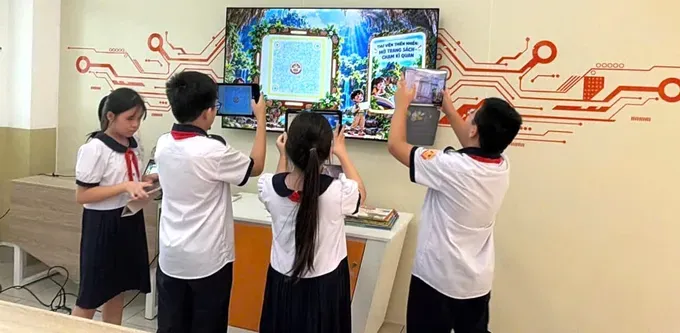
However, based on the implementation process, Prof. Le Hoai Bac, Head of the Department of Computer Science at the Faculty of Information Technology of the University of Science (Vietnam National University Ho Chi Minh City), noted that there are currently six bottlenecks in deploying AI education in general schools.
These bottlenecks include teacher capacity; infrastructure and equipment; funding and remuneration policies for teachers; student data safety; formalistic assessment; and proactiveness in implementation planning.
Specifically, the Ministry of Education and Training has not yet regulated which teachers are responsible for teaching AI education content. Amid a lack of additional staffing quotas, schools are flexibly assigning teachers from various subjects to participate in teaching, including Informatics teachers, Civic Education teachers, and homeroom teachers.
With the mandated duration of 12 periods per school year, schools operating two sessions per day can flexibly arrange their timetables, whereas one-session-per-day schools face difficulties and must condense the 12 periods into three to four thematic sessions during the school year.
Furthermore, AI materials and tools currently lack an official catalog and guidelines, leaving schools confused during execution. Several concepts and terms within the AI education content are absent or not yet synchronized with the 2018 General Education Program.
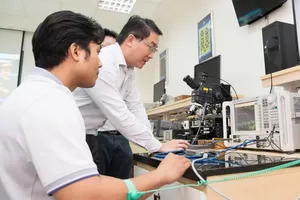
To address these challenges, Prof. Le Hoai Bac outlined several practical measures. He suggested that core teachers provide support to their peers through school-cluster networks, while offline instructional solutions could be expanded through the use of computers, projectors, and printed learning materials instead of specialized devices. He also proposed assigning teachers who have not yet fulfilled their required teaching loads to assist with classroom instruction.
According to the Ministry of Education and Training’s AI Education Content Framework, primary school students are introduced to AI through exploration and experience while lower secondary students focus on understanding and applying AI concepts and upper secondary students are expected to design and master AI-related content.