In September 2026, the finals of the AI City Challenge 2026, a global artificial intelligence and computer vision competition held in Malmo, Sweden, brought together hundreds of teams from leading technology nations in a highly competitive contest.
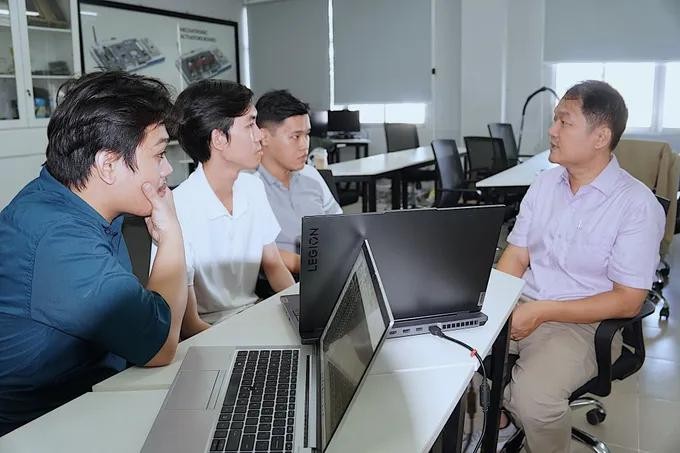
Surpassing strong competitors from the United States, China, and Japan, the Latent Painter - UTE team, comprising three students from the Faculty of Mechanical Engineering at Ho Chi Minh City University of Technology and Engineering, namely Bui Nguyen Hoai Thuong, Vo Thanh Nguyen, and Nguyen Trinh Tra Giang, achieved remarkable success by securing first place in Track 2 and third place in Track 5.
In the final round, the team faced the demanding task of enabling autonomous vehicles to recognize their surroundings and seamlessly transfer their perception capabilities from simulated environments to real-world conditions (sim-to-real).
Rather than following existing approaches, the three students engineered a unique biological operating system for autonomous vehicles by combining three advanced AI technologies.
The team utilized Meta's V-JEPA as the "eyes" for image recognition, LLaMA as the reasoning "brain," and Qwen3-VL to convert data into complete sentences.
"Real-world streets are full of unexpected variables like changing light, bad weather, or obscured objects. This motivated us to research a biological operating system for vehicles," Bui Nguyen Hoai Thuong shared.
In addition to solving recognition challenges, the team achieved a breakthrough in the traffic video prediction segment by training AI to anticipate upcoming road scenarios, enabling timely traffic congestion management and minimizing accident risks.
Assoc. Prof. Truong Nguyen Luan Vu, Dean of the Faculty of Mechanical Engineering at Ho Chi Minh City University of Technology and Engineering, stated that this success reflects a strategy of connecting research with practice. Beyond AI, the faculty has also achieved success in unmanned aerial vehicles (UAVs) for smart urban monitoring in Thu Duc Ward, with reputable enterprises already placing orders for student research applications.
Vietnamese students win top honors at global AI competition
In the domestic arena, the Ho Chi Minh City AI Challenge 2026 named team OpenCubee-1 from the University of Information Technology, Vietnam National University Ho Chi Minh City, as its new champion.
The competition focused on creating a smart virtual assistant to analyze and retrieve in-depth information from large multimedia databases containing images, audio, and text.
Team member Mai Vinh Nguyen noted that smart urban surveillance cameras generate massive data daily, making manual searches for a specific motorcycle across hundreds of video hours impossible.
To resolve this, the team built a framework integrating independent multi-models, combining deep computer vision processing for vehicle and human recognition with natural language processing models to comprehend textual and auditory contexts.
This approach allows the system to automatically extract information from complex angles, such as fisheye cameras, shortening data tracing time from hundreds of hours to a few minutes with high accuracy.
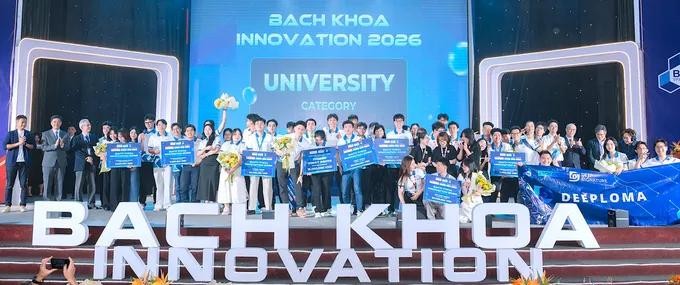
Young engineers are also addressing urban energy optimization using core technologies. To combat energy loss and grid overload, smart grid research projects by electrical and electronics students at the University of Technology, Vietnam National University Ho Chi Minh City, and Industrial University of Ho Chi Minh City were developed.
By installing IoT sensor systems along transmission lines to gather real-time data paired with machine learning algorithms, the system automatically forecasts peak loads and flexibly regulates power supplies to prevent short circuits and optimize distribution efficiency.
Meanwhile, in laboratories at the University of Science, Vietnam National University Ho Chi Minh City, faculty and students in the AI faculty are applying algorithms to social welfare challenges.
Beyond medical image processing for diagnostics, students have directly built AI models to automate public administrative procedures at local facilities, shortening the gap between laboratories and daily life while contributing to a smart, efficient urban administration.