In early December, the Southeast Asia Semiconductor Exhibition (SEMIEXPO Vietnam) 2026 will make its debut in Ho Chi Minh City.
Co-organized by the Southeast Asia Semiconductor Association (SEMI) and the National Innovation Center (NIC), this year’s exhibition will bring together approximately 200 booths from more than 20 countries and territories, focusing on direct business matchmaking to generate concrete purchase orders for Vietnamese partners.
Vo Xuan Hoai, Deputy Director of the National Innovation Center, noted that the event represents a golden opportunity for domestic enterprises to engage directly with international buyers, gradually upgrading their production capacities to integrate more deeply into the global supply chain.
According to Linda Tan, President of the Southeast Asia Semiconductor Association (SEMI Southeast Asia), linking domestic suppliers with global customers through the Supplier Sourcing Program is central to building a sustainable semiconductor ecosystem.
Nguyen Huu Yen, Deputy Director of the Ho Chi Minh City Department of Science and Technology, stated that following the expansion of its development space, the city is investing heavily in transport and social infrastructure, alongside planning concentrated digital technology zones to create optimal conditions for attracting high-tech capital, particularly in the semiconductor sector.
The Law on Urban Development is seen as a legal launchpad that enables Ho Chi Minh City to maximize its authority to plan high-tech spaces. The institutional corridor is also being cleared through a series of resolutions passed by the municipal People’s Council. Notably, under Resolution No. 65/2026/NQ-HDND, which took effect on October 1, the city is offering a support package of up to VND25 billion (US$968,000) for shared research infrastructure listed under strategic technologies.
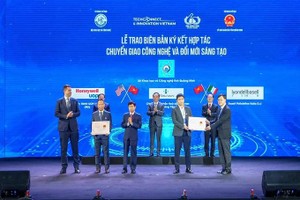
Alongside physical infrastructure, workforce needs through 2030 are being addressed through a tripartite collaboration model linking the State, academia, and businesses. Under a cooperation program between the Ho Chi Minh City Department of Science and Technology, the Ho Chi Minh City Semiconductor Industry Association, and Coherent Vietnam, the parties agreed to advance high-quality workforce training in semiconductors, optics, and photonics.
Accordingly, participating businesses will help review academic curricula, sponsor practical teaching materials, provide core technical training for lecturers, and co-organize specialized workshops to build an engineering workforce capable of meeting multinational corporations' standards. Taking a proactive step, the Saigon Hi-Tech Park (SHTP) Management Board has already put into operation a modern ecosystem of shared semiconductor practical workshops.
Prof. Dr. Nguyen Ky Phung, Head of the SHTP Management Board, reported that the unit is prioritizing the expansion project of the Saigon Hi-Tech Park—adding the functions of a Science and Technology Park—with a total investment scale exceeding VND16,000 billion (US$620 million). The expansion focuses on attracting key spearhead sectors such as semiconductor integrated circuits and artificial intelligence, providing engineers and trainees with modern spaces to finalize experimental projects, conduct international-standard chip testing, and accelerate product commercialization.