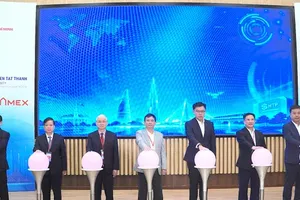
The Vietnam Artificial Intelligence Forum (AI360) 2026 took place in Hanoi yesterday. Organized by the Vietnam Software and IT Services Association (VINASA) under the auspices of the Ministry of Science and Technology, the event was themed "AI in Practice: Applications – Efficiency – Market."
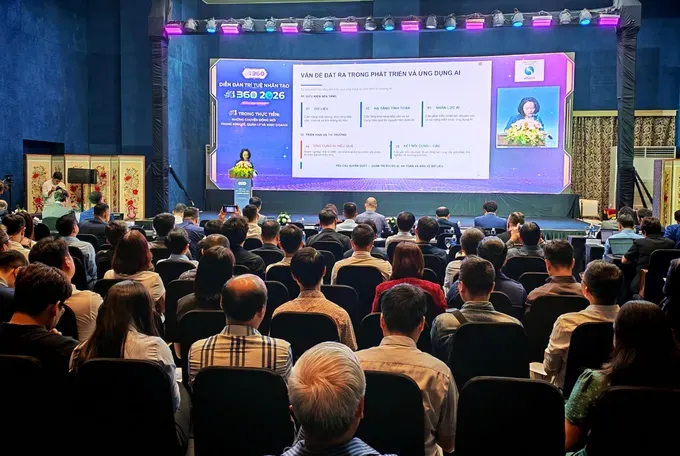
AI transformation must be linked to tangible outcomes
Deputy Director Tran Anh Tu of the Authority of Digital Technology and Artificial Intelligence, under the Ministry of Science and Technology, noted that the theme of AI360 2026 aligns closely with current policy directives for AI deployment. Specifically, this approach emphasizes the responsible integration of AI into operations to deliver tangible benefits for citizens, businesses, and the broader economy.
National AI transformation must go hand-in-hand with the development of domestic AI industrial capabilities, supported by an established legal framework. In this process, Vietnamese technology enterprises serve as the primary force for the research, development, and implementation of national AI transformation.
The Deputy Director of the Authority of Digital Technology and Artificial Intelligence outlined four key directions for future AI development. First, AI transformation must be tied to practical efficiency; every plan should include a baseline for comparison, clear evaluation criteria, and a comprehensive accounting of costs covering everything from data and system integration to training and operations. Second, the development of Vietnam’s AI capabilities must be market-oriented. Third, access to resources should be expanded, with a focus on solutions that are easy to implement and offer transparent pricing for small and medium-sized enterprises (SMEs) and individual business households. Fourth, AI governance should be risk-based.
The National Strategy on Artificial Intelligence to 2030, with a vision to 2045, establishes several key benchmarks for 2030. Under this framework, AI-related economic activity is projected to account for approximately 6 percent of GDP, while labor productivity in AI-adopting industries is expected to rise by 10 percent to 15 percent. Additionally, the strategy aims for full integration of AI across 100 percent of online public services, the establishment of at least 10 Vietnamese AI brands, and approximately US$5 billion in exports of AI products and services.
Digital technology enterprises call for stronger support
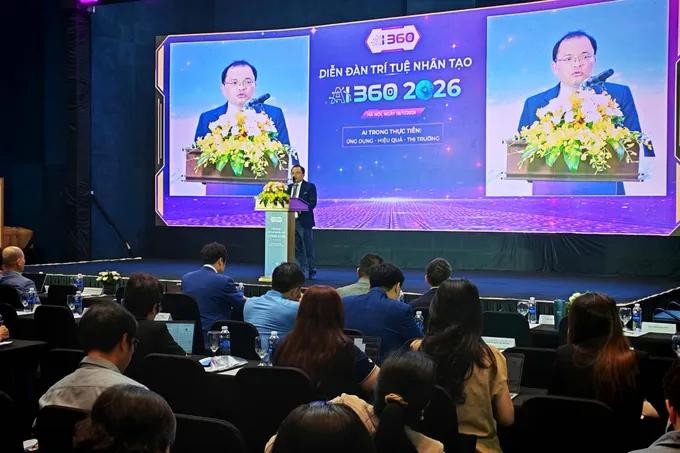
According to Chairman Nguyen Van Khoa of the Vietnam Software and IT Services Association (VINASA), this moment presents an unprecedented opportunity for the digital technology business community. A market has emerged, ranging from the demand for integrating AI into public services to the needs of hundreds of thousands of small and medium-sized enterprises (SMEs) seeking to boost productivity through AI.
The institutional framework is now clear, featuring controlled regulatory sandboxes, a National AI Development Fund, and mechanisms to support businesses. Vietnamese enterprises possess a deep understanding of the challenges faced by the Vietnamese people.
The target of creating 10 Vietnamese AI brands by 2030 is a clear mandate for the digital technology businesses attending in this hall.
Mr. Nguyen Van Khoa also submitted four key recommendations to the Ministry of Science and Technology. First, he urged the ministry to promptly operationalize the National AI Development Fund and its accompanying support mechanisms, prioritizing assistance for small and medium-sized enterprises (SMEs) in adopting domestically developed AI solutions. Second, he recommended expanding government procurement and public-private partnerships to enable local firms to help build shared AI platforms and integrate AI into public services. Third, he called for broader access to shared resources, specifically Vietnamese-language data sets and computational infrastructure. Finally, he proposed streamlining compliance and testing procedures while rapidly implementing tax incentives and interest rate subsidies for AI-related initiatives.
At the roundtable “Leadership Dialogue: From Application to Impact – Key Decisions,” chaired by Nguyen Tu Quang, Vice Chairman of VINASA and Chairman of the VINASA AI Committee, participants agreed on four conditions for AI to deliver sustainable results: start with a real-world problem, defined goals, and measurable indicators; address data, infrastructure, and security from the outset; assess performance based on real operational outcomes; and clearly establish the responsibilities of leaders and staff, along with oversight mechanisms.